
Bureau theme
Jev use case · Model routing

The right model.
For this request.

QQuantum.ai is building a model router that assesses the work before choosing a model. Jev can supply the fast judgements; the routing policy balances quality, cost and available capacity.

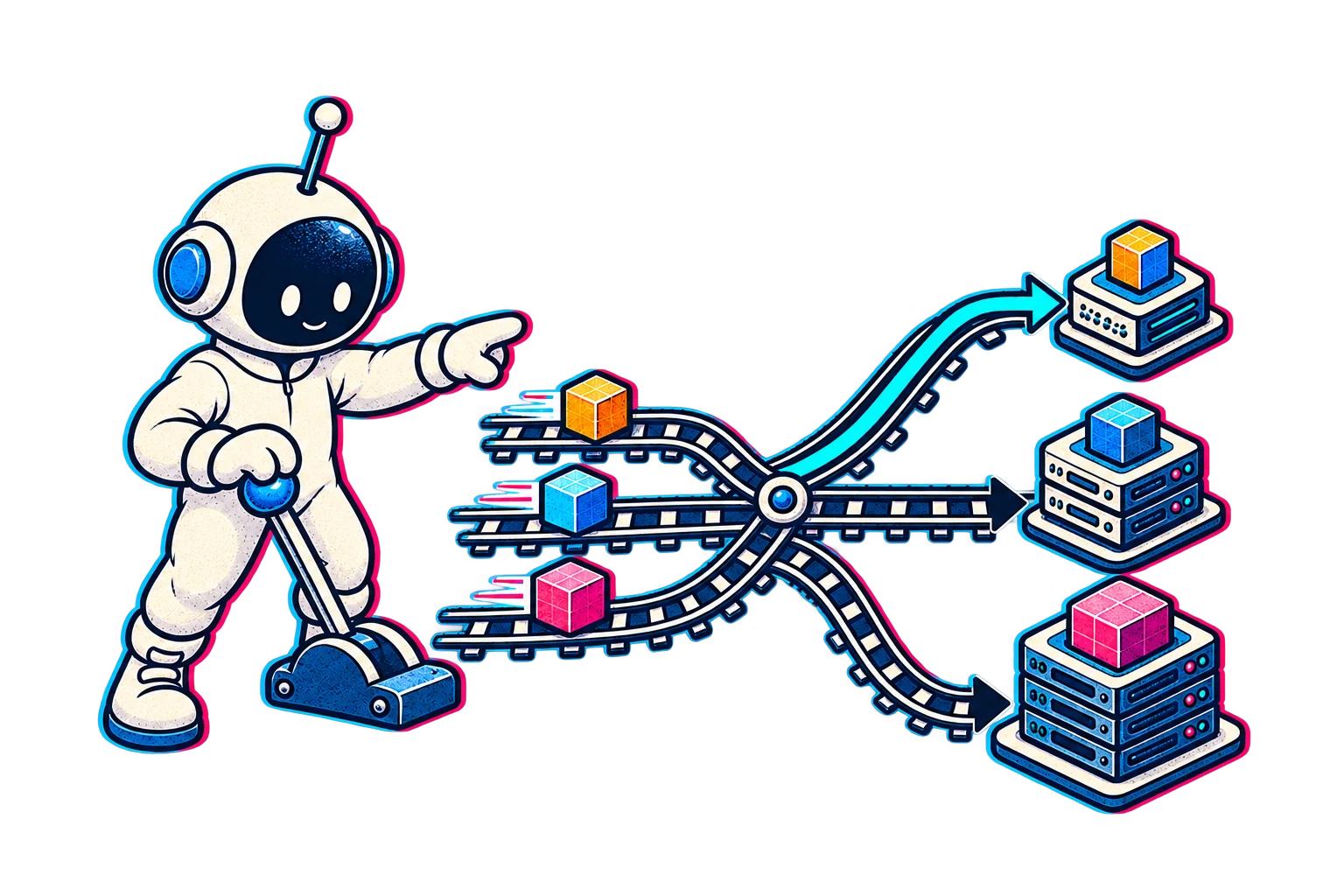
The Little Builder using a lever to direct request parcels toward three different computing modules
Scope your model router

In development · No production savings claimed

THE OPPORTUNITY

Stop paying the same price for different work.

A short classification and a difficult technical analysis should not automatically receive the same model budget. Our router design separates the decision about what a request needs from the model that ultimately answers it.

Jev can assess task category, whether the request needs extended reasoning, and whether the available context appears sufficient. Your application then checks the allowed providers, token budget, current quota and latency requirements. This is an application design informed by TypeSafe’s intent-routing pattern.

The router estimates requirements from the request and observable context. It does not inspect a model’s private thinking. Straightforward work can take a lower-cost route; uncertain or demanding requests can escalate to a stronger model or human review.

PROPOSED ROUTING FLOW
POLICY BEFORE GENERATION
  1. Request
    task + relevant context
  2. Eligibility rules
    privacy + capacity
  3. Jev assessment
    complexity + confidence
  4. Model selection
    cheapest eligible route
  5. Quality check
    accept or escalate
Privacy constraints run before any external call. If Jev itself is not an eligible processor, the request takes a permitted alternative.
THE COST MODEL

Count the gate. Count the retries.

A cheap routing call is useful only if the complete system costs less at the required quality. Compare total spend per accepted answer: the router, selected generator, verification, retries and escalations. Include duplicated input when more than one model sees the request.

For an illustrative routing request with 2,000 input tokens, the published Jev input price gives $0.000084 per assessment, or $8.40 for 100,000 assessments. Calculation: 2,000 × 100,000 ÷ 1,000,000 × $0.042. This excludes downstream model calls, retries, hosting, tax and engineering. It is arithmetic, not a measured saving. Price checked 18 September 2026.

Reducing expensive calls may preserve a provider’s available capacity. It cannot increase your contracted limits or bypass rate limiting. A router needs per-provider budgets, backoff and an explicit unavailable state.

TWO WAYS TO ROUTE
PRE-ROUTING

Choose before generating

Use a small set of request features to choose an eligible model. This avoids paying a frontier model on every request. The risk is sending difficult work to a model that cannot handle it; track those mistakes explicitly.
CASCADE

Verify, then escalate

Start with an economical generator, check its answer against the source, then escalate when the check fails. This spends more on difficult requests but can retain a cheaper path for routine work.

TypeSafe demonstrates the second pattern in its structured extraction cascade. That example is not a benchmark of our router.

THE PILOT

Prove the route before you trust the saving.

Start with a labelled set of real requests and the current system as a baseline. Run the proposed router in shadow mode: record what it would choose without changing the user’s answer. Compare success rate, escalation rate, total API spend and response-time percentiles by task category.

Use a separate holdout set to tune and then test the confidence gates. A confident decision can still be wrong, and a score is not an account permission. Pin the evaluated version and replay the holdout set when it changes. TypeSafe’s confidence documentation explains the distinction between the distribution and its confidence summary.

For a tiny workload or a task already handled well by one inexpensive model, the extra gate may add cost and latency. Our hybrid routing guide covers the broader deployment choices.

QUESTIONS
QUESTIONS — 3

That depends on the workload, selected models and escalation rate. We have not published production savings for our router. A pilot compares total cost per accepted answer with the existing system.

No. It can reduce unnecessary calls to constrained models, but every provider’s limits still apply. Capacity checks, budgets and backoff belong in the application.

The policy chooses a tested fallback, requests clarification or sends the case for review. Timeout and provider errors also need explicit paths.

Keep reading

Put your AI budget
where it matters.

Bring your request mix and current API spend. We will define a router pilot with an explicit quality floor and a complete cost baseline.

CASE STUDIES

Shipped work.
Go and check it.

The work we can name, with the live site, our scope and the boundary made explicit. Select a project to see the evidence; each is a full case study, not a logo or a claim.

sonora.com
The Sonora homepage on desktop: a full-bleed dune landscape behind the headline “Transform Your Life with Sound”, with App Store and Google Play download buttons.
sonora.com — homepage, 1440×900 sonora.com →
Live Consumer wellness · Mobile + web

Sonora

Cognitive AI Ltd · 2026

A free sound-wellness app, described by its publisher as AI sound therapy that reads a short vocal sample at the start of a session and generates a soundscape for that moment. We designed and built the website and its backend, produced assets for the iOS and Android apps, and supported the application prototype.
Read the case study →

See every published project →

WHO WE HAVE BUILT FOR

Twenty-one years of applications, platforms and campaigns for names you know.

See all of our work →