Dark theme
WELCOME TO QQUANTUM

Let Qubi show you around.

Choose how you’d like to explore.

Don’t agreeGo to yourOS instead ↗

Both choices allow Google Analytics, so we can see which pages help.

Sound is your choice. Essential cookies keep the site working. Continuing either way also allows Google Analytics (visits and pages viewed).

Read our Terms, Privacy and Cookies.

Change your choices anytime from the footer.

Getting Qubi ready.
Service

Custom LLM orchestration.

Enterprise LLM routing requires agnostic intelligence. We build systems that dynamically evaluate queries and route them to the most efficient model, preventing vendor lock-in and optimising operational costs.

All AI Architectures →
Pixel illustration for Custom LLM Orchestration: a brass switchboard joining several model routes.

Orchestration capabilities

01

Agnostic AI Models

Your data shouldn't be tied to OpenAI or Anthropic exclusively. Our orchestration layers easily swap models as new, better open-source alternatives release.
02

Dynamic Query Routing

Route simple formatting tasks to cheaper, faster open-weight models while reserving complex reasoning for frontier models.
03

Fallback Systems

Designed for high availability. If a provider goes down or rate-limits you, the orchestration layer cascades the request to a pre-validated secondary provider. We do not sell an uptime guarantee — your availability still depends on the providers behind it.
04

Unified Monitoring

A single pane of glass to view latency, token costs, and reasoning accuracy across all utilized foundation models in your enterprise.
ANALYSIS

How enterprise LLM orchestration reduces vendor lock-in and inference cost

Most enterprises begin by hardcoding a single frontier model into every workflow. The result is predictable: rising token costs, a single point of failure, and an architecture so tightly coupled to one vendor that migration becomes a multi-quarter engineering project. Orchestration is the structural answer to that fragility.

At its core, multi-model routing operates like an intelligent traffic controller for inference requests. When a query enters the orchestration layer, a lightweight classifier evaluates its complexity, domain requirements and latency tolerance. Simple formatting tasks — email summarisation, data extraction, template generation — are routed to cost-efficient open-weight models running at a fraction of the per-token cost of premium APIs. Complex reasoning chains, nuanced legal analysis, or multi-step code generation are escalated to frontier models where their superior capability justifies the premium.

Routing cheaper models to simple tasks can cut inference spend substantially; how much depends entirely on your traffic mix, and we measure the actual saving in the audit phase rather than quoting a number here. The orchestration layer continuously benchmarks model performance against your own use cases and redistributes traffic as new models emerge or providers adjust pricing. This is not static configuration — it treats foundation model management as an ongoing operational discipline.

Fallback cascading adds another layer of engineering resilience. When a primary provider experiences an outage, rate-limits your account, or returns degraded responses, the orchestration engine seamlessly redirects requests to a pre-validated secondary provider. The architecture is designed to keep availability inside your SLA targets rather than to promise them. Cascading failover, combined with unified monitoring across every model in your fleet, turns a brittle single-vendor dependency into a fleet you can reason about and measure.

Beyond cost optimisation and resilience, orchestration unlocks strategic flexibility. When a breakthrough open-source model drops — and they drop monthly now — you can integrate it into your routing table in hours, not months. Your AI infrastructure stays current: running a model you chose for each task, governed by your business logic, monitored in one place.

HOW IT DEPLOYS
PHASE 01

Audit & classify

We map every inference call in your stack, classify workloads by complexity and cost, and identify routing opportunities.

PHASE 02

Route & failover

The orchestration layer is deployed with dynamic routing rules, provider fallbacks and continuous benchmarking.

PHASE 03

Measure and rebalance

Live telemetry redistributes traffic as models and prices evolve — savings are tracked and reported, not assumed.

Questions

Questions about Custom LLM Orchestration.

What is LLM orchestration?

LLM orchestration is an architectural pattern that places an intelligent routing layer between your applications and multiple foundation models. Instead of hardcoding a single AI provider, the orchestration engine dynamically selects the optimal model for each request based on task complexity, cost constraints, and latency requirements — enabling model-agnostic AI infrastructure.

How does dynamic model routing work?

A lightweight classifier analyzes each incoming query in real-time, evaluating factors like token count, reasoning complexity, and domain specificity. Based on configurable routing rules, it dispatches the request to the most cost-effective model capable of delivering the required output quality. Simple extraction tasks go to efficient open-source models; complex analysis goes to frontier models.

What cost savings can orchestration deliver?

It depends on your traffic mix, and we will not quote a figure we have not measured on your workload. The mechanism is simple: most requests in a typical stack do not need a frontier model, and paying frontier prices for them is waste. The audit phase measures your current spend per workload class and models the saving before you commit; after launch we report the actual figure against that baseline.

Can I use open-source models alongside commercial APIs?

Absolutely. Our orchestration layer is fully model-agnostic and supports any combination of commercial APIs (OpenAI, Anthropic, Google) and self-hosted open-weight models. You can run open-weight models on-premise for sensitive workloads while routing non-sensitive tasks to cloud APIs — achieving both AI vendor lock-in prevention and data sovereignty.

How is orchestration maintained after launch?

The routing layer continuously benchmarks live traffic against every configured model and rebalances automatically. New models can be added to the routing table in hours, and monthly telemetry reports show exactly where every token was spent and saved.

Does routing add latency to responses?

The classifier is designed to add well under 100 milliseconds to a request. Because many requests then run on faster models than a one-size-fits-all frontier deployment would use, the net effect on median response time is often neutral or positive — but that is measured on your traffic, not assumed.

Optimise your
AI expenditure.

Build a model-agnostic orchestration layer that scales with your business logic, and measure what it saves.

30-minute technical call · no deck

Shipped & in build

Real work. Check it yourself.

What we built, what stage it is at, and a link to the live thing wherever there is one.

The updated yourOS homepage: Roxy’s open ring surrounded by bento cards for calls, voice, translation, building, design, apps and more.
The yourOS homepage on a phone, with its compact navigation, welcome film button and bento cards.
youros.tech — the homepage bento hero
Our own · coming soon

yourOS

yourOS is an operating system with an AI at its heart. You talk to it like a person, out loud or typed. It makes your calls, plans your days and works on your projects with a crew of agents, on your own private server. Our own product, built from the first commit; the waitlist is open.

What we built
  • Operating system
  • Roxy
  • Agent crew
  • Voice calls
  • App store
  • Website
Meet yourOS →
The Sonora homepage on desktop: a full-bleed dune landscape behind the headline “Transform Your Life with Sound”, with App Store and Google Play download buttons.
The Sonora homepage on a mobile viewport, showing the same hero reflowed to a single column.
sonora.com — homepage, 1440×900
Live · iOS · Android

Sonora

Website, backend and app assets for Sonora, a free AI sound-therapy app on iOS and Android published by Cognitive AI.

What we built
  • Website
  • Backend
  • App assets
Read the case study →
The updated Podswap homepage on desktop: “Grow on Instagram and TikTok for free, with real engagement from creators your size”, beside a tilted wall of exchange, tool and guide cards on a violet gradient.
The updated Podswap homepage on a phone, with its floating navigation, Instagram and TikTok engagement headline and tilted tool cards.
podswap.app — homepage, 1440×900
Five platforms

Podswap

Brand, website, prototype, apps on five platforms, the AI backend and the algorithm-intelligence pipeline for Podswap, a social growth engine that runs without a human in the loop.

What we built
  • Brand
  • Website
  • Prototype
  • Apps on five platforms
  • AI backend
  • Algorithm pipeline
Read the case study →
The unOpen.AI homepage introducing Roxy, a private AI assistant that remembers who you are.
The unOpen.AI homepage on a mobile viewport.
unopen.ai — homepage, 1440×900
Prototype · closed beta

unOpen.AI

In closed beta: Roxy, a private AI assistant with permanent memory running on infrastructure the user owns. Brand, site, product, backend and conversational design.

What we built
  • Brand
  • Site
  • Product
  • Backend
  • Conversational design
Read the case study →
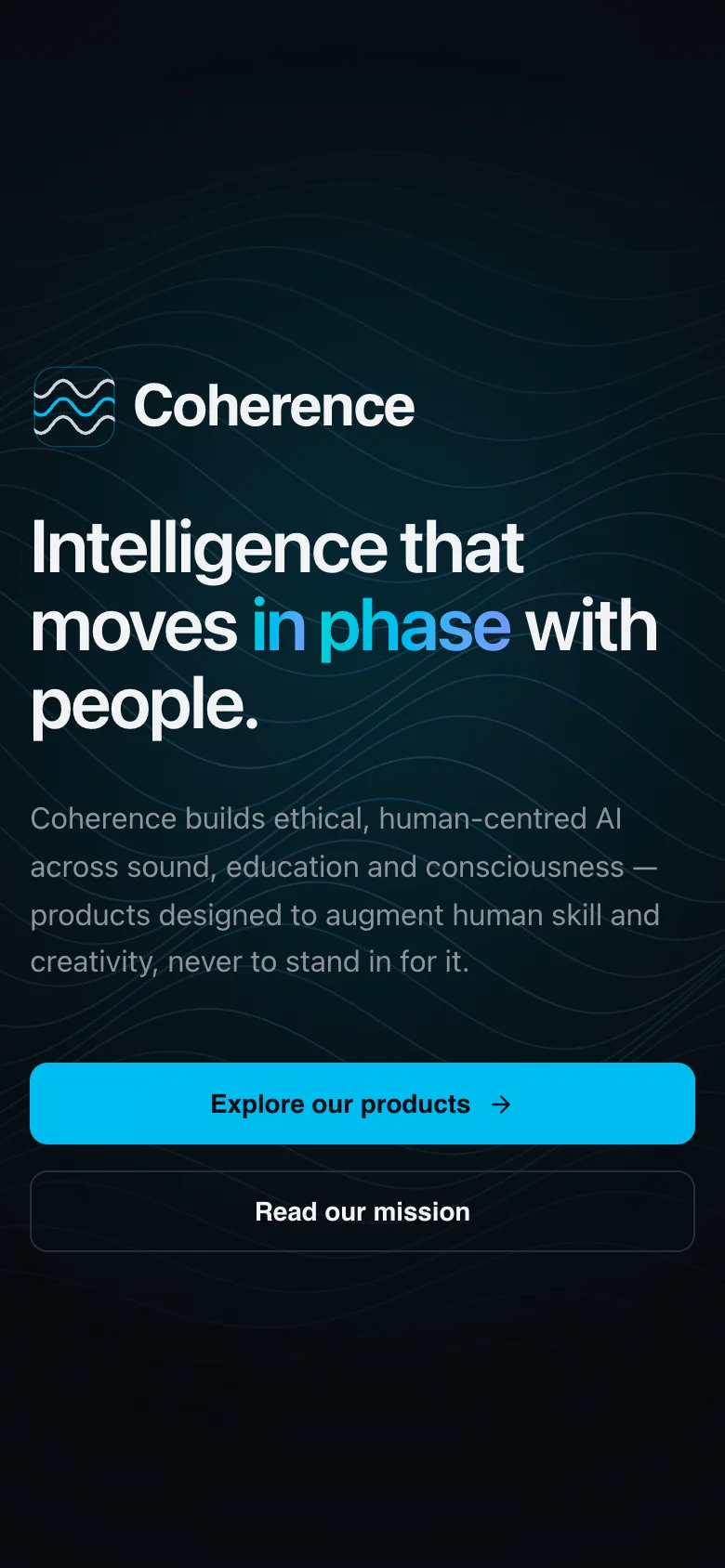
coherence.com on desktop, headed "Intelligence that moves in phase with people".
coherence.com on a mobile viewport, reflowed to a single column.
coherence.com — homepage, 1440×900
Live

Coherence

Live at coherence.com: brand identity generated with AI agents we directed, the motion system and website for the group behind Sonora, AboutAI, WakeUp and MudShadows. Agent work remains in build.

What we built
  • Brand identity
  • Motion system
  • Live website
  • Agent work — in build
Read the case study →
The new Domain Booth homepage on desktop: the headline “Premium Domains. Serious Buyers. Proven Results.” beside the animated DB monogram.
The new Domain Booth homepage on a phone, reflowed to a single column.
Our build of the Domain Booth homepage — 1440×900
Live

Domain Booth

Live at domainbooth.com for DomainBooth, a premium domain brokerage: a new animated mark, every page redesigned and rebuilt with designed mobile layouts, and a custom CMS for its sales record, featured names, press and enquiries.

What we built
  • Animated mark
  • Every page redesigned
  • Designed mobile layouts
  • Custom CMS
Read the case study →
Who we have built for

Twenty-one years. Names you know.

Apps, platforms and campaigns for these teams, long before the AI work. Every one is written up on the work page — what we did, and where our part ended.

See all of our work →
  • BBC Good Food logo
  • Charities Aid Foundation logo
  • GAME logo
  • NatWest logo
  • Next logo
  • NSPCC logo
  • Tesco logo
  • Worldpay logo
  • Samsung logo
  • Sony logo
  • Land Rover logo
  • UAP Limited logo
  • Netflix logo
  • Amazon Prime Video logo
  • Mercedes-Benz dealerships logo
  • San Miguel logo
  • Biovene Barcelona logo
  • Seventy7 logo
  • Littlewoods logo
  • Smile logo
  • The Co-operative Bank logo