Dark theme
WELCOME TO QQUANTUM

Let Qubi show you around.

Choose how you’d like to explore.

Don’t agreeGo to yourOS instead ↗

Both choices allow Google Analytics, so we can see which pages help.

Sound is your choice. Essential cookies keep the site working. Continuing either way also allows Google Analytics (visits and pages viewed).

Read our Terms, Privacy and Cookies.

Change your choices anytime from the footer.

Getting Qubi ready.
Technology

Voice AI systems.
Under a second.

A voice system is a text system with a stopwatch attached. Everything that is merely slow in a chat interface becomes an audible pause on a phone call, and the pause is what people judge the system by.

  • Cascaded and speech-to-speech
  • Telephony and web
Last reviewed 19 September 2026 · Engineering guidance, not legal advice.
All Technology & Model Stack →
Pixel illustration for Voice AI & Speech Systems: a studio microphone beside a waveform instrument and listening headset.

September 2026 update

Keep talking while the tools work.

OpenAI’s 10 September changelog lists GPT-Live 1 as generally available: full-duplex voice with reasoning and tools delegated to a backend model or agent. The listed voice-session rate is $0.05 per minute, billed per second; backend model and tool costs are additional. Official release and pricing note.

A useful pilot is a support call that continues naturally while an approved backend checks an order. Test interruptions, corrections and a delayed or failed lookup. The voice layer must distinguish an acknowledgement from a confirmed action: it should never tell a customer that a refund succeeded before the business system confirms it.

This separation gives teams another architecture to evaluate alongside a speech-to-text pipeline. It does not remove telephony latency or the need for human transfer. See GPT-Live documentation and our September technology briefing.

The latency budget is the architecture

In human conversation the gap between one person finishing and the next beginning is short — a few hundred milliseconds in most studied languages, and long enough to be noticed when it stretches. A voice agent has to land inside roughly that window, or the caller starts talking over it, repeating themselves, or assuming the line has dropped.

That single constraint decides almost every design question on this page. The perceived pause is not the model's response time; it is the sum of every stage in the loop, plus the network under all of them. A transcription stage that is 200 ms slower than it needs to be cannot be recovered by a faster model, and a reasoning step that makes two sequential tool calls has spent the whole budget before it has said a word.

So the first thing to write down on a voice project is not the prompt. It is the budget: how many milliseconds each stage may take, measured end to end from the caller stopping speaking to the first audible syllable coming back. Everything else is negotiated against it.

THE CONVERSATIONAL LOOP
  1. 01
    Capture

    mic or SIP trunk

  2. 02
    Endpoint

    has the caller stopped?

  3. 03
    Transcribe

    streaming, partial results

  4. 04
    Reason

    model + tools

  5. 05 · Branch / escalation
    Barge-in

    cancel and re-listen

  6. 06
    Synthesise

    streamed by sentence

  7. 07
    Playback

    jitter buffer

Lower box = the caller interruptsMarker = one conversational turn
Every stage streams into the next. The loop is only worth drawing because the failure people complain about — the pause — is not owned by any single box in it.

Where the milliseconds go

The figures below are a budget, not a measurement. They are the allocation we would start a scoping call from for a telephone agent answering account questions, and the point of writing them down is that each line can be argued with, moved, or bought back somewhere else. Your numbers will differ by provider, region and workload.

Compare your options
An illustrative budget of the shape we design to, not measured client outcomes. Note what dominates: endpointing and the tool calls, both of which are yours to control, rather than the model, which is usually the part teams try to optimise first.
Criterion Illustrative allocation What moves it
Network in (caller to your edge) 80–150 ms Region choice, carrier route, WebRTC versus SIP
Endpointing decision 200–500 ms How long a silence has to last before you believe the turn ended
Final transcription after endpoint 50–150 ms Streaming with partials versus batch on the whole utterance
Reasoning to first token 300–600 ms Model size, prompt length, cache hits, whether a tool call is needed
Each sequential tool call +150–800 ms Your own API latency, and whether calls can run in parallel
Speech synthesis to first audio 100–300 ms Streaming voice versus waiting for the full sentence
Network out and jitter buffer 80–200 ms Buffer depth traded against robustness to packet loss

Two things follow from the arithmetic. The first is that everything streams. Transcription emits partial hypotheses while the caller is still speaking, so the reasoning stage can begin drafting; synthesis starts on the first complete clause rather than the finished answer; audio plays as it arrives. A batch stage anywhere in the chain adds its full duration to the pause, and there is no budget for one.

The second is that a slow tool is a slow agent. If answering requires a lookup in a system that takes 900 ms, no amount of model tuning saves the turn. The fixes are architectural: parallelise independent calls, pre-fetch what the caller's identity already implies, cache what is stable, and — where the wait is genuinely unavoidable — say something. A short, honest acknowledgement while the lookup runs is not a trick; it is what a person does, and it converts dead air into a turn.

Turn-taking, which is the hard part

01

Endpointing

Deciding that the caller has finished, rather than paused. Fixed silence thresholds fail in both directions: short ones cut people off mid-sentence, long ones make the agent feel sluggish. Someone reading out a card number, thinking aloud, or speaking a language with different pause structure breaks a threshold tuned on fluent short answers. Semantic endpointing — using the partial transcript to judge whether the utterance is syntactically complete — helps, and it is another model in the loop with its own latency and its own errors.
02

Barge-in

The caller starts talking while the agent is speaking. The system must stop playback immediately, discard the rest of the generated response, and treat what it now hears as the live turn. That means cancellable synthesis, a cancellable model call, and acoustic echo cancellation good enough that the agent does not interrupt itself by hearing its own voice. Systems that cannot be interrupted are the single most common complaint about voice agents, and the fix is plumbing rather than intelligence.
03

Backchannels and false starts

“Mm-hm”, “right”, “sorry, go on”. These are not turns and should not trigger a full response cycle, but they look identical to speech at the audio layer. Treating every vocalisation as an interruption produces an agent that flinches. Classifying short overlapping utterances before acting on them is a small model doing a small job, and it noticeably changes how the conversation feels.
04

Latency masking

When a turn will be slow, the response can begin before the answer is known: acknowledge, restate the request, then continue into the substance once the lookup returns. Used sparingly this reads as natural. Used on every turn it reads as stalling, and callers notice quickly. It is a budget-of-last-resort, not a substitute for fixing the slow stage.

Cascaded or speech-to-speech

A cascaded pipeline chains three separate systems: speech recognition, then a text model, then speech synthesis. A speech-to-speech model takes audio in and emits audio out, with no text bottleneck between them. Both are in production use, and the choice is rarely about which is more advanced.

Compare your options
Structural properties of the two shapes as of September 2026. Capabilities move quickly; the auditability row is the one that has held longest, and it is usually what decides regulated deployments.
Criterion Cascaded pipeline Speech-to-speech
Stages you can swap independently Three One
Latency floor Sum of three stages Lower — no text round trip
Prosody, tone and emotion preserved Discarded at the transcript Carried through
Inspectable transcript of what was understood Yes, at every turn Not inherently — must be produced alongside
Domain vocabulary and biasing Word lists and custom lexicons Prompting, with less direct control
Tool calling and structured output Mature Improving, more variable by provider
Self-hosting options Open-weight models at every stage Fewer, and heavier
Debugging a wrong answer Attributable to a stage Harder to localise

Our default for anything with a compliance or quality-assurance requirement is the cascaded pipeline, for one unglamorous reason: it produces a transcript of what the system believed it heard, at every turn, which is the artefact an investigation asks for. Speech-to-speech earns its place where the interaction is short, conversational and low-stakes, and where tone genuinely matters — reception, triage, qualification. A hybrid is common and sensible: speech-to-speech for the conversational surface, with a parallel transcription stream kept purely for logging and evaluation.

The telephone is a constraint, not a detail

  • Bandwidth.

    A traditional telephone call is narrowband: 8 kHz sampling, roughly 300 Hz to 3.4 kHz of usable audio, compressed by a codec designed in the 1970s. Recognition accuracy measured on studio-quality audio does not survive the trip. If the system will answer phone calls, evaluate it on phone-quality audio from the first week, not on clean recordings from a laptop microphone.
  • Packet loss and jitter.

    Real calls drop packets. A jitter buffer smooths that out and costs latency to do it, which is a direct trade against the budget above. Deep buffers sound robust and feel slow; shallow ones feel responsive and stutter on a bad connection. There is no setting that is right for every route.
  • The rest of the telephony stack.

    DTMF tones for the cases where speech is the wrong input — card numbers, menu selections. Warm transfer that carries context to the human rather than making the caller start again. Call recording with its own consent and retention rules. Hold, conference and disconnection semantics. None of this is AI work, and it is usually where the integration time goes.
  • Accents, noise and vocabulary.

    Recognition quality is not uniform across speakers, and published research has repeatedly found accuracy gaps between accent and dialect groups. Treat that as a design input rather than an unfortunate footnote: build the evaluation set from your actual callers, including the accents and the background noise your service really encounters, and check performance per group rather than in aggregate. Domain vocabulary — product names, drug names, reference formats — is worth handling explicitly with biasing lists or a post-recognition correction step, because these are precisely the tokens a general model has never seen and the caller most needs to be got right.

Evaluating a voice system

Word error rate measures transcription. It does not measure whether the caller got what they rang for, and a system can hold an excellent word error rate while failing the job — mishearing the one token that mattered, interrupting badly, or answering the question it heard rather than the one that was asked. The metric that decides whether a voice deployment survives contact with users is task completion, and everything else is diagnostic.

Target by task
Task n Baseline Target
Task completed without transfer 300 recorded calls existing IVR containment ≥ 0.75
Entity accuracy on reference numbers and postcodes 200 utterances unmeasured ≥ 0.98
Playback stops within 300 ms of a barge-in 150 interruptions unmeasured ≥ 0.95
Turn latency inside the agreed budget 2,000 turns unmeasured ≥ 0.95 at p95
Escalates rather than guessing when confidence is low 80 adversarial unmeasured ≥ 0.95
Completion parity across accent groups in the set 300, grouped unmeasured no group below 0.90 of the mean

Method: An illustrative gate of the shape we build, not results from a specific deployment. Sets are built from recorded calls with consent, replayed through the telephony path at call-quality audio rather than from clean source files, so codec and packet loss are inside the measurement. Latency is measured from the caller's final speech energy to the first returned audio frame, reported at p50 and p95 rather than as a mean, because a mean hides exactly the turns people complain about. Completion is graded by a human against a written rubric; transcription accuracy is scored automatically against verified references. Thresholds are set per engagement against the existing process, never against 100%.

When the system talks to the public

Article 50 of the EU AI Act sets transparency duties for systems that interact directly with people: a person must be informed that they are dealing with an AI system unless that is obvious to a reasonably observant person in the circumstances. On a phone line it is not obvious — synthetic speech is convincing enough that assuming otherwise is not defensible — so the disclosure belongs in the opening turn, in plain language, before anything is collected.

That is cheap to implement and worth doing beyond the compliance argument: callers who know they are talking to a machine phrase things more clearly and ask to be transferred earlier, which improves both completion and satisfaction. The related duties in the same article concern marking synthetic audio content, which matters if the system generates recordings rather than only holding live conversations.

Separately from the AI Act, a voice system usually processes personal data and frequently records it. Recording consent, lawful basis, retention periods and the rights of the caller are ordinary data protection questions with ordinary answers, and they are easier to answer when the recording, the transcript and the model's context are all inside infrastructure you control. Whether an emotion-recognition component is permissible at all is a separate question with a stricter answer in some contexts, and a good reason not to add one because a provider offers it.

Questions

Questions about Voice AI & Speech Systems.

What end-to-end latency should we aim for?

Sub-second from the caller finishing to the first audible syllable is the target that makes a conversation feel like a conversation, and roughly 1.5 seconds is where most people begin to notice a lag. Both are design targets rather than universal thresholds: a caller reading out a long reference number tolerates more than a caller answering yes or no. Agree the budget per turn type at the start, instrument it at p95, and treat a regression in it the same way you would treat a drop in accuracy.

Can we reuse our chat agent for voice?

The tools and the retrieval layer usually transfer; the prompt and the interaction design rarely do. Text answers are structured for the eye — lists, headings, links — and all of that is unusable spoken aloud. Voice answers need to be shorter, front-load the answer, offer one thing at a time, and be recoverable when the caller was not listening. Expect to keep the backend and rewrite the conversational layer.

Should we self-host the speech models?

It is a real option: capable open-weight recognition and synthesis models exist, and for high call volumes or audio that may not leave your perimeter, self-hosting is often the right answer. The trade is operational — you own the GPUs, the scaling and the availability of something that is on a phone call when it fails. A common middle position is self-hosted recognition, where the audio is most sensitive, with a hosted model for reasoning against redacted text.

How do we handle a caller who wants a human?

Immediately, on the first request, without negotiation. The transfer should carry context — who the caller is, what they asked, what the agent already did — so they do not start again from the beginning. Systems that make the escalation path hard to find measure well on containment and badly on everything a business actually cares about, and callers learn the trick within one call anyway.

What does the model provider keep from a call?

It depends entirely on the provider and the tier you are on, and it is the question to settle before any audio is sent. At the time of writing, enterprise arrangements from the major providers generally offer zero-retention or short-retention processing and do not train on inputs, but those are their terms and they change — confirm against the provider's current terms and get it in the contract rather than relying on a documentation page. Where the answer has to be certain, the deployment moves inside your own infrastructure.

Ring it and listen
to the pause.

Bring a recording of ten real calls. The latency budget and the escalation path tell you most of what a voice project will cost.

30-minute technical call · no deck

Shipped & in build

Real work. Check it yourself.

What we built, what stage it is at, and a link to the live thing wherever there is one.

The updated yourOS homepage: Roxy’s open ring surrounded by bento cards for calls, voice, translation, building, design, apps and more.
The yourOS homepage on a phone, with its compact navigation, welcome film button and bento cards.
youros.tech — the homepage bento hero
Our own · coming soon

yourOS

yourOS is an operating system with an AI at its heart. You talk to it like a person, out loud or typed. It makes your calls, plans your days and works on your projects with a crew of agents, on your own private server. Our own product, built from the first commit; the waitlist is open.


What we built
  • Operating system
  • Roxy
  • Agent crew
  • Voice calls
  • App store
  • Website
Meet yourOS →
The Sonora homepage on desktop: a full-bleed dune landscape behind the headline “Transform Your Life with Sound”, with App Store and Google Play download buttons.
The Sonora homepage on a mobile viewport, showing the same hero reflowed to a single column.
sonora.com — homepage, 1440×900
Live · iOS · Android

Sonora

Website, backend and app assets for Sonora, a free AI sound-therapy app on iOS and Android published by Cognitive AI.

What we built
  • Website
  • Backend
  • App assets
Read the case study →
The updated Podswap homepage on desktop: “Grow on Instagram and TikTok for free, with real engagement from creators your size”, beside a tilted wall of exchange, tool and guide cards on a violet gradient.
The updated Podswap homepage on a phone, with its floating navigation, Instagram and TikTok engagement headline and tilted tool cards.
podswap.app — homepage, 1440×900
Five platforms

Podswap

Brand, website, prototype, apps on five platforms, the AI backend and the algorithm-intelligence pipeline for Podswap, a social growth engine that runs without a human in the loop.

What we built
  • Brand
  • Website
  • Prototype
  • Apps on five platforms
  • AI backend
  • Algorithm pipeline
Read the case study →
The unOpen.AI homepage introducing Roxy, a private AI assistant that remembers who you are.
The unOpen.AI homepage on a mobile viewport.
unopen.ai — homepage, 1440×900
Prototype · closed beta

unOpen.AI

In closed beta: Roxy, a private AI assistant with permanent memory running on infrastructure the user owns. Brand, site, product, backend and conversational design.

What we built
  • Brand
  • Site
  • Product
  • Backend
  • Conversational design
Read the case study →
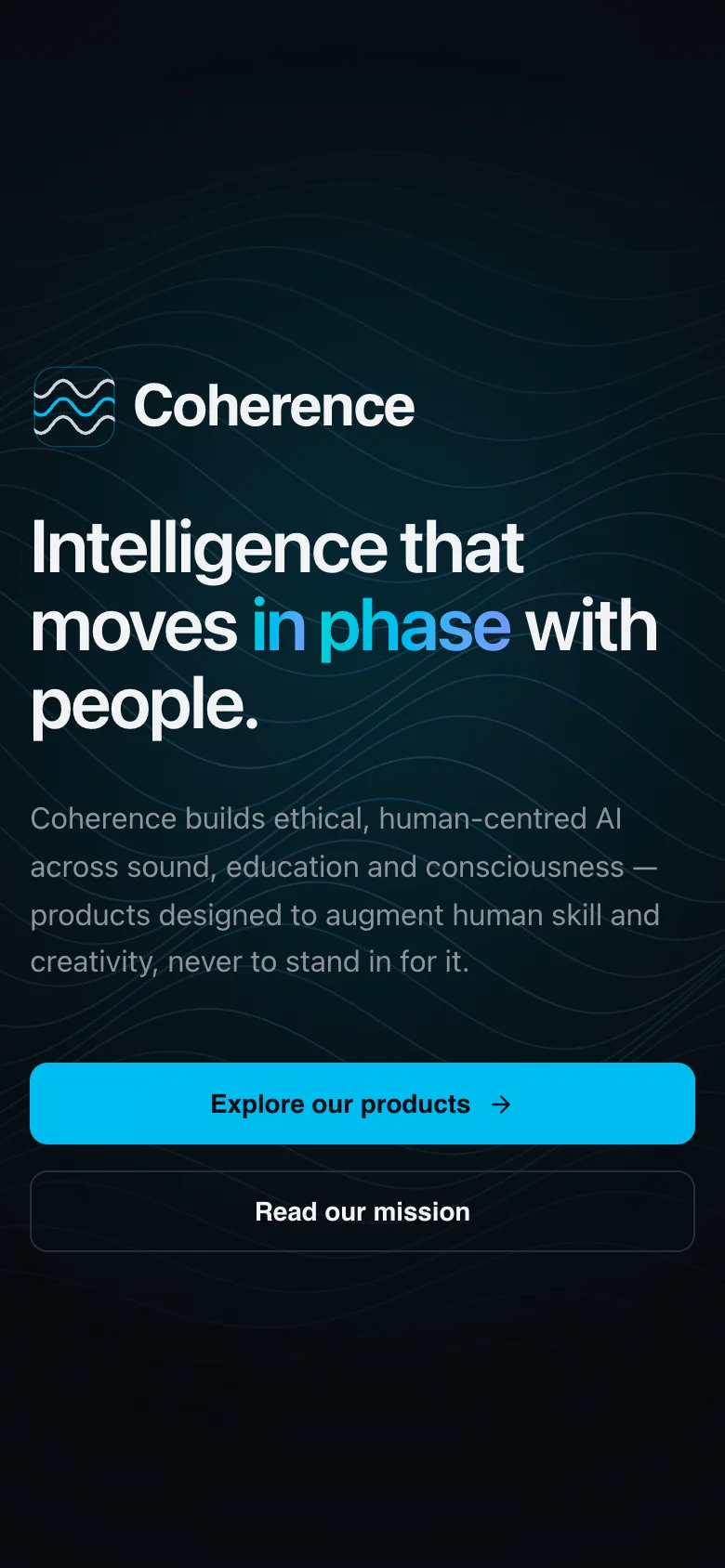
coherence.com on desktop, headed "Intelligence that moves in phase with people".
coherence.com on a mobile viewport, reflowed to a single column.
coherence.com — homepage, 1440×900
Live

Coherence

Live at coherence.com: brand identity generated with AI agents we directed, the motion system and website for the group behind Sonora, AboutAI, WakeUp and MudShadows. Agent work remains in build.

What we built
  • Brand identity
  • Motion system
  • Live website
  • Agent work — in build
Read the case study →
The new Domain Booth homepage on desktop: the headline “Premium Domains. Serious Buyers. Proven Results.” beside the animated DB monogram.
The new Domain Booth homepage on a phone, reflowed to a single column.
Our build of the Domain Booth homepage — 1440×900
Live

Domain Booth

Live at domainbooth.com for DomainBooth, a premium domain brokerage: a new animated mark, every page redesigned and rebuilt with designed mobile layouts, and a custom CMS for its sales record, featured names, press and enquiries.

What we built
  • Animated mark
  • Every page redesigned
  • Designed mobile layouts
  • Custom CMS
Read the case study →
Who we have built for

Twenty-one years. Names you know.

Apps, platforms and campaigns for these teams, long before the AI work. Every one is written up on the work page — what we did, and where our part ended.

See all of our work →
  • BBC Good Food logo
  • Charities Aid Foundation logo
  • GAME logo
  • NatWest logo
  • Next logo
  • NSPCC logo
  • Tesco logo
  • Worldpay logo
  • Samsung logo
  • Sony logo
  • Land Rover logo
  • UAP Limited logo
  • Netflix logo
  • Amazon Prime Video logo
  • Mercedes-Benz dealerships logo
  • San Miguel logo
  • Biovene Barcelona logo
  • Seventy7 logo
  • Littlewoods logo
  • Smile logo
  • The Co-operative Bank logo