ECM.01
Merchandising & Site Search
Semantic search, ranking and recommendation over a catalogue that changes faster than a model can be retrained.
Open pageMerchandising, search, support and forecasting for retail, built against the order data that holds the answer — with a person committing every stock and budget decision.

Almost everything that matters in retail AI depends on what the system can see. A support agent that can read order status, carrier tracking and returns history — and take a bounded set of actions within a value limit — resolves a large share of routine contacts; the same model over a help centre resolves very few. Search that knows which products actually sell together outperforms search that only knows the product text.
So we start with the integration, and we measure rather than quote. Deflection is measured on your own ticket history. Forecast quality is measured against your sales record. The system proposes stock and budget rebalancing; a planner confirms it, because an automated commit converts a data error into a financial one.
Agents wired into order management, carrier tracking and returns, taking bounded actions within a value limit — process a return, reissue a label, update an address before dispatch — in the languages your catalogue and your customers use.
SEE CUSTOMER SERVICE →Large numbers of specific landing pages and product descriptions targeting long-tail search, with quality gates so they are indexable rather than flagged as scaled content.
SEE PROGRAMMATIC SEO →Forecasting models that read purchasing patterns, seasonality and ad spend to predict inventory requirements and inform return on ad spend, with the proposed action left to a planner.
SEE DEMAND FORECASTING →Middleware that keeps storefront, ERP, 3PL and CRM in step, reconciling inventory and order state with exceptions routed to a person rather than silently overwritten.
SEE CROSS-PLATFORM WORKFLOWS →These are engineering controls we build into the architecture, not certifications. QQuantum.ai holds no security certifications, and the audits and attestations your sector requires remain yours to run — see our trust centre.
Semantic search, ranking and recommendation over a catalogue that changes faster than a model can be retrained.
Open pageForecasting inventory and promotion response, where the loss function is asymmetric and rarely modelled that way.
Open pageOrder-aware support agents wired into the systems that hold the answer, not a FAQ with a chat window.
Open pageIt depends almost entirely on integration depth rather than on the model. An agent wired into order management, carrier tracking and returns resolves a large share of routine contacts, because most retail contacts are about a specific order; one built over a help centre resolves very few. We scope the integration and measure the rate on your own ticket history rather than quoting one.
Generating large numbers of specific landing pages and product descriptions to target long-tail search — the thousands of low-competition queries a catalogue can answer precisely. Done without quality gates it produces pages that search engines treat as scaled content; done with them, each page has to earn its place by being genuinely useful for its query. We build the gates first, and we measure indexation and organic traffic rather than promising either.
Forecasting models read purchasing patterns, seasonality and ad spend together to predict inventory requirements and to inform return on ad spend. The system proposes stock routing and budget rebalancing; a planner confirms it. Forecast quality is measured against your own sales history before anything is acted on.
Yes. Middleware connects Shopify or another storefront, ERP systems, 3PL providers and CRM platforms, reconciling inventory and order state across them with exceptions routed to a person. It typically requires no platform migration; the integration is usually the larger part of the build.
Start with an architecture review of your support, search or forecasting workflow, measured on your own order history.
30-minute technical call · no deck
What we built, what stage it is at, and a link to the live thing wherever there is one.


yourOS is an operating system with an AI at its heart. You talk to it like a person, out loud or typed. It makes your calls, plans your days and works on your projects with a crew of agents, on your own private server. Our own product, built from the first commit; the waitlist is open.


Website, backend and app assets for Sonora, a free AI sound-therapy app on iOS and Android published by Cognitive AI.


Brand, website, prototype, apps on five platforms, the AI backend and the algorithm-intelligence pipeline for Podswap, a social growth engine that runs without a human in the loop.


In closed beta: Roxy, a private AI assistant with permanent memory running on infrastructure the user owns. Brand, site, product, backend and conversational design.

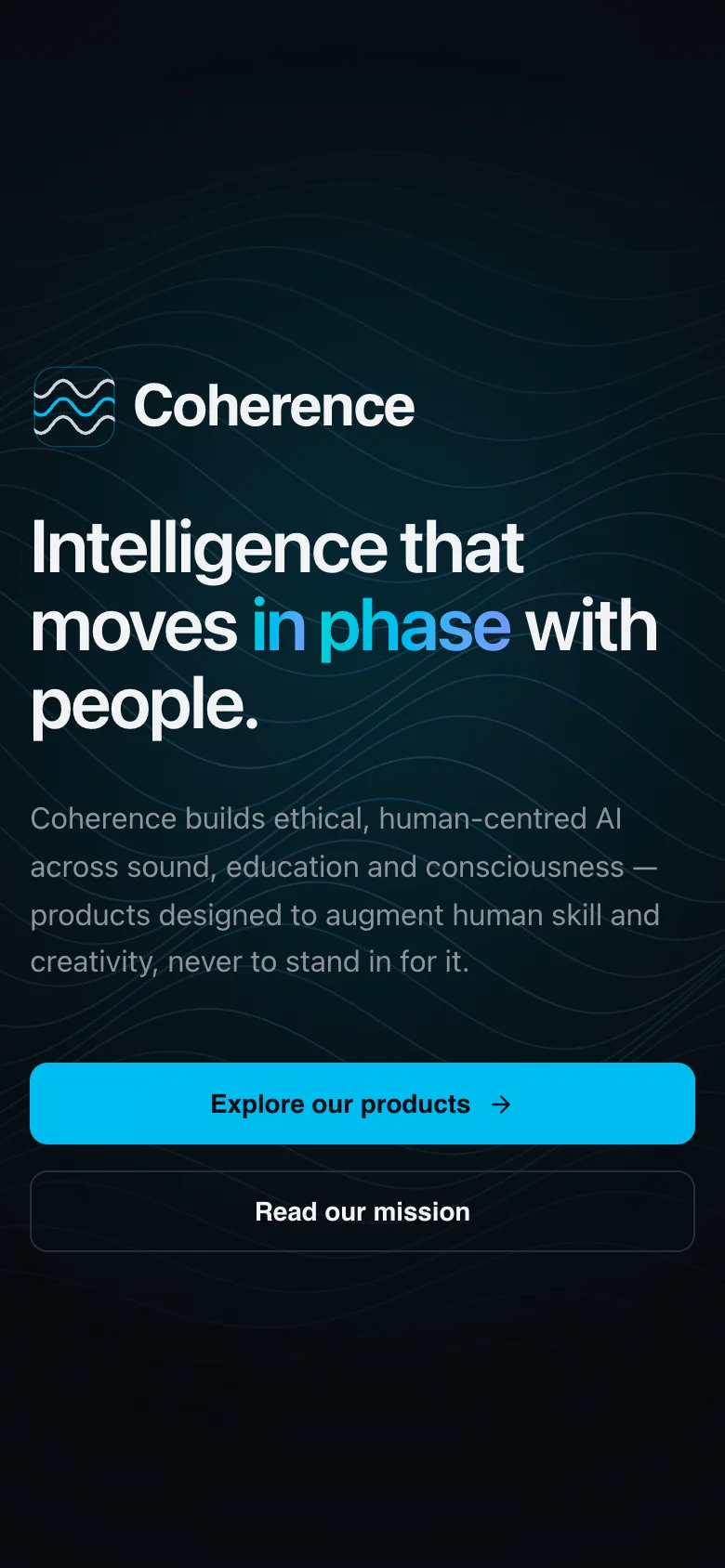
Live at coherence.com: brand identity generated with AI agents we directed, the motion system and website for the group behind Sonora, AboutAI, WakeUp and MudShadows. Agent work remains in build.


Live at domainbooth.com for DomainBooth, a premium domain brokerage: a new animated mark, every page redesigned and rebuilt with designed mobile layouts, and a custom CMS for its sales record, featured names, press and enquiries.
Apps, platforms and campaigns for these teams, long before the AI work. Every one is written up on the work page — what we did, and where our part ended.




















