Dark theme
WELCOME TO QQUANTUM

Let Qubi show you around.

Choose how you’d like to explore.

Don’t agreeGo to yourOS instead ↗

Both choices allow Google Analytics, so we can see which pages help.

Sound is your choice. Essential cookies keep the site working. Continuing either way also allows Google Analytics (visits and pages viewed).

Read our Terms, Privacy and Cookies.

Change your choices anytime from the footer.

Getting Qubi ready.
Comparison

Agency or in-house?

We are an agency, so read this accordingly. It includes the cases where hiring beats engaging us, because those cases are real and pretending otherwise wastes everyone's time.

All Comparisons →
Pixel illustration for AI Agency vs In-House Team: a balanced comparison of several connected work stations with different tools and a local server cabinet with an ownership key.

The comparison

Compare your options
Illustrative ranges, not quotes. The salary figure is our own unsourced estimate for senior AI engineering in Western Europe as of 2026, loaded to include employer contributions, equipment and recruitment; check it against current market data for your country. The fractional figure is the published range on our pricing page.
Criterion Hire in-house Engage an agency Fractional
Time to start productive work 3–6 months 1–2 weeks 1–2 weeks
Annual cost (senior, EU) €120–180k loaded Per project €4–9k per month
Domain knowledge accrual Deep, permanent Partial, transferred Good, ongoing
Breadth of experience One person's history Many projects Many projects
Availability Full time Project duration Agreed days
Risk if they leave Significant Contractual handover Contractual handover
Can you evaluate them? Hard without AI expertise Judge by delivered work Judge by delivered work
Scales down No Yes Yes

When to hire instead

01

AI is your product

If the AI capability is the thing customers pay for, that expertise belongs inside the company permanently. Outsourcing your core competence is a strategic error regardless of short-term convenience.
02

The work is genuinely continuous

Past roughly full-time ongoing demand, an employee is cheaper and accumulates context an external party cannot match. We will tell you when you have crossed that line rather than quietly billing through it.
03

Deep domain knowledge is the bottleneck

Where the hard part is understanding your industry rather than the AI, someone embedded permanently will outperform a specialist who has to learn it each engagement.
04

You can attract and assess talent

If you have a strong technical brand and someone able to evaluate AI engineers, hiring is a solved problem and the calculus favours it. The difficulty for most companies is the assessment, not the salary.

When an agency makes more sense

  • You need it working before you could finish hiring.

    A senior AI search commonly takes three to six months from opening the role to productive output. If the deadline is sooner, hiring is not an option on the timeline, whatever its long-run merits.
  • The project is bounded.

    Building one system does not justify a permanent role. Hiring for a project and then having no work is worse for the person than for the company.
  • You cannot yet evaluate candidates.

    Without someone who has built AI systems, interviewing for the skill is close to guesswork. Engaging first — and having your team work alongside — makes the eventual hire much better informed.
  • You want the decisions made once, correctly.

    Architecture, evaluation strategy and model selection are decided early and are expensive to reverse. Buying experienced judgement for that window is high leverage even if everything afterwards is in-house.

The pattern we see work best: engage for the first system, pair your engineers alongside, and hire once the ongoing workload is clearly full-time. You get speed now and capability permanently, and the hire arrives into a codebase your team already understands.

Questions

Questions about AI Agency vs In-House Team.

What does an agency cost compared to a hire?

Higher day rate, far lower total commitment. On our own unsourced 2026 estimate a senior AI engineer in Western Europe runs €120–180k fully loaded, plus three to six months of unproductive search. A bounded engagement runs from around €8–25k for a prototype sprint to €30–120k for a production build — the ranges published on our pricing page — and delivers in weeks. Past sustained full-time demand the employee is clearly cheaper, and that crossover is the real decision point rather than the day rate comparison.

How do we avoid dependency on an agency?

Insist on it contractually and check it is happening: code in your repositories from day one, infrastructure as code in your accounts, documented architectural decisions, and your engineers pairing on the work. Any agency resisting those terms is optimising for lock-in — that is a reason to walk, and it applies to us as much as anyone.

Can we do both?

That is usually the strongest arrangement. Agency for the initial architecture and the first system; your team learning alongside; a permanent hire when the workload justifies it, arriving into something already built and documented. It costs slightly more than either alone and removes the biggest risk in both.

What happens if we hire someone mid-engagement?

Good — that is the intended trajectory. We fold them in, transfer context deliberately, and scale our involvement down as they ramp. An agency that treats a client hire as a threat has the wrong business model.

Tell us the shape
of the work.

If it looks like a permanent role, we will say so.

30-minute call · no deck

Shipped & in build

Real work. Check it yourself.

What we built, what stage it is at, and a link to the live thing wherever there is one.

The updated yourOS homepage: Roxy’s open ring surrounded by bento cards for calls, voice, translation, building, design, apps and more.
The yourOS homepage on a phone, with its compact navigation, welcome film button and bento cards.
youros.tech — the homepage bento hero
Our own · coming soon

yourOS

yourOS is an operating system with an AI at its heart. You talk to it like a person, out loud or typed. It makes your calls, plans your days and works on your projects with a crew of agents, on your own private server. Our own product, built from the first commit; the waitlist is open.


What we built
  • Operating system
  • Roxy
  • Agent crew
  • Voice calls
  • App store
  • Website
Meet yourOS →
The Sonora homepage on desktop: a full-bleed dune landscape behind the headline “Transform Your Life with Sound”, with App Store and Google Play download buttons.
The Sonora homepage on a mobile viewport, showing the same hero reflowed to a single column.
sonora.com — homepage, 1440×900
Live · iOS · Android

Sonora

Website, backend and app assets for Sonora, a free AI sound-therapy app on iOS and Android published by Cognitive AI.

What we built
  • Website
  • Backend
  • App assets
Read the case study →
The updated Podswap homepage on desktop: “Grow on Instagram and TikTok for free, with real engagement from creators your size”, beside a tilted wall of exchange, tool and guide cards on a violet gradient.
The updated Podswap homepage on a phone, with its floating navigation, Instagram and TikTok engagement headline and tilted tool cards.
podswap.app — homepage, 1440×900
Five platforms

Podswap

Brand, website, prototype, apps on five platforms, the AI backend and the algorithm-intelligence pipeline for Podswap, a social growth engine that runs without a human in the loop.

What we built
  • Brand
  • Website
  • Prototype
  • Apps on five platforms
  • AI backend
  • Algorithm pipeline
Read the case study →
The unOpen.AI homepage introducing Roxy, a private AI assistant that remembers who you are.
The unOpen.AI homepage on a mobile viewport.
unopen.ai — homepage, 1440×900
Prototype · closed beta

unOpen.AI

In closed beta: Roxy, a private AI assistant with permanent memory running on infrastructure the user owns. Brand, site, product, backend and conversational design.

What we built
  • Brand
  • Site
  • Product
  • Backend
  • Conversational design
Read the case study →
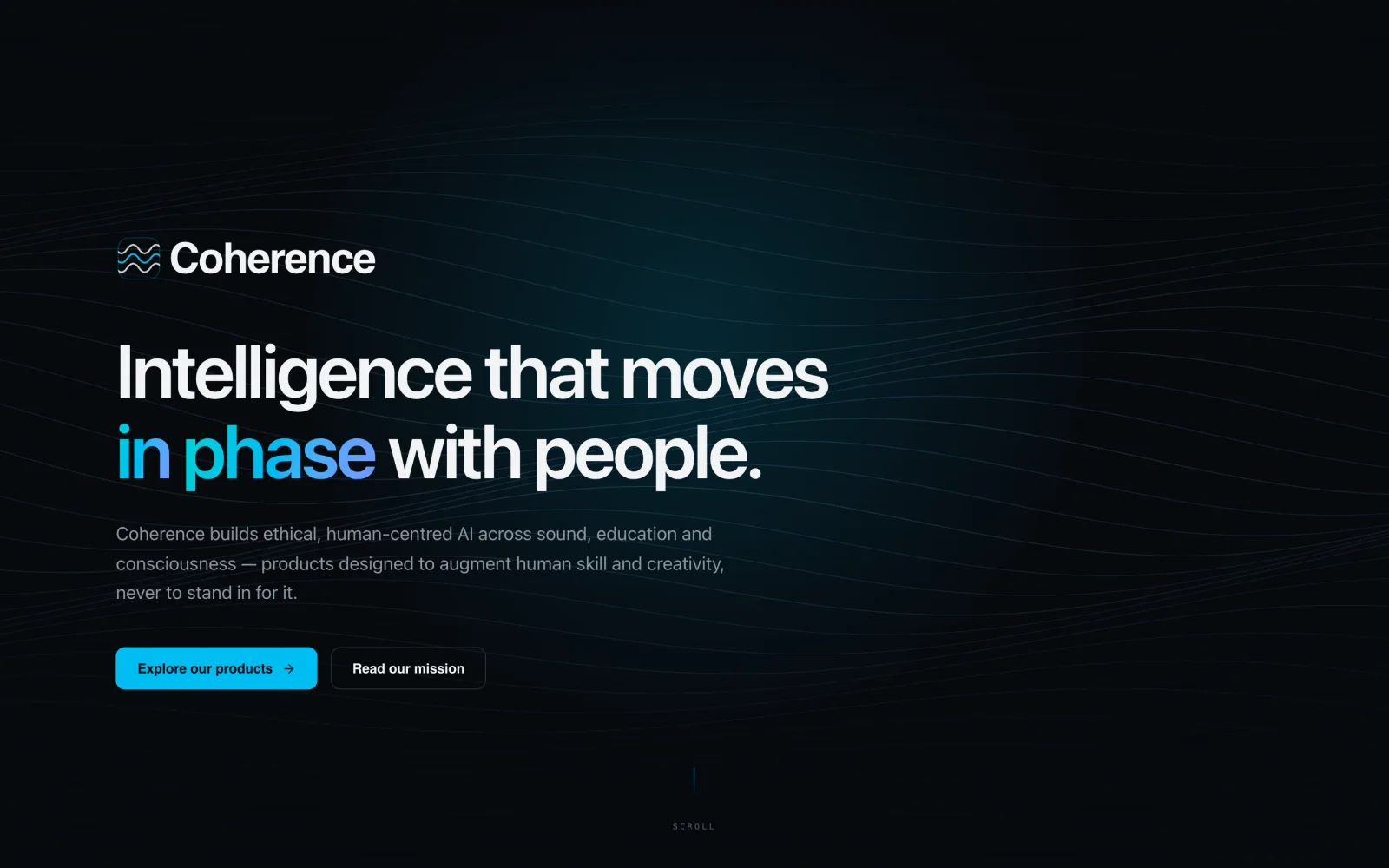
coherence.com on desktop, headed "Intelligence that moves in phase with people".
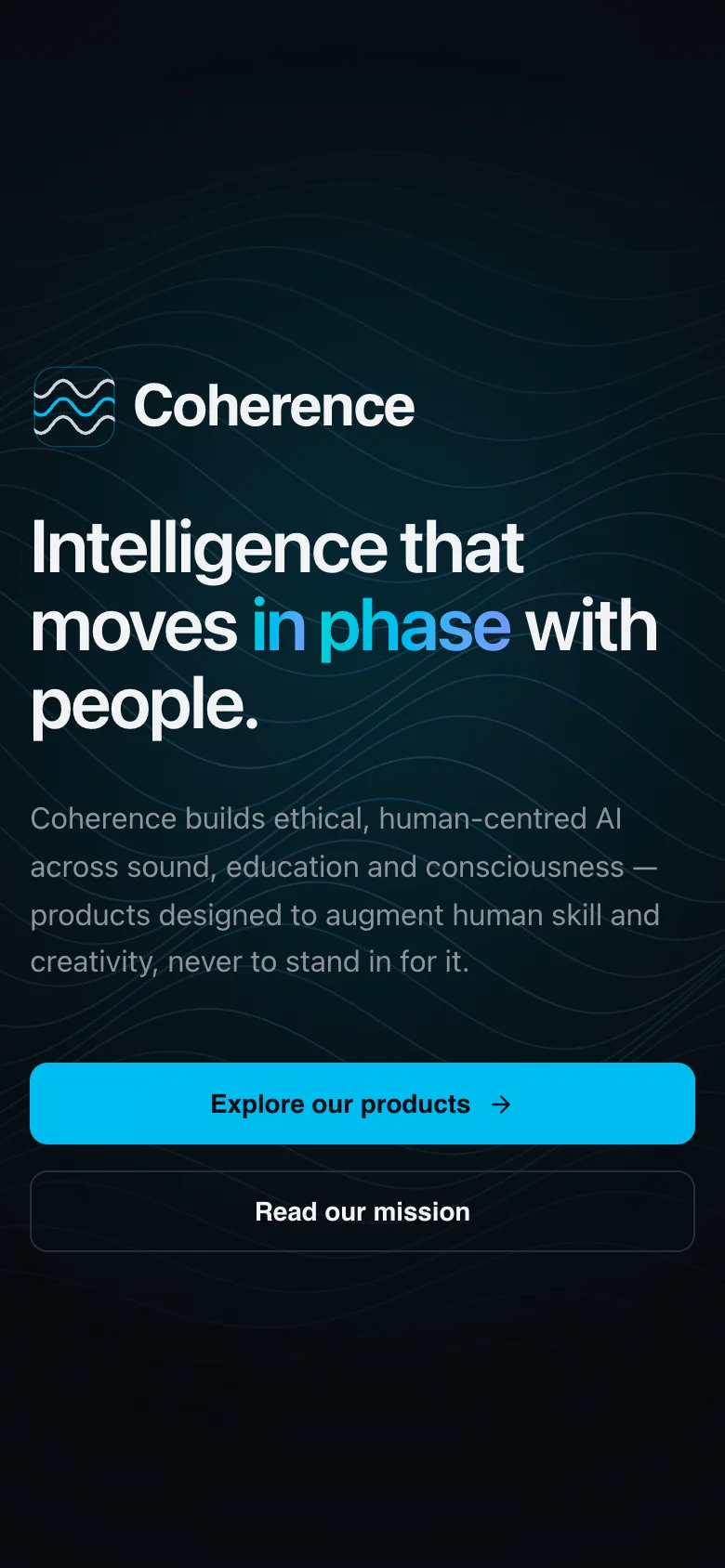
coherence.com on a mobile viewport, reflowed to a single column.
coherence.com — homepage, 1440×900
Live

Coherence

Live at coherence.com: brand identity generated with AI agents we directed, the motion system and website for the group behind Sonora, AboutAI, WakeUp and MudShadows. Agent work remains in build.

What we built
  • Brand identity
  • Motion system
  • Live website
  • Agent work — in build
Read the case study →
The new Domain Booth homepage on desktop: the headline “Premium Domains. Serious Buyers. Proven Results.” beside the animated DB monogram.
The new Domain Booth homepage on a phone, reflowed to a single column.
Our build of the Domain Booth homepage — 1440×900
Live

Domain Booth

Live at domainbooth.com for DomainBooth, a premium domain brokerage: a new animated mark, every page redesigned and rebuilt with designed mobile layouts, and a custom CMS for its sales record, featured names, press and enquiries.

What we built
  • Animated mark
  • Every page redesigned
  • Designed mobile layouts
  • Custom CMS
Read the case study →
Who we have built for

Twenty-one years. Names you know.

Apps, platforms and campaigns for these teams, long before the AI work. Every one is written up on the work page — what we did, and where our part ended.

See all of our work →
  • BBC Good Food logo
  • Charities Aid Foundation logo
  • GAME logo
  • NatWest logo
  • Next logo
  • NSPCC logo
  • Tesco logo
  • Worldpay logo
  • Samsung logo
  • Sony logo
  • Land Rover logo
  • UAP Limited logo
  • Netflix logo
  • Amazon Prime Video logo
  • Mercedes-Benz dealerships logo
  • San Miguel logo
  • Biovene Barcelona logo
  • Seventy7 logo
  • Littlewoods logo
  • Smile logo
  • The Co-operative Bank logo