Dark theme
WELCOME TO QQUANTUM

Let Qubi show you around.

Choose how you’d like to explore.

Don’t agreeGo to yourOS instead ↗

Both choices allow Google Analytics, so we can see which pages help.

Sound is your choice. Essential cookies keep the site working. Continuing either way also allows Google Analytics (visits and pages viewed).

Read our Terms, Privacy and Cookies.

Change your choices anytime from the footer.

Getting Qubi ready.
Amsterdam

Amsterdam AI studio.
Fintech and freight.

Dutch clients ask about explainability first and capability second, which is the opposite of most markets and, in our experience, the better order. The Autoriteit Persoonsgegevens has been unusually forward on algorithmic supervision, and the country has a recent and painful memory of automated decisions going wrong at scale. It shows in the questions we get asked in the first meeting.

  • Worked from Barcelona
  • Built for AP scrutiny of automated decisions
  • Same hour as us
Last reviewed 5 September 2026 · Engineering guidance, not legal advice.
All Where We Work →
Pixel illustration for Amsterdam AI Consultancy: a destination postcard for Amsterdam, with an illustrative city silhouette and a travel route.

What is actually different here

01

A regulator that supervises algorithms, not only data

The Autoriteit Persoonsgegevens has taken on a coordinating role on algorithmic oversight in the Netherlands and publishes periodic reporting on algorithmic risk. That is a meaningfully different posture from a data protection authority that looks only at lawful basis and retention. The questions that follow are about how a system behaves: what it decides, on what inputs, how often it is wrong, in which direction it is wrong, and who noticed. Those are answerable, but only by a system built to answer them.
02

The automated decision question arrives early

In the Netherlands, a design that produces decisions about people gets scrutinised on that basis long before it gets scrutinised on accuracy. The GDPR's limits on solely automated decision-making with legal or similarly significant effects are the legal frame; the engineering consequence is that where a person is meant to review, that review has to be real — with the reasoning, the evidence and enough time to disagree — rather than a button that says approve on a queue of four hundred. We design the review surface as part of the system, because a nominal human in the loop is the failure mode everyone recognises here.
03

In-country compute exists, with an asterisk

Amsterdam sits beside one of the world's largest internet exchanges, and at the time of writing Microsoft and Google both operate regions physically in the Netherlands while the nearest AWS regions are in Ireland and Frankfurt. If Dutch residency is a genuine requirement rather than a preference, that difference decides your provider before it decides your architecture. Region footprints change; confirm against the provider's current documentation rather than against this page.
04

Consent is load-bearing for anything personalised

Adtech, media and commerce clients here run into the same wall: the interesting personalisation depends on data whose lawful basis is consent, and consent is refusable, revocable and audited. That is not a reason to abandon the feature. It is a reason to design it so it degrades honestly for the substantial share of users who decline, instead of silently depending on data you are not entitled to.

The work that comes out of this city

Amsterdam's four big clusters send us four fairly different problems, though they converge on the same requirement to explain themselves.

Payments and fintech dominates. Transaction monitoring, sanctions screening and fraud detection all share an awkward property: the system produces enormous numbers of alerts, almost all of which are wrong, and each false positive is a decision about a real person whose money is not moving. Reducing the alert volume is easy and reducing it defensibly is not, because the burden is to show why a case was closed as well as why it was raised. That is the work described under fraud and AML, and the instrumentation it needs under observability.

Logistics around Schiphol brings air freight documentation, customs and handling data, with an emphasis on speed that port work does not have. The document work is similar in kind to a sea freight pipeline and different in tempo; the pattern is the same one described in our logistics pipeline.

Media and adtech arrive with personalisation, content operations and measurement, and with a lawful-basis constraint sitting under all three.

Agrifood and trading businesses bring forecasting against perishable inventory, where the cost of being wrong is asymmetric and rarely modelled as such.

Across all four, the AI Act classification question comes up on its own, usually from the client rather than from us. It is covered under the EU AI Act.

How an amsterdam project actually runs

01

Discovery in person

Barcelona to Amsterdam is a direct flight of a couple of hours. We come for the first workshop, and we find Dutch discovery sessions unusually efficient — people say what they think the problem is, and say so when they think we are wrong. That saves a fortnight.
02

Then remote, with no offset at all

Same timezone, whole working day shared. No morning-only overlap window, no answer arriving after you have gone home.
03

And back for handover

In person, with the documentation your privacy officer will want to read written alongside the code rather than after it. The system then runs in your own accounts.
Questions

Questions about Amsterdam AI Consultancy.

Do you have an Amsterdam office?

No. We have one office and it is in Barcelona. We travel to Amsterdam for discovery, for handover and for anything that needs a room. We are a small senior team and we would rather be plain about that than dress up a virtual address.

How do we show the AP that a decision was not solely automated?

By making the human review substantive and recording it. In practice that means the reviewer sees the evidence and the reasoning rather than a score, has the authority and the time to disagree, and their disagreements are visible in the data afterwards. If nobody ever overrides the system, that is itself the finding. We build the review interface and the audit record as part of the system; whether it satisfies your obligations is your privacy officer's call, not ours.

Can all our data stay in the Netherlands?

Often, though it depends on your provider. At the time of writing there are hyperscale regions physically in the Netherlands from some providers and not others, and open-weight models can be self-hosted wherever your infrastructure is. If Dutch residency is a hard requirement, tell us in the first conversation, because it constrains the platform choice more than it constrains the design.

Do you build the model or the explanation?

Both, and the second is usually where the effort goes. Anyone can produce a score. Producing a system that can say which inputs drove a particular outcome, cite the record it relied on, and reproduce the same answer six months later on request is a different piece of engineering, and it is the part that survives contact with a supervisor.

What does an Amsterdam engagement cost?

The same ranges as anywhere else, published on the pricing page in euros and exclusive of VAT. We do not price by postcode. As an EU supplier invoicing a Dutch business the VAT position is normally straightforward; your finance team will know the mechanics better than we do.

In Amsterdam, and it
has to be explainable?

Thirty minutes on the decision, the evidence behind it, and what it would take to defend it.

30-minute technical call · no deck

Shipped & in build

Real work. Check it yourself.

What we built, what stage it is at, and a link to the live thing wherever there is one.

The updated yourOS homepage: Roxy’s open ring surrounded by bento cards for calls, voice, translation, building, design, apps and more.
The yourOS homepage on a phone, with its compact navigation, welcome film button and bento cards.
youros.tech — the homepage bento hero
Our own · coming soon

yourOS

yourOS is an operating system with an AI at its heart. You talk to it like a person, out loud or typed. It makes your calls, plans your days and works on your projects with a crew of agents, on your own private server. Our own product, built from the first commit; the waitlist is open.

What we built
  • Operating system
  • Roxy
  • Agent crew
  • Voice calls
  • App store
  • Website
Meet yourOS →
The Sonora homepage on desktop: a full-bleed dune landscape behind the headline “Transform Your Life with Sound”, with App Store and Google Play download buttons.
The Sonora homepage on a mobile viewport, showing the same hero reflowed to a single column.
sonora.com — homepage, 1440×900
Live · iOS · Android

Sonora

Website, backend and app assets for Sonora, a free AI sound-therapy app on iOS and Android published by Cognitive AI.

What we built
  • Website
  • Backend
  • App assets
Read the case study →
The updated Podswap homepage on desktop: “Grow on Instagram and TikTok for free, with real engagement from creators your size”, beside a tilted wall of exchange, tool and guide cards on a violet gradient.
The updated Podswap homepage on a phone, with its floating navigation, Instagram and TikTok engagement headline and tilted tool cards.
podswap.app — homepage, 1440×900
Five platforms

Podswap

Brand, website, prototype, apps on five platforms, the AI backend and the algorithm-intelligence pipeline for Podswap, a social growth engine that runs without a human in the loop.

What we built
  • Brand
  • Website
  • Prototype
  • Apps on five platforms
  • AI backend
  • Algorithm pipeline
Read the case study →
The unOpen.AI homepage introducing Roxy, a private AI assistant that remembers who you are.
The unOpen.AI homepage on a mobile viewport.
unopen.ai — homepage, 1440×900
Prototype · closed beta

unOpen.AI

In closed beta: Roxy, a private AI assistant with permanent memory running on infrastructure the user owns. Brand, site, product, backend and conversational design.

What we built
  • Brand
  • Site
  • Product
  • Backend
  • Conversational design
Read the case study →
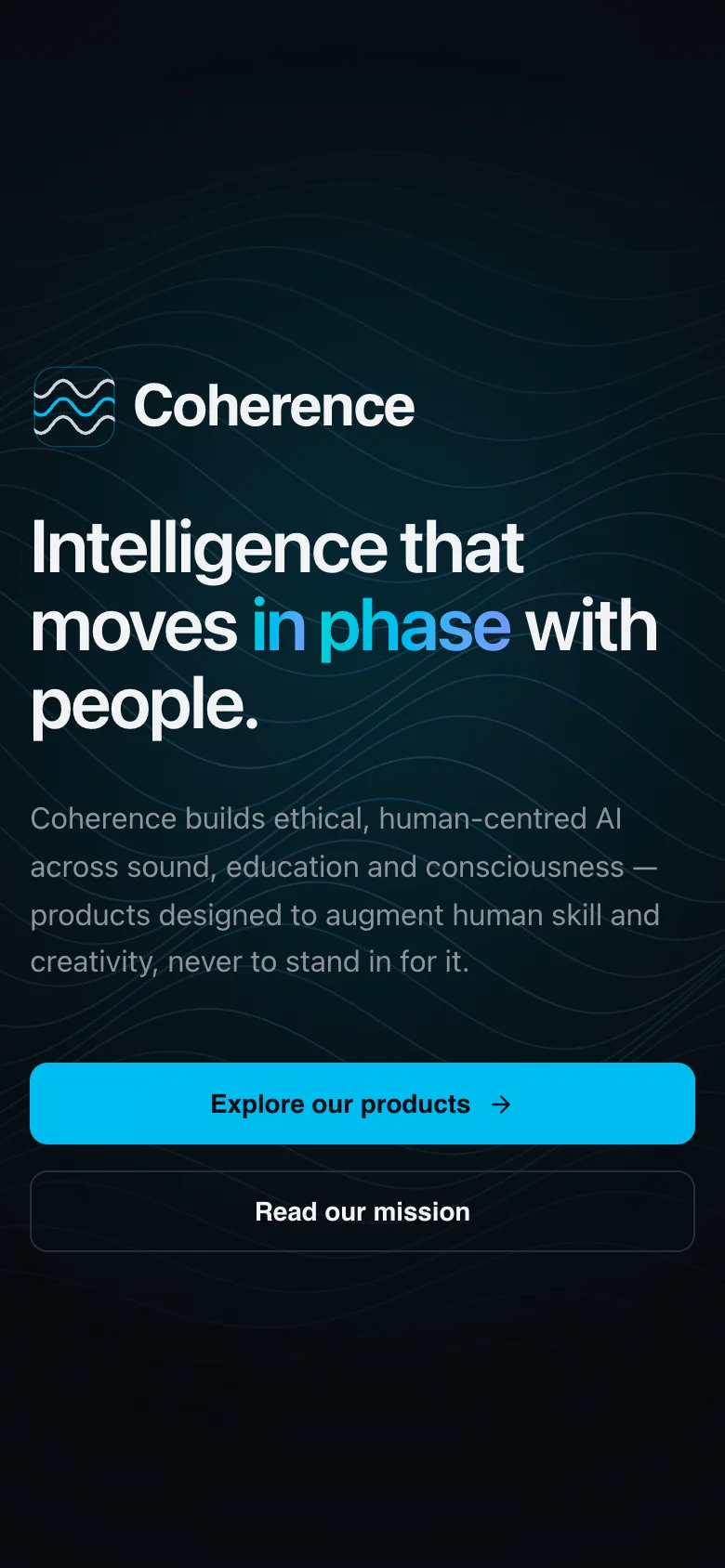
coherence.com on desktop, headed "Intelligence that moves in phase with people".
coherence.com on a mobile viewport, reflowed to a single column.
coherence.com — homepage, 1440×900
Live

Coherence

Live at coherence.com: brand identity generated with AI agents we directed, the motion system and website for the group behind Sonora, AboutAI, WakeUp and MudShadows. Agent work remains in build.

What we built
  • Brand identity
  • Motion system
  • Live website
  • Agent work — in build
Read the case study →
The new Domain Booth homepage on desktop: the headline “Premium Domains. Serious Buyers. Proven Results.” beside the animated DB monogram.
The new Domain Booth homepage on a phone, reflowed to a single column.
Our build of the Domain Booth homepage — 1440×900
Live

Domain Booth

Live at domainbooth.com for DomainBooth, a premium domain brokerage: a new animated mark, every page redesigned and rebuilt with designed mobile layouts, and a custom CMS for its sales record, featured names, press and enquiries.

What we built
  • Animated mark
  • Every page redesigned
  • Designed mobile layouts
  • Custom CMS
Read the case study →
Who we have built for

Twenty-one years. Names you know.

Apps, platforms and campaigns for these teams, long before the AI work. Every one is written up on the work page — what we did, and where our part ended.

See all of our work →
  • BBC Good Food logo
  • Charities Aid Foundation logo
  • GAME logo
  • NatWest logo
  • Next logo
  • NSPCC logo
  • Tesco logo
  • Worldpay logo
  • Samsung logo
  • Sony logo
  • Land Rover logo
  • UAP Limited logo
  • Netflix logo
  • Amazon Prime Video logo
  • Mercedes-Benz dealerships logo
  • San Miguel logo
  • Biovene Barcelona logo
  • Seventy7 logo
  • Littlewoods logo
  • Smile logo
  • The Co-operative Bank logo