Dark theme
WELCOME TO QQUANTUM

Let Qubi show you around.

Choose how you’d like to explore.

Don’t agreeGo to yourOS instead ↗

Both choices allow Google Analytics, so we can see which pages help.

Sound is your choice. Essential cookies keep the site working. Continuing either way also allows Google Analytics (visits and pages viewed).

Read our Terms, Privacy and Cookies.

Change your choices anytime from the footer.

Getting Qubi ready.
Stockholm

Stockholm.
Cost per inference.

We are based in Barcelona and share your working hours exactly. Stockholm is the European city where the cost conversation happens first and hardest — partly because the companies here sell to consumers at thin margins, and partly because the cloud region on their doorstep is one of the cheapest and lowest-carbon in the EU, which makes the arithmetic worth actually doing.

  • Worked from Barcelona
  • Nordic region compute
  • Same hour as us
Last reviewed 5 September 2026 · Engineering guidance, not legal advice.
All Where We Work →
Pixel illustration for Stockholm AI Engineering: a destination postcard for Stockholm, with an illustrative city silhouette and a travel route.

What is actually different here

01

A Stockholm cloud region, and it is cheap

Sweden hosts a major Nordic cloud region, drawing on a grid that is largely hydro and nuclear, and it has historically been among the lower-priced regions in the EU. Two consequences follow. Keeping data in Sweden is an ordinary configuration choice rather than a project. And for a workload that runs continuously, region choice is a genuine cost lever rather than a rounding error. Pricing and grid mix both change, so we take the current figures from the provider at design time rather than quoting them as fixed.
02

Ordinary regulator, unusually linked data

IMY supervises data protection under the same GDPR as everywhere else in the EU, which is the straightforward part. The Swedish complication is the personal identity number: records here join up across systems far more readily than in most countries, so a support transcript or a log line can be more identifying than it looks, and pseudonymisation that would be adequate elsewhere often is not. We look for that early, because it decides what may be sent to a hosted model at all.
03

Unit economics is the design constraint

Swedish product companies typically know their revenue per user or per transaction to the öre, and an AI feature has to sit under it with room left. That is not a procurement conversation, it is an architecture one: it decides model size, whether small models handle the common path, how much context is loaded per call and what is cached. We size that before building, and GPU sizing and cost is where the method is written down.
04

Two industries pulling opposite ways

Gaming wants very high volume at very low latency and near-zero marginal cost, and can tolerate an imperfect answer. Payments and fintech want an answer that can be explained to a supervisor months later, and cannot tolerate an unexplained one. Both are Stockholm industries and they produce almost opposite architectures. A studio that builds them the same way is building one of them badly.

The work that comes out of this city

  • Payments and fintech.

    Stockholm exports consumer finance across Europe, and the AI problem that comes with it is transaction monitoring and fraud work where a flagged customer eventually asks why. Precision matters commercially, because every false positive is a real person blocked at a checkout, and explainability matters legally, because an automated decision that materially affects someone has to be accountable. The architecture that results keeps the model as one input to a decision rather than the decision itself, and that is what we describe under fraud and AML.
  • Gaming.

    A studio with millions of players has support volume in a dozen languages, around the clock, at a cost per contact that has to stay below what a player is worth. This is one of the few settings where deflection rate and cost per resolved contact are the only two numbers anybody cares about, and where the honest engineering answer is often a smaller model doing most of the work with a larger one held in reserve. It also produces the toughest evaluation problem we see, because player language is nothing like the polite corpus these systems are usually measured on.
  • Telecoms and industrial technology.

    The network and equipment companies in and around the city hold enormous technical documentation estates and field-service histories. Making those answerable to an engineer standing in front of a fault is straightforward retrieval work with a very high value per query, and it rarely requires the most expensive model available.
  • Product teams generally.

    Whatever the sector, a Stockholm client tends to arrive already convinced the feature is possible and wanting to know what it will cost to run and how they will know it still works after a model update. That is an evaluation question before it is a modelling one, and building the evaluation first is the only version of this that survives its second year.

How a stockholm project actually runs

01

We come north for discovery

Barcelona to Stockholm is a longer hop than most of our European work — roughly three and a half hours direct — and still worth doing for the first workshop. Decisions here tend to be reached by the group rather than announced to it, so we ask for everyone who can veto the design in that first session rather than meeting them one at a time in month two.
02

Then remote, identical hours

Sweden and Spain keep the same clock all year, so there is no conversion and no truncated overlap. The one thing we do plan around is the Swedish summer: July is genuinely quiet, and a milestone that assumes otherwise will slip.
03

And back for handover, with the cost model

The ownership session includes the thing Stockholm clients ask for most and get least often: a working model of what the system costs to run at ten times current volume, with the assumptions visible so you can argue with them. After that the system is yours, in your repositories and your cloud accounts.
Questions

Questions about Stockholm AI Engineering.

Do you have a Stockholm office?

No. We have one office and it is in Barcelona. We travel to Stockholm for discovery, for handover and for anything where being in the room changes the outcome. There is no Swedish entity and no Nordic partner firm behind us.

Can we run everything in Sweden?

Yes, and it is easier here than in most of Europe. There is a major cloud region in Sweden, and open-weight models can be self-hosted inside your own perimeter, so a system where no personal data leaves the country is an ordinary configuration. The usual reason to look further afield is a specific hosted model that is not offered in the region, and that is a trade-off worth making explicitly rather than by default. Where a hosted model is used we document its retention and training terms at the time of writing, and you should confirm them against the provider's current terms.

Can you tell us the carbon footprint of the system?

Partly, and it is worth being precise about which part. We can measure what the system does — tokens processed, calls made, GPU hours consumed — and that is the half that actually depends on the engineering. Converting that into emissions relies on the provider's own disclosures for the region, which we can cite but cannot audit. So the honest deliverable is a defensible activity figure plus the provider's published factors, not a number of our own invention. If your company reports under the CSRD, that distinction will matter to whoever signs the report.

How do we keep the cost from running away?

By deciding the budget per interaction before choosing a model, and by instrumenting the system so cost per outcome is visible from the first day rather than discovered in an invoice. In practice that usually means routing the common cases to a smaller model, caching aggressively, and keeping the expensive path for the small share of traffic that needs it. It also means being willing to conclude that a feature is not viable at the price, which is a legitimate finding and cheaper in week two than in month nine.

What does a Stockholm engagement cost?

The same as anywhere else — the ranges are on the pricing page, in euros and exclusive of VAT. We do not price by postcode, and we do not price against Nordic consultancy rates.

In Stockholm and
building something?

Thirty minutes on the problem, and an honest read on whether we are the right team for it.

30-minute technical call · no deck

Shipped & in build

Real work. Check it yourself.

What we built, what stage it is at, and a link to the live thing wherever there is one.

The updated yourOS homepage: Roxy’s open ring surrounded by bento cards for calls, voice, translation, building, design, apps and more.
The yourOS homepage on a phone, with its compact navigation, welcome film button and bento cards.
youros.tech — the homepage bento hero
Our own · coming soon

yourOS

yourOS is an operating system with an AI at its heart. You talk to it like a person, out loud or typed. It makes your calls, plans your days and works on your projects with a crew of agents, on your own private server. Our own product, built from the first commit; the waitlist is open.


What we built
  • Operating system
  • Roxy
  • Agent crew
  • Voice calls
  • App store
  • Website
Meet yourOS →
The Sonora homepage on desktop: a full-bleed dune landscape behind the headline “Transform Your Life with Sound”, with App Store and Google Play download buttons.
The Sonora homepage on a mobile viewport, showing the same hero reflowed to a single column.
sonora.com — homepage, 1440×900
Live · iOS · Android

Sonora

Website, backend and app assets for Sonora, a free AI sound-therapy app on iOS and Android published by Cognitive AI.

What we built
  • Website
  • Backend
  • App assets
Read the case study →
The updated Podswap homepage on desktop: “Grow on Instagram and TikTok for free, with real engagement from creators your size”, beside a tilted wall of exchange, tool and guide cards on a violet gradient.
The updated Podswap homepage on a phone, with its floating navigation, Instagram and TikTok engagement headline and tilted tool cards.
podswap.app — homepage, 1440×900
Five platforms

Podswap

Brand, website, prototype, apps on five platforms, the AI backend and the algorithm-intelligence pipeline for Podswap, a social growth engine that runs without a human in the loop.

What we built
  • Brand
  • Website
  • Prototype
  • Apps on five platforms
  • AI backend
  • Algorithm pipeline
Read the case study →
The unOpen.AI homepage introducing Roxy, a private AI assistant that remembers who you are.
The unOpen.AI homepage on a mobile viewport.
unopen.ai — homepage, 1440×900
Prototype · closed beta

unOpen.AI

In closed beta: Roxy, a private AI assistant with permanent memory running on infrastructure the user owns. Brand, site, product, backend and conversational design.

What we built
  • Brand
  • Site
  • Product
  • Backend
  • Conversational design
Read the case study →
coherence.com on desktop, headed "Intelligence that moves in phase with people".
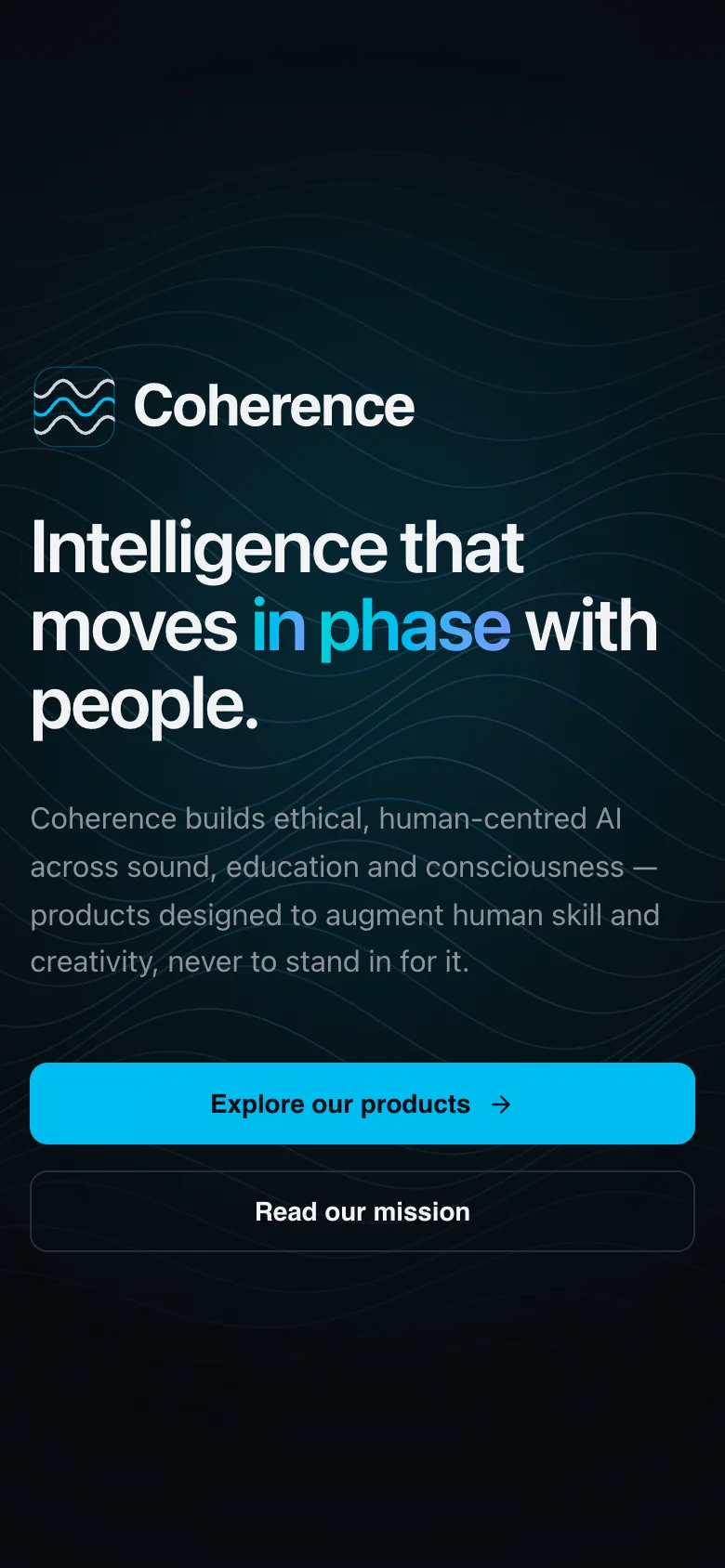
coherence.com on a mobile viewport, reflowed to a single column.
coherence.com — homepage, 1440×900
Live

Coherence

Live at coherence.com: brand identity generated with AI agents we directed, the motion system and website for the group behind Sonora, AboutAI, WakeUp and MudShadows. Agent work remains in build.

What we built
  • Brand identity
  • Motion system
  • Live website
  • Agent work — in build
Read the case study →
The new Domain Booth homepage on desktop: the headline “Premium Domains. Serious Buyers. Proven Results.” beside the animated DB monogram.
The new Domain Booth homepage on a phone, reflowed to a single column.
Our build of the Domain Booth homepage — 1440×900
Live

Domain Booth

Live at domainbooth.com for DomainBooth, a premium domain brokerage: a new animated mark, every page redesigned and rebuilt with designed mobile layouts, and a custom CMS for its sales record, featured names, press and enquiries.

What we built
  • Animated mark
  • Every page redesigned
  • Designed mobile layouts
  • Custom CMS
Read the case study →
Who we have built for

Twenty-one years. Names you know.

Apps, platforms and campaigns for these teams, long before the AI work. Every one is written up on the work page — what we did, and where our part ended.

See all of our work →
  • BBC Good Food logo
  • Charities Aid Foundation logo
  • GAME logo
  • NatWest logo
  • Next logo
  • NSPCC logo
  • Tesco logo
  • Worldpay logo
  • Samsung logo
  • Sony logo
  • Land Rover logo
  • UAP Limited logo
  • Netflix logo
  • Amazon Prime Video logo
  • Mercedes-Benz dealerships logo
  • San Miguel logo
  • Biovene Barcelona logo
  • Seventy7 logo
  • Littlewoods logo
  • Smile logo
  • The Co-operative Bank logo