Dark theme
WELCOME TO QQUANTUM

Let Qubi show you around.

Choose how you’d like to explore.

Don’t agreeGo to yourOS instead ↗

Both choices allow Google Analytics, so we can see which pages help.

Sound is your choice. Essential cookies keep the site working. Continuing either way also allows Google Analytics (visits and pages viewed).

Read our Terms, Privacy and Cookies.

Change your choices anytime from the footer.

Getting Qubi ready.
Model families

Gemini for
long-context work.

Gemini's distinguishing properties are context length and native multimodality — it was built to take video, audio, images and documents as first-class inputs rather than through a bolted-on pipeline. That combination decides a specific class of problem.

All Model Families →
Pixel illustration for Gemini for Enterprise: sound, image and document samples converging at a glass lens.

Specification

Provider
Google, United States (EU regions available through Vertex AI)
Weights
Closed — API access only. The smaller Gemma family is separate and open-weight.
Context window
Among the longest available; documented at one million tokens or more on the top tier — check current documentation
Modality
Text, image, audio and video as native inputs
Access paths
Google AI Studio API, or Vertex AI inside your own Google Cloud project and region
Where we use it
Long-document and video/audio understanding, and where a client already runs on Google Cloud

Provider-published specifications as of 1 September 2026, not figures we measured. Model families move quickly — check the provider's own documentation before committing to a number.

Where it fits well

01

Genuinely long context

Where the alternative is aggressive chunking and reassembly, putting the whole corpus in the window removes an entire class of retrieval bug. It is not free — you pay for every token, every call — but for a one-off analysis over a large document set it is often cheaper than building the retrieval layer you would otherwise need.
02

Native multimodal input

Video and audio in, structured output back, without a transcription-then-analysis pipeline that loses timing and visual context between stages. For meeting analysis, media archives and inspection footage this is a structural rather than incremental advantage.
03

Vertex deployment

Consumed inside your own Google Cloud project and region, which frequently resolves data-residency and procurement questions using an infrastructure agreement you already hold. That path is often faster through security review than a new vendor relationship.
04

Model tiering

A wide capability and price range within one family, so routing between tiers does not mean integrating a second provider. The cheapest tiers are cheap enough to sit in high-volume paths where a frontier model could not.

The honest caveats

  • A long context window is not a memory.

    Filling a million-token window and expecting uniform recall across it is the most common and most expensive mistake we see with this family. Retrieval quality degrades unevenly across a very long context in ways that are workload-specific, and the only way to know how yours behaves is to test it at the length you actually intend to use. A retrieval layer over the same corpus is frequently both cheaper and more accurate, and it gives you a citation.
  • Cost scales with what you put in it.

    Long-context calls are priced on input tokens, and a system that re-sends a large document on every turn of a conversation multiplies that by the conversation length. Caching a stable prefix helps materially, but only if the context is designed so the stable part is genuinely a prefix — that is an architectural decision worth making before the first line of integration code, not after the first bill.
  • Weights are closed.

    If your requirement is that no data leaves your hardware, this family is out and the conversation moves to open weights. Vertex in your own region resolves residency; it does not resolve "on our own metal".
Questions

Questions about Gemini for Enterprise.

Should we use the long context instead of building retrieval?

For a one-off or low-volume analysis, often yes — it is dramatically less engineering. For a system that runs continuously over a corpus that changes, almost always no: you pay the full input cost on every call, you cannot cite a source span, and recall across very long contexts is uneven. The usual answer is retrieval for the system and long context for the exploratory work that designs it.

Does data sent to Vertex stay in our region?

Vertex offers regional endpoints and, at the time of writing, the data handling follows your existing agreement with Google Cloud — confirm against the provider's current terms — which is why it is often the faster procurement path. Confirm the specific region and the specific model availability, because not every model is served from every region, and that detail has derailed more than one deployment at the last stage.

Gemini or Claude or GPT?

For long-document and multimodal work Gemini has a structural advantage on paper; we still benchmark. For agentic tool use and instruction adherence under complex constraints we more often reach for Claude. For breadth of ecosystem and integrations, GPT. Anyone answering that confidently without seeing your workload is guessing, and we benchmark rather than assume.

Long context or
real retrieval?

The answer changes the cost of the system by an order of magnitude. We work it out against your corpus.

30-minute technical call · no deck

Shipped & in build

Real work. Check it yourself.

What we built, what stage it is at, and a link to the live thing wherever there is one.

The updated yourOS homepage: Roxy’s open ring surrounded by bento cards for calls, voice, translation, building, design, apps and more.
The yourOS homepage on a phone, with its compact navigation, welcome film button and bento cards.
youros.tech — the homepage bento hero
Our own · coming soon

yourOS

yourOS is an operating system with an AI at its heart. You talk to it like a person, out loud or typed. It makes your calls, plans your days and works on your projects with a crew of agents, on your own private server. Our own product, built from the first commit; the waitlist is open.


What we built
  • Operating system
  • Roxy
  • Agent crew
  • Voice calls
  • App store
  • Website
Meet yourOS →
The Sonora homepage on desktop: a full-bleed dune landscape behind the headline “Transform Your Life with Sound”, with App Store and Google Play download buttons.
The Sonora homepage on a mobile viewport, showing the same hero reflowed to a single column.
sonora.com — homepage, 1440×900
Live · iOS · Android

Sonora

Website, backend and app assets for Sonora, a free AI sound-therapy app on iOS and Android published by Cognitive AI.

What we built
  • Website
  • Backend
  • App assets
Read the case study →
The updated Podswap homepage on desktop: “Grow on Instagram and TikTok for free, with real engagement from creators your size”, beside a tilted wall of exchange, tool and guide cards on a violet gradient.
The updated Podswap homepage on a phone, with its floating navigation, Instagram and TikTok engagement headline and tilted tool cards.
podswap.app — homepage, 1440×900
Five platforms

Podswap

Brand, website, prototype, apps on five platforms, the AI backend and the algorithm-intelligence pipeline for Podswap, a social growth engine that runs without a human in the loop.

What we built
  • Brand
  • Website
  • Prototype
  • Apps on five platforms
  • AI backend
  • Algorithm pipeline
Read the case study →
The unOpen.AI homepage introducing Roxy, a private AI assistant that remembers who you are.
The unOpen.AI homepage on a mobile viewport.
unopen.ai — homepage, 1440×900
Prototype · closed beta

unOpen.AI

In closed beta: Roxy, a private AI assistant with permanent memory running on infrastructure the user owns. Brand, site, product, backend and conversational design.

What we built
  • Brand
  • Site
  • Product
  • Backend
  • Conversational design
Read the case study →
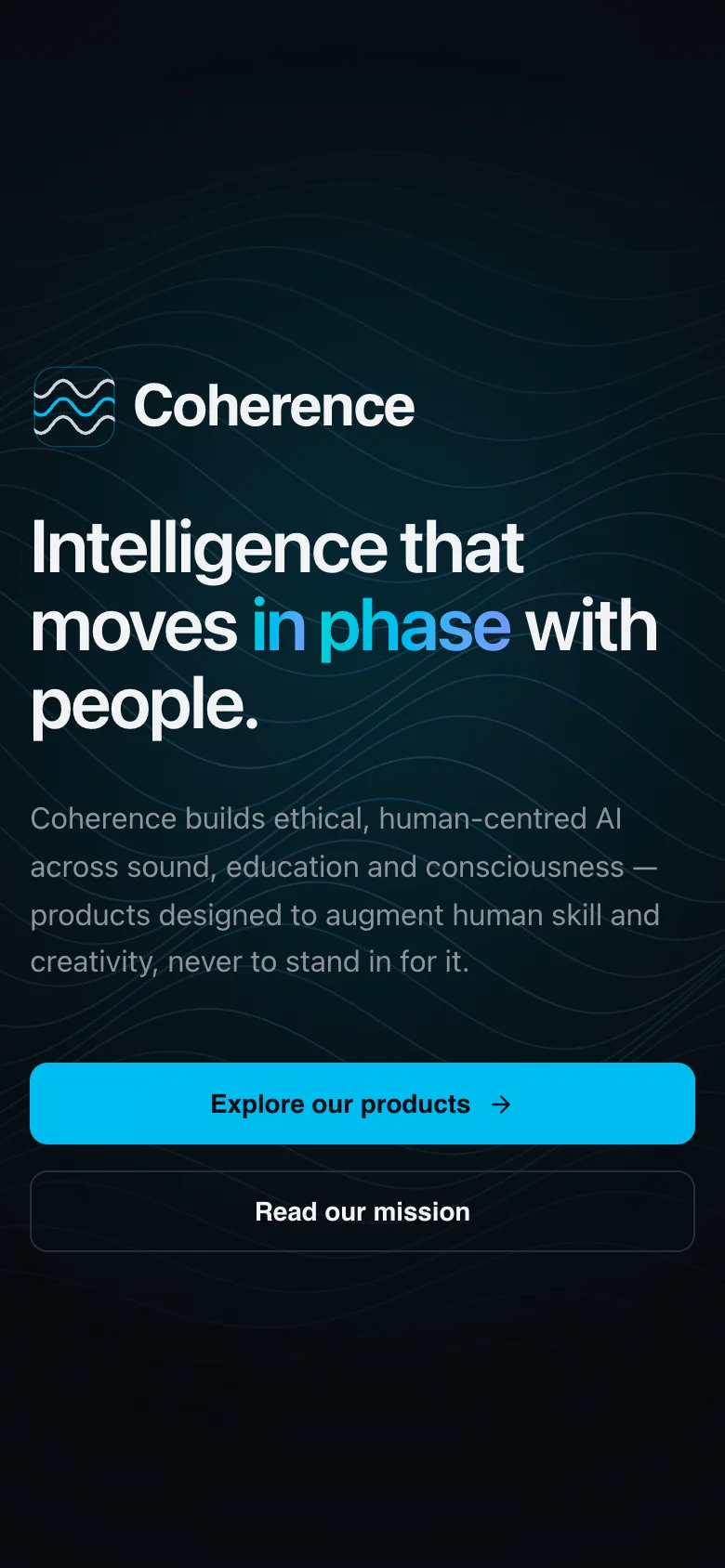
coherence.com on desktop, headed "Intelligence that moves in phase with people".
coherence.com on a mobile viewport, reflowed to a single column.
coherence.com — homepage, 1440×900
Live

Coherence

Live at coherence.com: brand identity generated with AI agents we directed, the motion system and website for the group behind Sonora, AboutAI, WakeUp and MudShadows. Agent work remains in build.

What we built
  • Brand identity
  • Motion system
  • Live website
  • Agent work — in build
Read the case study →
The new Domain Booth homepage on desktop: the headline “Premium Domains. Serious Buyers. Proven Results.” beside the animated DB monogram.
The new Domain Booth homepage on a phone, reflowed to a single column.
Our build of the Domain Booth homepage — 1440×900
Live

Domain Booth

Live at domainbooth.com for DomainBooth, a premium domain brokerage: a new animated mark, every page redesigned and rebuilt with designed mobile layouts, and a custom CMS for its sales record, featured names, press and enquiries.

What we built
  • Animated mark
  • Every page redesigned
  • Designed mobile layouts
  • Custom CMS
Read the case study →
Who we have built for

Twenty-one years. Names you know.

Apps, platforms and campaigns for these teams, long before the AI work. Every one is written up on the work page — what we did, and where our part ended.

See all of our work →
  • BBC Good Food logo
  • Charities Aid Foundation logo
  • GAME logo
  • NatWest logo
  • Next logo
  • NSPCC logo
  • Tesco logo
  • Worldpay logo
  • Samsung logo
  • Sony logo
  • Land Rover logo
  • UAP Limited logo
  • Netflix logo
  • Amazon Prime Video logo
  • Mercedes-Benz dealerships logo
  • San Miguel logo
  • Biovene Barcelona logo
  • Seventy7 logo
  • Littlewoods logo
  • Smile logo
  • The Co-operative Bank logo