Dark theme
WELCOME TO QQUANTUM

Let Qubi show you around.

Choose how you’d like to explore.

Don’t agreeGo to yourOS instead ↗

Both choices allow Google Analytics, so we can see which pages help.

Sound is your choice. Essential cookies keep the site working. Continuing either way also allows Google Analytics (visits and pages viewed).

Read our Terms, Privacy and Cookies.

Change your choices anytime from the footer.

Getting Qubi ready.
Pricing

AI project pricing.
Estimate it in a minute.

Ranges from past work, and an estimator that narrows them to your scope. Your project could cost a lot less than the top of a range; every quote follows a written scope.

Introduction transcript. Client: How much does an AI project cost? Qubi: Let’s measure the job before we make a promise. Qubi: These ranges are a starting point. Your quote follows a written scope. Client: No mystery extras hiding in the lining? Qubi: We spell out the assumptions. And you own the code. Qubi: Tell us what you need. We’ll work it out together.

Engagement models

Start with the work you need.

Prove an idea, choose a direction, build for production, or keep improving after launch. Every one-off range is drawn on the same € scale, so you can see how they compare.

Indicative ranges from past client work. All prices are in EUR, exclusive of VAT. Your quote follows a scoping call and a written scope. These are estimates: many projects can be scoped to cost less.

Estimate yours
Prove the approach

Prototype Sprint

For proving a technical approach works — investor demos, internal buy-in, or de-risking an architecture before committing to it.

Indicative project range

€8–25k

Typical duration
2–4 weeks
What the work includes
  • A working system on your real data
  • Deployed somewhere your team can actually use it
  • Written assessment of what production would take
  • Code in your repositories from day one
Choose the right build

Discovery

For deciding what to build. Assessment of data, systems, constraints and feasibility, with a costed shortlist.

Indicative project range

€8–20k

Typical duration
2–4 weeks
What the work includes
  • Data and systems assessment
  • Prioritised use-case shortlist with effort ranges
  • Reference architecture and evaluation plan
  • Written to be usable by another vendor
Launch a real system Most common

Production Build

Building the system properly: integrations, evaluation, monitoring, error handling and handover.

Indicative project range

€30–120k

Typical duration
6–16 weeks
What the work includes
  • Integrated with your real systems
  • Evaluation set and regression gates in CI
  • Monitoring, cost tracking and runbooks
  • Security documentation for your review process
  • Larger multi-system builds are quoted separately
Keep improving

Ongoing

Fractional capacity after launch — quality monitoring, iteration, and building the next thing alongside your team.

Indicative monthly range

€4–9k/ month

Commitment
Month to month
What the work includes
  • Agreed days per month, working in your systems
  • Quality and cost monitoring, model migrations
  • Knowledge transfer as an explicit goal
  • Month to month — no annual lock-in

Side by side.

What each engagement is for, what you leave with and how it is priced. Pick one to bring its column forward.

Compare your options
Indicative ranges from past client work, in EUR excluding VAT.
Criterion Prototype Sprint Discovery Production Build Ongoing
Best for Proving an approach before you commit to it Deciding what to build, and in which order Launching a system people rely on Improving a system after launch
You leave with A working system on your data and a written production assessment A costed shortlist and a reference architecture An integrated, evaluated and monitored system, handed over Agreed days each month, monitoring and model migrations
Typical range €8–25k €8–20k €30–120k €4–9k / month
Typical duration 2–4 weeks 2–4 weeks 6–16 weeks Month to month
How it is priced Fixed quote Fixed quote Fixed for a bounded scope; phases for larger work Monthly capacity, month to month
Natural next step A production build, or a clear no A build with us, or with another vendor Ongoing care, or fully in-house In-house, once your team is ready
Custom AI agents

One task. A role. A whole system.

An agent can mean one automated step or work across your entire stack. These are three common shapes, estimated from past work and quoted on their own scope.

One task

Single-workflow agent

One job, one or two tools. Triage inbound email, draft replies from a knowledge base, enrich CRM records, summarise and route tickets.

Indicative project range

€8–25k

Typical duration
2–5 weeks
What the work includes
  • One or two integrations
  • Human approval before anything is sent
  • Evaluation set for the one task it does
  • Logging of every action taken
A whole role Most common

Production agent

An agent that carries a role: support, sales research, data analysis or internal ops. Retrieval over your documents, several integrations, escalation paths.

Indicative project range

€25–75k

Typical duration
6–12 weeks
What the work includes
  • Three to five integrations, permissions respected
  • Retrieval with citations and guardrails
  • Escalation to a person with full context
  • Monitoring, cost tracking, regression gates in CI
Across your stack

Multi-agent system

Several agents coordinating across ERP, CRM, email and your data warehouse, with approvals, audit trail and a compliance review to pass.

Indicative project range

€75k+

Typical duration
12+ weeks
What the work includes
  • Orchestration, hand-offs and shared state
  • Approval workflows and full audit trail
  • Security documentation for your review
  • Priced in phases, re-estimated at each one
Estimate your project

Your scope. Your range.

Tell us what you are building and how. The figure moves inside the ranges above, shows its working, and can land below them when your team takes on part of the work.

What are you building?

Bigger than these? Multi-agent systems start around €75k and are priced in phases.

2 systems

CRM, ERP, helpdesk, a database, an internal API…

State of your data

Is it clean, labelled and reachable today?

Who uses it

Customers bring guardrails and escalation paths.

Accuracy bar

From good to reliably good is where effort goes.

Compliance

Regulated data, EU-only hosting, audit trails.

Who does the work

Your engineers can take a real share of it.

Your likely range Production build

€41–59k

7–9 weeks · EUR, excluding VAT

Arithmetic on your answers over the ranges on this page: not a quote, and not a measured client outcome. Your project could cost less. The written quote is what counts.

The working

How your figure is built.

How the estimate is built, line by line
ItemYour answerEffect
Starting point Lowest figure in €30–120k €30k
Systems it connects to 2 systems +€10k
State of your data Some clean-up needed +€9k
Who uses it Your team —
Accuracy bar A person checks the output —
Compliance Standard —
Who does the work We build it —
Central figure Likely €41–59k €49k
How the estimator works

Every answer adds a share of the published range above its lowest figure. Integrations carry the largest share, each system more than the last, then the state of your data. Answer everything at its most demanding and you reach the top of the range; at its simplest, its floor.

Your engineers taking a share of the work scales the whole figure down, which is how a project can come in under the published range. The likely range runs from 15% under the central figure to 20% over it, because scoping always finds something.

After launch

Your spend, month by month.

3 months
€4k
BuildOngoing Month
Build
€49k
Ongoing
€12k
Total
€61k

Build spread evenly across its months for illustration; real invoices follow agreed milestones. Model inference, hosting and tools are paid by you, on top.

Worked examples

What does a project like yours cost?

Real shapes of past work, with client names left off, on one € scale. Slide your budget across them to see what it covers.

€40k

€40k covers the whole range of 2 project shapes, and the lower end of 4 more.

  • Investor or board demo

    One workflow on real data, deployed to a URL, written production assessment

    Typical range
    €8–20k
    Fits your budget
    Typical timeline
    2–3 weeks
  • Internal knowledge assistant

    Retrieval over your documents with citations, permissions respected, evaluation set

    Typical range
    €20–45k
    Fits a narrower scope
    Typical timeline
    4–8 weeks
  • Document processing pipeline

    Extraction and classification of invoices, contracts or forms into your systems, with human review queue

    Typical range
    €25–60k
    Fits a narrower scope
    Typical timeline
    5–10 weeks
  • AI product MVP for a startup

    Six-week build of the core feature, one or two integrations, ready to put in front of users

    Typical range
    €30–60k
    Fits a narrower scope
    Typical timeline
    ~6 weeks
  • Customer-facing support agent

    Ticketing and CRM integration, escalation paths, guardrails, monitoring and cost tracking

    Typical range
    €40–90k
    Fits a narrower scope
    Typical timeline
    8–14 weeks
  • Multi-system automation

    Agents acting across three or more systems (ERP, CRM, email), approvals, audit trail

    Typical range
    €60–120k
    Above your budget
    Typical timeline
    10–16 weeks
  • Marketing site with AI-readable content

    Laravel build, design system, structured data, llms.txt and lead capture

    Typical range
    €12–35k
    Fits your budget
    Typical timeline
    3–6 weeks
  • Large or multi-team programme

    Several systems, several phases, compliance review, dedicated capacity

    Typical range
    Quoted separately
    Typical timeline
    Months

Indicative ranges from past client work, in EUR excluding VAT. Your scope can land outside these ranges, below as well as above. The written quote is what counts.

What moves the number

The scope does the pricing.

Six things we look at before estimating the work, and which way each one moves it. Integrations and data readiness usually have the biggest effect.

What moves the price of a project, and in which direction
What we look at Brings it down Pushes it up
01 Integrations Biggest effect One system with a clean, documented API can be about a week of the work. Three legacy systems with undocumented behaviour can be most of the budget. Each additional system tends to add more than its share.
02 State of the data Biggest effect Clean, accessible, labelled data keeps a project at the low end of its range. Scattered, inconsistent or permission-locked data pushes it up before any AI work begins.
03 Who sees the output An internal tool used by ten people is cheaper than the same tool facing customers. External users bring guardrails, escalation paths, monitoring and a higher bar for evaluation.
04 Accuracy bar A person reviews the output before anything is acted on. Getting from good to reliably good is where effort concentrates. The acceptance criteria agreed in discovery decide how much evaluation the build needs.
05 Compliance and security Standard data on your usual hosting. Regulated data, on-premise or EU-only hosting, security questionnaires and audit trails all add real work. They are costed rather than absorbed.
06 How much you do A client engineer who owns data access and deployment can take a meaningful share in-house. The project gets cheaper and the handover easier. We carry every part of the work ourselves, from data access to deployment.

The estimator above weighs the same six things, in the same order.

How we price

A range first. A written scope next.

The figures above describe what past clients paid. The proposal describes your project.

  1. Talk through the job

    A free, usually 30-minute scoping call to understand the systems, data and constraints. We say early if the budget and scope do not meet.

  2. Write down the scope

    Agree what will be delivered, the assumptions and acceptance criteria. A structured Discovery engagement is paid work with its own deliverable.

  3. Quote the work

    A fixed figure for bounded work, or agreed phases and capacity for a larger programme. You can review the scope before committing.

A fixed scope has a fixed quote

For well-bounded work, the figure stays fixed unless the scope changes. If it changes, we re-quote at the boundary. The estimating risk sits with us.

Larger work is priced in phases

Multi-phase or open-ended work runs on phases or agreed capacity per month, with a fresh estimate at each phase. Several systems, teams or a compliance review call for a bespoke proposal.

Acceptance, in writing

A commitment you can check.

We do not offer a blanket accuracy guarantee with a refund attached. A useful commitment needs defined outputs, an agreed sample and a way to judge the result. Those details belong in the statement of work.

  1. Agree the test

    During discovery, set acceptance criteria against a held-out evaluation set.

  2. Measure each milestone

    If a milestone misses the agreed criteria, we fix it at no charge.

  3. Resolve it fairly

    If we cannot meet those criteria, we agree a fair reduction for that milestone, under the statement of work.

We do not charge per seat, per token or per agent. Our fees cover the agreed work; inference, hosting and third-party tools remain your running costs. These ranges are estimates, not a rate card: integration effort and data preparation become clear during scoping.

The wider market

A small team. Senior work.

Our ranges sit between offshore agencies and marketplace freelancers, and the larger consultancies. This is our positioning, rather than a published market price comparison.

  1. Below us

    Freelancers and offshore agencies

    For similar work, they tend to quote below us.

  2. Where we sit

    A small senior team

    No account managers and no bench to keep busy, so we can price the work rather than the overhead.

  3. Above us

    Large consultancies

    For similar work, they tend to quote above us.

We do not publish other suppliers’ figures without a source you can check, so this scale has no numbers on it.

All prices here are in EUR and exclude VAT. Spanish IVA is charged where it applies; EU businesses with a valid VAT number are reverse-charged.

Questions

What people ask before they call.

Are these prices fixed?

No. They are estimates drawn from past client work, published so you get a realistic idea of cost before we talk. Every project is different and is quoted on its own scope after a scoping call. Once quoted, well-bounded work is a fixed figure against a written scope; larger or open-ended work is priced in phases.

Can a project cost less than these ranges?

Yes. The ranges describe typical past work, not a floor. A narrower first version, one integration instead of three, clean data, or your own engineers taking a real share of the work can all bring a project in under them. Tell us the budget and we will say what fits.

How accurate is the estimator?

It is arithmetic on your answers over the ranges published on this page, and it shows every step. It is a sensible place to start a conversation, not a quote: integration effort and data preparation only become clear during scoping. The written quote after a scoping call is the figure that counts.

Why publish price ranges at all?

Because the alternative wastes both our time. If your budget is €10k and the work is a €60k build, a call establishing that is a call neither of us needed. Hidden pricing often ends up being priced against perceived budget rather than against the work, and we would rather not start a relationship that way.

What if my project is much bigger than anything here?

Then none of these bands apply and we will say so. A large programme — several systems, several phases, compliance review, dedicated capacity — gets a proposal written for it, usually priced phase by phase with a fresh estimate at each one. Trying to squeeze it into a published band would give you a number that is confidently wrong.

What if our budget is below these bands?

Say so early and we will tell you honestly whether the scope can be cut to fit. Sometimes it can — a narrower prototype, one integration instead of three. Sometimes it cannot, and then we would rather point you toward an off-the-shelf product or a smaller supplier than take an underfunded project that disappoints everyone.

How much does a custom AI agent cost?

Roughly €8–25k for a single-workflow agent with one or two integrations, €25–75k for a production agent that carries a whole role with retrieval, several integrations and escalation, and €75k upwards for a multi-agent system priced in phases. Those are estimates from past work; the number of systems the agent has to act in and the accuracy bar you need are what move it. Running costs — inference, hosting, tools — are separate and paid by you.

Do you work on a day rate?

For ongoing and open-ended work, yes: the Ongoing model is a set number of days per month, and phased programmes can run on agreed capacity. For bounded projects we prefer a quoted figure, because it puts the estimating risk on us rather than on you.

Do you charge for the scoping call?

No. The first call is free and usually 30 minutes. Discovery — the structured assessment with a written deliverable — is a paid engagement, because it is real work producing something valuable whether or not you go on to build with us.

Are there ongoing costs after handover?

Yes, and they are yours rather than ours: model inference, hosting and storage. We model these during the build so there are no surprises, and cost optimisation is part of the work rather than an upsell. If you take the system fully in-house, you owe us nothing further.

What about equity or revenue share?

We do not do equity-for-services or revenue share. It aligns incentives in theory and in practice creates a conflict about scope on every subsequent decision. Quoted fees keep the relationship clean, and we would rather be a supplier you can fire than a shareholder you cannot.

Tell us the scope
and the budget.

We will tell you within a call whether they meet — including when they do not.

30-minute call · no deck

Shipped & in build

Real work. Check it yourself.

What we built, what stage it is at, and a link to the live thing wherever there is one.

The updated yourOS homepage: Roxy’s open ring surrounded by bento cards for calls, voice, translation, building, design, apps and more.
The yourOS homepage on a phone, with its compact navigation, welcome film button and bento cards.
youros.tech — the homepage bento hero
Our own · coming soon

yourOS

yourOS is an operating system with an AI at its heart. You talk to it like a person, out loud or typed. It makes your calls, plans your days and works on your projects with a crew of agents, on your own private server. Our own product, built from the first commit; the waitlist is open.

What we built
  • Operating system
  • Roxy
  • Agent crew
  • Voice calls
  • App store
  • Website
Meet yourOS →
The Sonora homepage on desktop: a full-bleed dune landscape behind the headline “Transform Your Life with Sound”, with App Store and Google Play download buttons.
The Sonora homepage on a mobile viewport, showing the same hero reflowed to a single column.
sonora.com — homepage, 1440×900
Live · iOS · Android

Sonora

Website, backend and app assets for Sonora, a free AI sound-therapy app on iOS and Android published by Cognitive AI.

What we built
  • Website
  • Backend
  • App assets
Read the case study →
The updated Podswap homepage on desktop: “Grow on Instagram and TikTok for free, with real engagement from creators your size”, beside a tilted wall of exchange, tool and guide cards on a violet gradient.
The updated Podswap homepage on a phone, with its floating navigation, Instagram and TikTok engagement headline and tilted tool cards.
podswap.app — homepage, 1440×900
Five platforms

Podswap

Brand, website, prototype, apps on five platforms, the AI backend and the algorithm-intelligence pipeline for Podswap, a social growth engine that runs without a human in the loop.

What we built
  • Brand
  • Website
  • Prototype
  • Apps on five platforms
  • AI backend
  • Algorithm pipeline
Read the case study →
The unOpen.AI homepage introducing Roxy, a private AI assistant that remembers who you are.
The unOpen.AI homepage on a mobile viewport.
unopen.ai — homepage, 1440×900
Prototype · closed beta

unOpen.AI

In closed beta: Roxy, a private AI assistant with permanent memory running on infrastructure the user owns. Brand, site, product, backend and conversational design.

What we built
  • Brand
  • Site
  • Product
  • Backend
  • Conversational design
Read the case study →
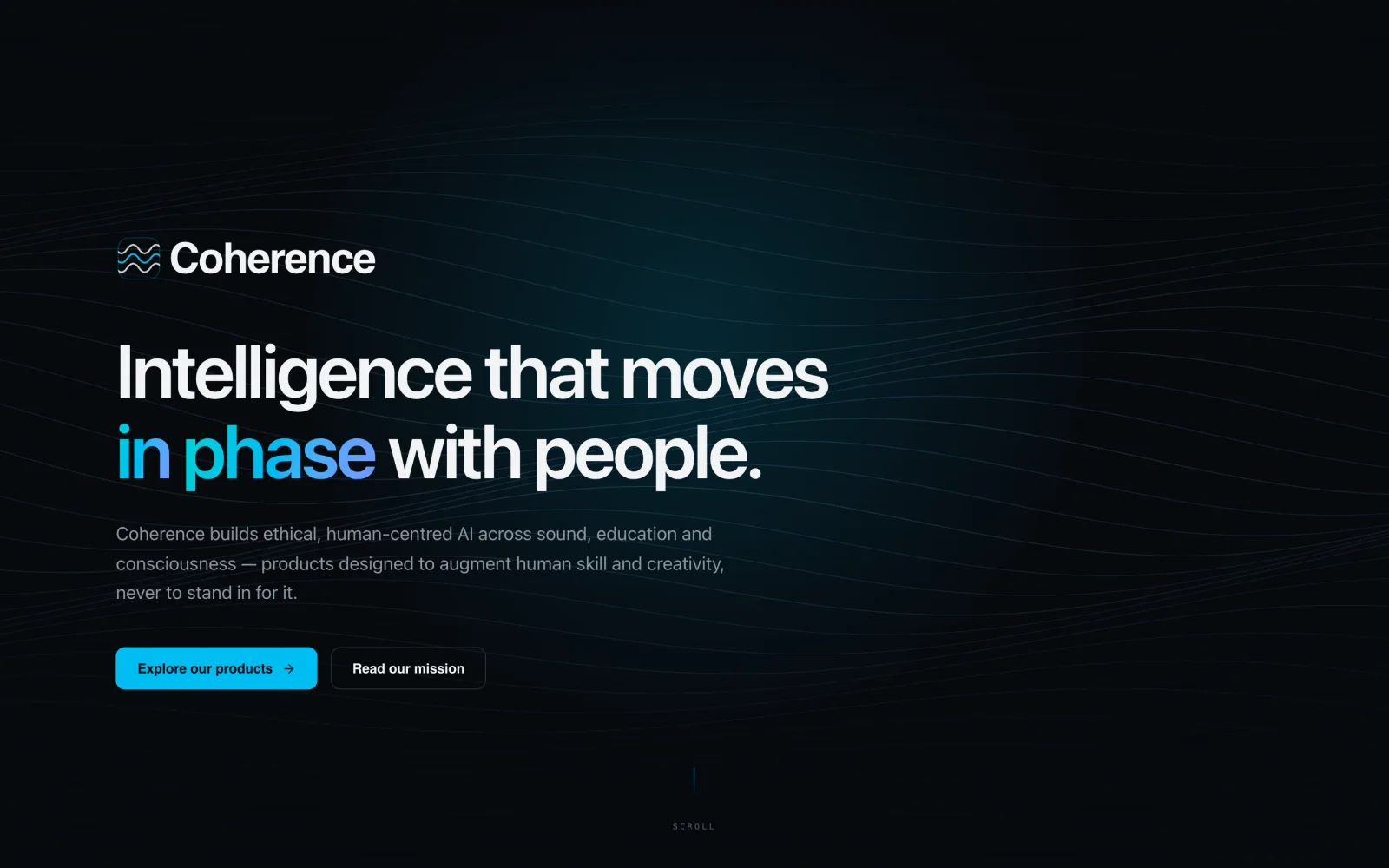
coherence.com on desktop, headed "Intelligence that moves in phase with people".
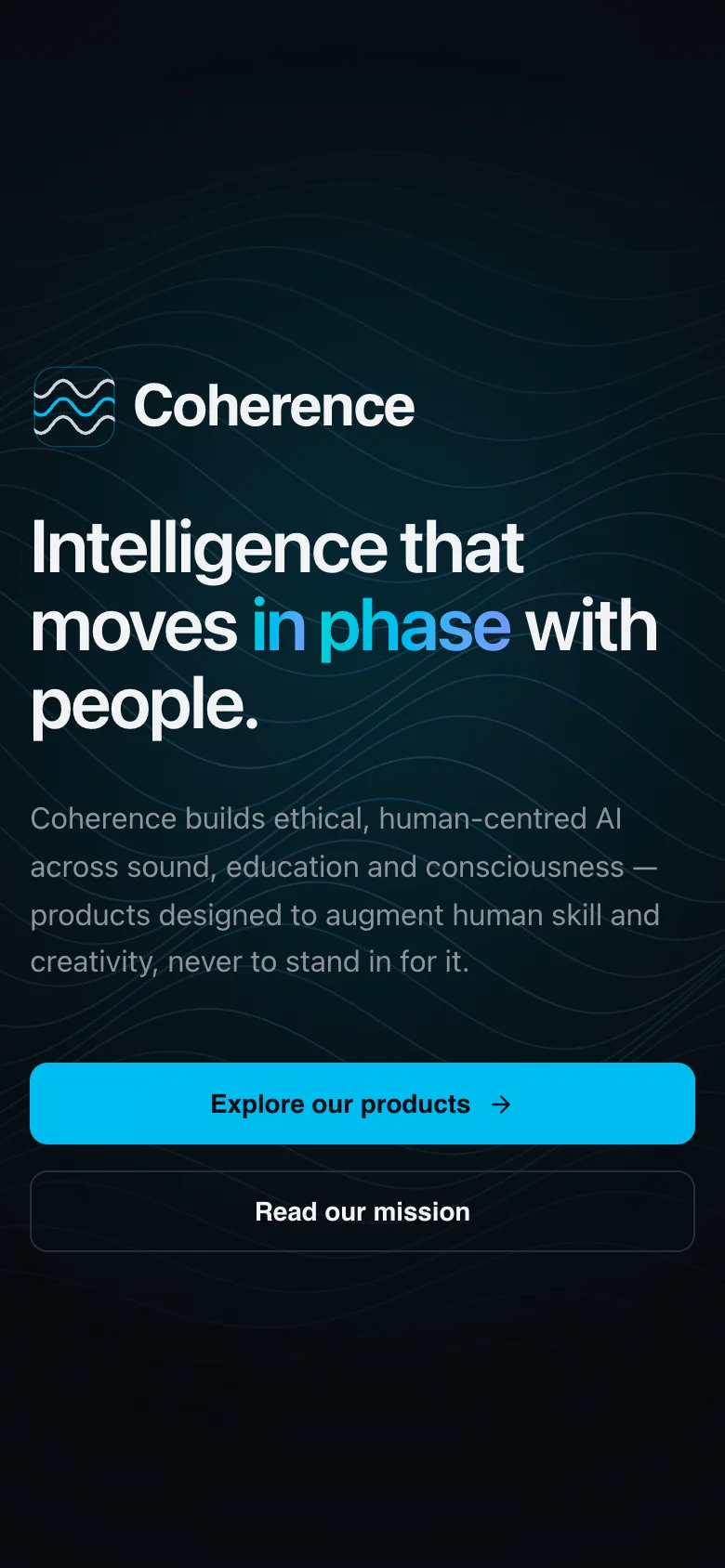
coherence.com on a mobile viewport, reflowed to a single column.
coherence.com — homepage, 1440×900
Live

Coherence

Live at coherence.com: brand identity generated with AI agents we directed, the motion system and website for the group behind Sonora, AboutAI, WakeUp and MudShadows. Agent work remains in build.

What we built
  • Brand identity
  • Motion system
  • Live website
  • Agent work — in build
Read the case study →
The new Domain Booth homepage on desktop: the headline “Premium Domains. Serious Buyers. Proven Results.” beside the animated DB monogram.
The new Domain Booth homepage on a phone, reflowed to a single column.
Our build of the Domain Booth homepage — 1440×900
Live

Domain Booth

Live at domainbooth.com for DomainBooth, a premium domain brokerage: a new animated mark, every page redesigned and rebuilt with designed mobile layouts, and a custom CMS for its sales record, featured names, press and enquiries.

What we built
  • Animated mark
  • Every page redesigned
  • Designed mobile layouts
  • Custom CMS
Read the case study →
Who we have built for

Twenty-one years. Names you know.

Apps, platforms and campaigns for these teams, long before the AI work. Every one is written up on the work page — what we did, and where our part ended.

See all of our work →
  • BBC Good Food logo
  • Charities Aid Foundation logo
  • GAME logo
  • NatWest logo
  • Next logo
  • NSPCC logo
  • Tesco logo
  • Worldpay logo
  • Samsung logo
  • Sony logo
  • Land Rover logo
  • UAP Limited logo
  • Netflix logo
  • Amazon Prime Video logo
  • Mercedes-Benz dealerships logo
  • San Miguel logo
  • Biovene Barcelona logo
  • Seventy7 logo
  • Littlewoods logo
  • Smile logo
  • The Co-operative Bank logo