Dark theme
WELCOME TO QQUANTUM

Let Qubi show you around.

Choose how you’d like to explore.

Don’t agreeGo to yourOS instead ↗

Both choices allow Google Analytics, so we can see which pages help.

Sound is your choice. Essential cookies keep the site working. Continuing either way also allows Google Analytics (visits and pages viewed).

Read our Terms, Privacy and Cookies.

Change your choices anytime from the footer.

Getting Qubi ready.
Infrastructure

AI deployment options:
five places it can run.

This page exists so the decision can be made in one sitting. Each option is described by what it gives you and what it takes, with no recommendation attached — because the right answer genuinely varies and we build all five.

All AI Hosting & Infrastructure →
Pixel illustration for Deployment Options Compared: a route map with several destinations and a hand-held compass.

The comparison

Compare your options
Structural properties of each deployment model. Timelines are ranges we scope to, not measured client outcomes.
Criterion Public API Your cloud Private DC On-premise Air-gapped
Data leaves your perimeter Yes To your own tenancy To your own rack No No
Frontier capability available Yes Yes No No No
Choose the physical location No Region only Yes Yes Yes
Single tenancy No No Yes Yes Yes
Cost shape Per token Per token Fixed Fixed Fixed
Capital outlay None None Leased or owned Owned Owned
Vendor can deprecate your model Yes Yes No No No
Works without an internet link No No No Yes Yes
Operational burden on you None Low Moderate High Highest
Time to first pilot Days Weeks Weeks 4–10 weeks 8–16 weeks

Choosing without an argument

Work down the constraints in this order, and the answer usually falls out before you reach the bottom.

1. Is there a hard rule about where the data may go? A regulation, a customer contract, a classification. If yes, that eliminates options before anything else is considered, and no capability argument overturns it.

2. Does the system have to work without connectivity? A factory floor, a vessel, a remote site, an isolated control network. If yes, you are on-premise or air-gapped and the rest is detail.

3. Is the volume sustained and high? If yes, fixed-cost hosting will beat per-token pricing, and the crossover is worth calculating properly rather than estimating. If the volume is low or spiky, the API wins and will keep winning.

4. Does the workload need frontier capability for every request? Rarely true once tested, and if it is genuinely true then hosted is the answer. If it is true for a minority, that is a routing problem rather than an infrastructure one.

5. Is there anyone to operate it? The question that quietly decides more of these than the other four combined. If there is no team and no budget for managed operation, choose the option with the lowest operational burden that satisfies your constraints — and be honest about it now rather than in eighteen months.

The common answers

Questions

Questions about Deployment Options Compared.

Can we change our mind later?

If the system was built for it, yes and relatively cheaply. That means the model behind an interface, no dependency on a provider-specific feature, prompts and evaluation sets kept portable, and infrastructure defined as code. We build that way by default, because the most common regret we hear about is a system welded to a provider chosen in week one.

Can we mix them?

Most mature deployments do. Local for the bulk and sensitive work, hosted for the hard minority. That is the hybrid routing pattern and it is usually the honest answer to a question phrased as either-or.

Which do most of your clients choose?

We would expect it to split by constraint rather than by preference — regulated and high-volume work toward the controlled end, early-stage and exploratory work toward the hosted end. We would rather set out the trade-offs than tell you what is popular, because popularity is not evidence about your constraints.

Decide it in
one sitting.

Bring the constraints. Five options, a short conversation, and a recommendation we will argue against if you push back well.

30-minute technical call · no deck

Shipped & in build

Real work. Check it yourself.

What we built, what stage it is at, and a link to the live thing wherever there is one.

The updated yourOS homepage: Roxy’s open ring surrounded by bento cards for calls, voice, translation, building, design, apps and more.
The yourOS homepage on a phone, with its compact navigation, welcome film button and bento cards.
youros.tech — the homepage bento hero
Our own · coming soon

yourOS

yourOS is an operating system with an AI at its heart. You talk to it like a person, out loud or typed. It makes your calls, plans your days and works on your projects with a crew of agents, on your own private server. Our own product, built from the first commit; the waitlist is open.

What we built
  • Operating system
  • Roxy
  • Agent crew
  • Voice calls
  • App store
  • Website
Meet yourOS →
The Sonora homepage on desktop: a full-bleed dune landscape behind the headline “Transform Your Life with Sound”, with App Store and Google Play download buttons.
The Sonora homepage on a mobile viewport, showing the same hero reflowed to a single column.
sonora.com — homepage, 1440×900
Live · iOS · Android

Sonora

Website, backend and app assets for Sonora, a free AI sound-therapy app on iOS and Android published by Cognitive AI.

What we built
  • Website
  • Backend
  • App assets
Read the case study →
The updated Podswap homepage on desktop: “Grow on Instagram and TikTok for free, with real engagement from creators your size”, beside a tilted wall of exchange, tool and guide cards on a violet gradient.
The updated Podswap homepage on a phone, with its floating navigation, Instagram and TikTok engagement headline and tilted tool cards.
podswap.app — homepage, 1440×900
Five platforms

Podswap

Brand, website, prototype, apps on five platforms, the AI backend and the algorithm-intelligence pipeline for Podswap, a social growth engine that runs without a human in the loop.

What we built
  • Brand
  • Website
  • Prototype
  • Apps on five platforms
  • AI backend
  • Algorithm pipeline
Read the case study →
The unOpen.AI homepage introducing Roxy, a private AI assistant that remembers who you are.
The unOpen.AI homepage on a mobile viewport.
unopen.ai — homepage, 1440×900
Prototype · closed beta

unOpen.AI

In closed beta: Roxy, a private AI assistant with permanent memory running on infrastructure the user owns. Brand, site, product, backend and conversational design.

What we built
  • Brand
  • Site
  • Product
  • Backend
  • Conversational design
Read the case study →
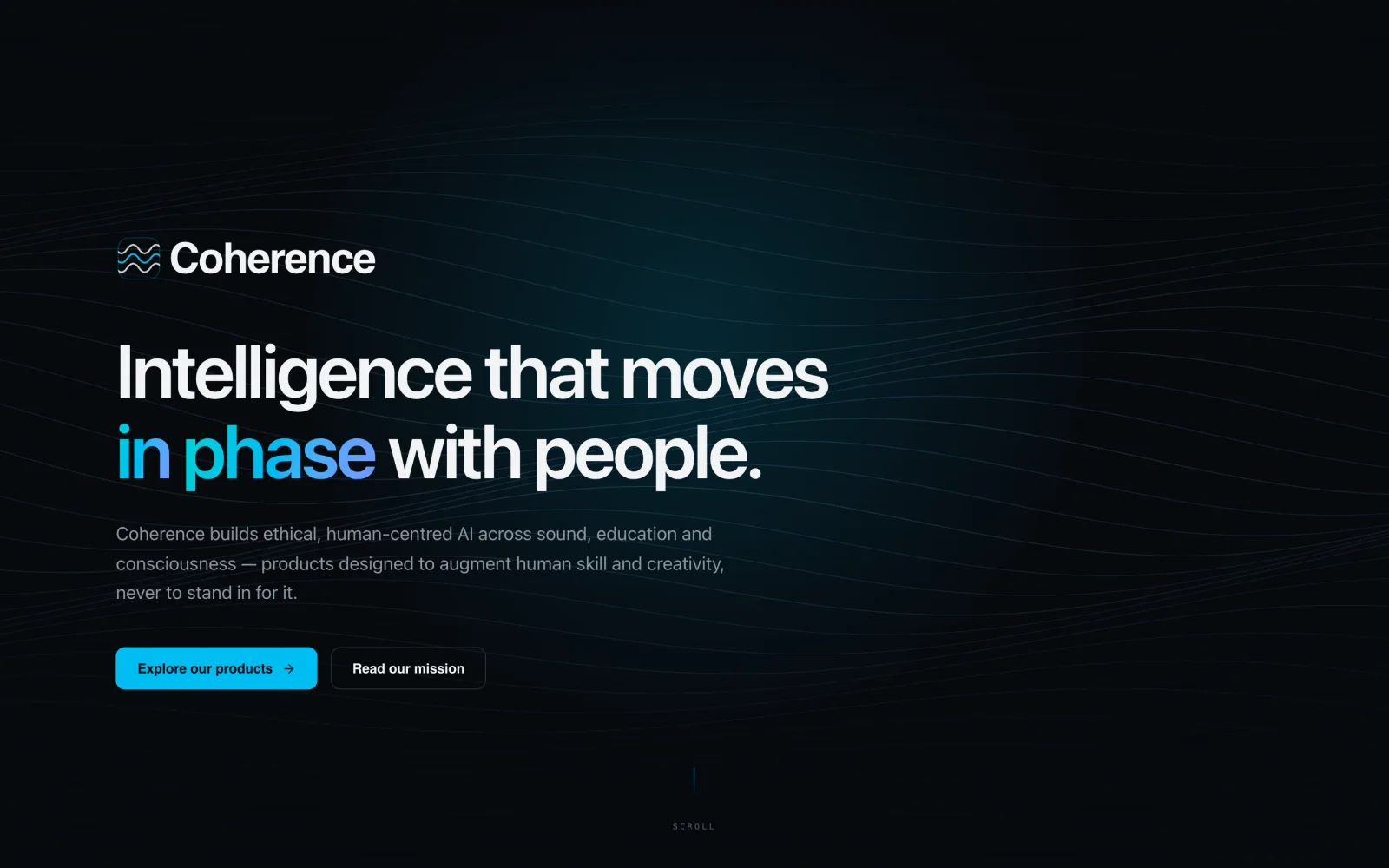
coherence.com on desktop, headed "Intelligence that moves in phase with people".
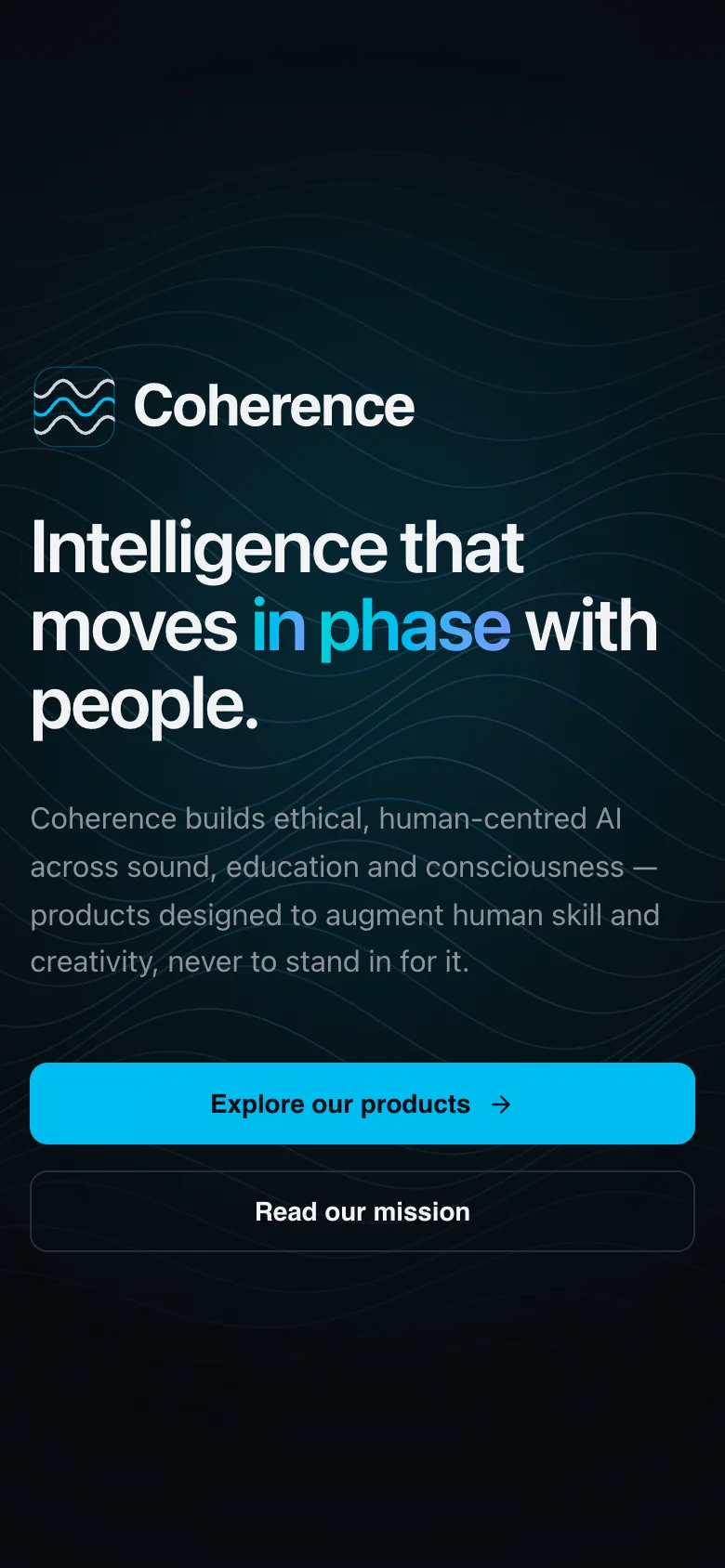
coherence.com on a mobile viewport, reflowed to a single column.
coherence.com — homepage, 1440×900
Live

Coherence

Live at coherence.com: brand identity generated with AI agents we directed, the motion system and website for the group behind Sonora, AboutAI, WakeUp and MudShadows. Agent work remains in build.

What we built
  • Brand identity
  • Motion system
  • Live website
  • Agent work — in build
Read the case study →
The new Domain Booth homepage on desktop: the headline “Premium Domains. Serious Buyers. Proven Results.” beside the animated DB monogram.
The new Domain Booth homepage on a phone, reflowed to a single column.
Our build of the Domain Booth homepage — 1440×900
Live

Domain Booth

Live at domainbooth.com for DomainBooth, a premium domain brokerage: a new animated mark, every page redesigned and rebuilt with designed mobile layouts, and a custom CMS for its sales record, featured names, press and enquiries.

What we built
  • Animated mark
  • Every page redesigned
  • Designed mobile layouts
  • Custom CMS
Read the case study →
Who we have built for

Twenty-one years. Names you know.

Apps, platforms and campaigns for these teams, long before the AI work. Every one is written up on the work page — what we did, and where our part ended.

See all of our work →
  • BBC Good Food logo
  • Charities Aid Foundation logo
  • GAME logo
  • NatWest logo
  • Next logo
  • NSPCC logo
  • Tesco logo
  • Worldpay logo
  • Samsung logo
  • Sony logo
  • Land Rover logo
  • UAP Limited logo
  • Netflix logo
  • Amazon Prime Video logo
  • Mercedes-Benz dealerships logo
  • San Miguel logo
  • Biovene Barcelona logo
  • Seventy7 logo
  • Littlewoods logo
  • Smile logo
  • The Co-operative Bank logo