Dark theme
WELCOME TO QQUANTUM

Let Qubi show you around.

Choose how you’d like to explore.

Don’t agreeGo to yourOS instead ↗

Both choices allow Google Analytics, so we can see which pages help.

Sound is your choice. Essential cookies keep the site working. Continuing either way also allows Google Analytics (visits and pages viewed).

Read our Terms, Privacy and Cookies.

Change your choices anytime from the footer.

Getting Qubi ready.
Model families

Small language models.
The case for smaller.

Most production AI work is not hard. It is classification, extraction, routing and rewriting, at volume, against a fixed schema. Sending that to a frontier model is the most common expensive default in the field, and it is often a short piece of work to fix.

All Model Families →
Pixel illustration for Small Language Models: a tiny model mechanism under a large inspection lens.

Specification

Size range
Roughly 1B to 14B parameters — the class that fits on one accelerator, often with room to spare
Families
Llama, Qwen, Mistral, Gemma, Phi, and distillations of larger reasoning models
Hardware
A single GPU serves a substantial number of concurrent users; the lower sizes run on CPU at usable speeds for batch work
Cost against a frontier API
One to two orders of magnitude lower per token, and fixed rather than usage-linked once self-hosted
Suited to
Fixed-schema extraction, classification, routing, reranking, and any path where latency is felt by a user
Not suited to
Multi-step agentic work, open-ended reasoning over long context, and holding many simultaneous constraints

Provider-published specifications as of 1 September 2026, not figures we measured. Model families move quickly — check the provider's own documentation before committing to a number.

What counts as small

Roughly, anything from one to fourteen billion parameters — the range that fits on a single accelerator, often with room to spare, and in the lower half runs acceptably on a CPU. Every major family ships in this class: Llama, Qwen, Mistral, Gemma, Phi and the distilled variants of larger reasoning models.

The interesting property is not that they are cheap, though they are, by one to two orders of magnitude per token against a frontier API. It is that they are local. A model that fits on one GPU can run inside your building, at the edge, on a laptop, or in a container next to the service that calls it — with no network hop, no per-token bill and no third party in the data path. That changes what is architecturally possible, not just what it costs.

Where they win outright

01

Fixed-schema extraction

Pulling defined fields out of a document into a known structure. The task is bounded, the output is validated downstream, and a small model fine-tuned on a few thousand of your own examples can match a frontier model on it.
02

Classification and routing

Deciding which queue, which team, which template, which model. High volume, narrow decision space, and a place where latency is felt directly by a user. This is the single highest-value small-model deployment in most organisations.
03

Reranking and filtering

Sitting between retrieval and generation to reorder candidates. Called many times per request, which makes unit cost dominate and makes a frontier model structurally unaffordable in the slot.
04

Anywhere latency is the product

Autocomplete, inline suggestion, real-time moderation. A small local model answers in the time a network round trip to an API would still be in flight, and users experience that difference as quality.

Where they stop being enough

  • Multi-step agentic work.

    Holding a plan across many tool calls, recovering sensibly when one fails, and not losing the thread halfway through is where the capability gap is still wide and obvious. Small models can execute a step; they are much less reliable at owning a sequence.
  • Open-ended reasoning over long context.

    Synthesis across a large document set, or any task where the shape of the answer is not known in advance. The gap narrows every release and it has not closed.
  • Instruction adherence under many simultaneous constraints.

    Hold this schema, in this tone, within this policy, across a long interaction. Frontier models are noticeably better at not dropping one of the four.

The practical architecture that follows is a ladder, not a choice: a small model handles the bulk, a gate detects the requests it should not have taken, and those escalate. Building that gate well is the actual engineering, and it is covered on hybrid model routing.

Questions

Questions about Small Language Models.

How do we know a small model is good enough for a task?

You build an evaluation set from real examples of that task — a few hundred is usually enough to be decisive — and run both. It is a day or two of work and it settles the question with evidence instead of instinct. In our experience, more of the workload typically moves down than teams expect.

Do we need to fine-tune?

Often not. A well-designed prompt plus a few examples closes most of the gap on a bounded task. Fine-tune when you have a stable task, a few thousand labelled examples, and a measured gap that prompting has not closed — in that order.

What does it cost to run one?

A single accelerator will serve a small model to a substantial number of concurrent users, and the smallest run on CPU for batch work. The cost conversation moves from per-token to per-hour, which is exactly what makes high-volume workloads viable — the bill stops scaling with usage.

Is this just cost-cutting?

Cost is the visible benefit and rarely the important one. The important one is that a model small enough to run on your own hardware removes the third party from the data path entirely, which removes the third-party-processor part of the governance conversation.

Move the bulk
down a rung.

We measure which request classes a small model handles identically, then build the gate for the ones it does not.

30-minute technical call · no deck

Shipped & in build

Real work. Check it yourself.

What we built, what stage it is at, and a link to the live thing wherever there is one.

The updated yourOS homepage: Roxy’s open ring surrounded by bento cards for calls, voice, translation, building, design, apps and more.
The yourOS homepage on a phone, with its compact navigation, welcome film button and bento cards.
youros.tech — the homepage bento hero
Our own · coming soon

yourOS

yourOS is an operating system with an AI at its heart. You talk to it like a person, out loud or typed. It makes your calls, plans your days and works on your projects with a crew of agents, on your own private server. Our own product, built from the first commit; the waitlist is open.


What we built
  • Operating system
  • Roxy
  • Agent crew
  • Voice calls
  • App store
  • Website
Meet yourOS →
The Sonora homepage on desktop: a full-bleed dune landscape behind the headline “Transform Your Life with Sound”, with App Store and Google Play download buttons.
The Sonora homepage on a mobile viewport, showing the same hero reflowed to a single column.
sonora.com — homepage, 1440×900
Live · iOS · Android

Sonora

Website, backend and app assets for Sonora, a free AI sound-therapy app on iOS and Android published by Cognitive AI.

What we built
  • Website
  • Backend
  • App assets
Read the case study →
The updated Podswap homepage on desktop: “Grow on Instagram and TikTok for free, with real engagement from creators your size”, beside a tilted wall of exchange, tool and guide cards on a violet gradient.
The updated Podswap homepage on a phone, with its floating navigation, Instagram and TikTok engagement headline and tilted tool cards.
podswap.app — homepage, 1440×900
Five platforms

Podswap

Brand, website, prototype, apps on five platforms, the AI backend and the algorithm-intelligence pipeline for Podswap, a social growth engine that runs without a human in the loop.

What we built
  • Brand
  • Website
  • Prototype
  • Apps on five platforms
  • AI backend
  • Algorithm pipeline
Read the case study →
The unOpen.AI homepage introducing Roxy, a private AI assistant that remembers who you are.
The unOpen.AI homepage on a mobile viewport.
unopen.ai — homepage, 1440×900
Prototype · closed beta

unOpen.AI

In closed beta: Roxy, a private AI assistant with permanent memory running on infrastructure the user owns. Brand, site, product, backend and conversational design.

What we built
  • Brand
  • Site
  • Product
  • Backend
  • Conversational design
Read the case study →
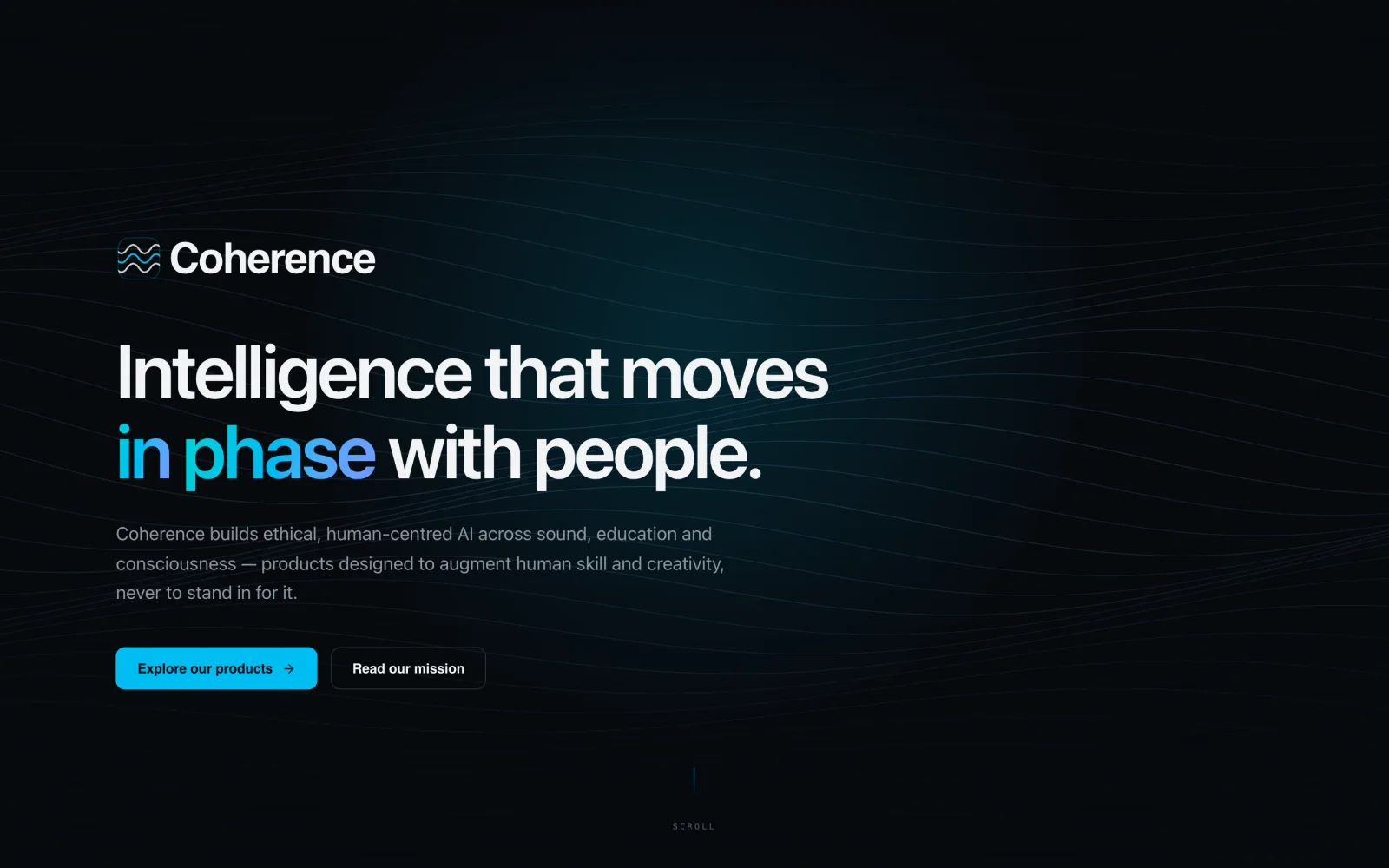
coherence.com on desktop, headed "Intelligence that moves in phase with people".
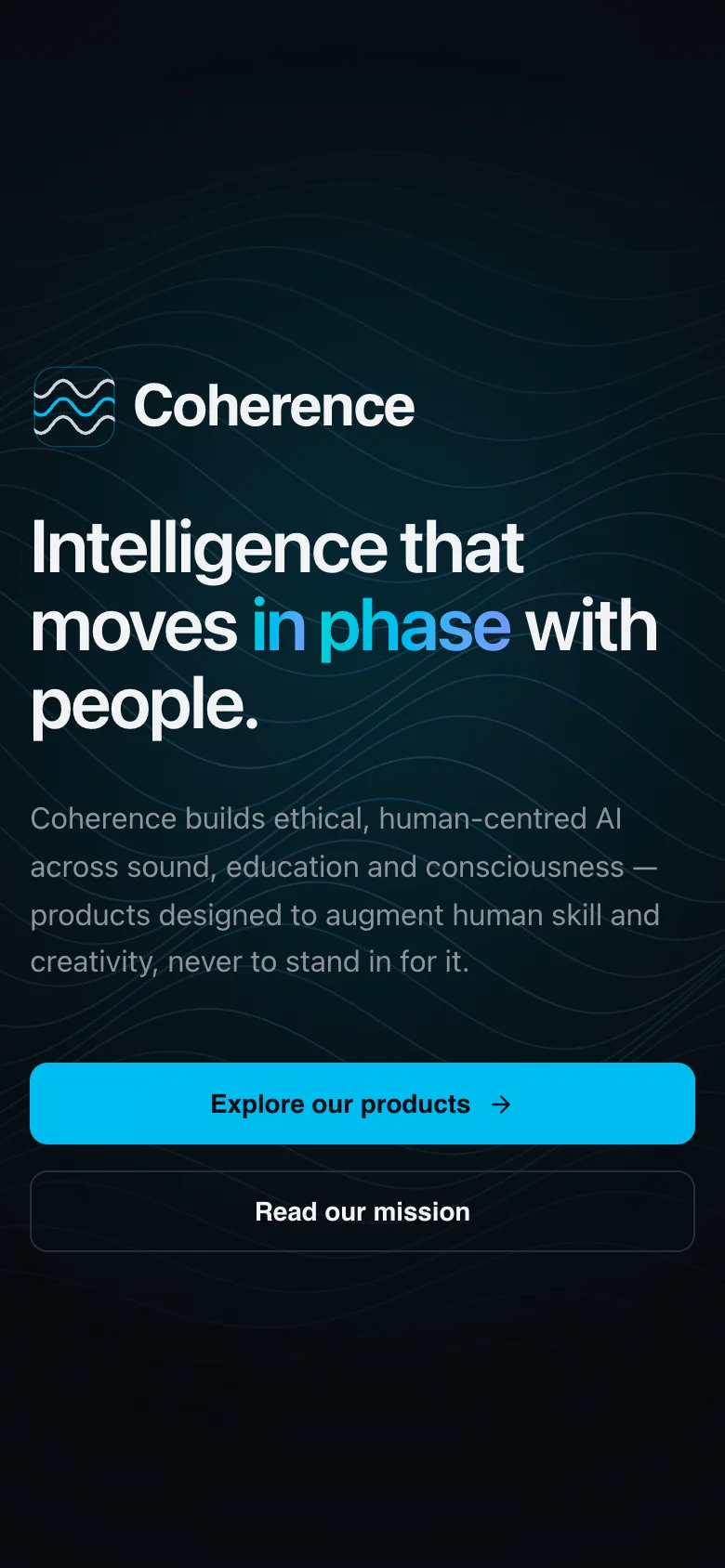
coherence.com on a mobile viewport, reflowed to a single column.
coherence.com — homepage, 1440×900
Live

Coherence

Live at coherence.com: brand identity generated with AI agents we directed, the motion system and website for the group behind Sonora, AboutAI, WakeUp and MudShadows. Agent work remains in build.

What we built
  • Brand identity
  • Motion system
  • Live website
  • Agent work — in build
Read the case study →
The new Domain Booth homepage on desktop: the headline “Premium Domains. Serious Buyers. Proven Results.” beside the animated DB monogram.
The new Domain Booth homepage on a phone, reflowed to a single column.
Our build of the Domain Booth homepage — 1440×900
Live

Domain Booth

Live at domainbooth.com for DomainBooth, a premium domain brokerage: a new animated mark, every page redesigned and rebuilt with designed mobile layouts, and a custom CMS for its sales record, featured names, press and enquiries.

What we built
  • Animated mark
  • Every page redesigned
  • Designed mobile layouts
  • Custom CMS
Read the case study →
Who we have built for

Twenty-one years. Names you know.

Apps, platforms and campaigns for these teams, long before the AI work. Every one is written up on the work page — what we did, and where our part ended.

See all of our work →
  • BBC Good Food logo
  • Charities Aid Foundation logo
  • GAME logo
  • NatWest logo
  • Next logo
  • NSPCC logo
  • Tesco logo
  • Worldpay logo
  • Samsung logo
  • Sony logo
  • Land Rover logo
  • UAP Limited logo
  • Netflix logo
  • Amazon Prime Video logo
  • Mercedes-Benz dealerships logo
  • San Miguel logo
  • Biovene Barcelona logo
  • Seventy7 logo
  • Littlewoods logo
  • Smile logo
  • The Co-operative Bank logo