Dark theme
WELCOME TO QQUANTUM

Let Qubi show you around.

Choose how you’d like to explore.

Don’t agreeGo to yourOS instead ↗

Both choices allow Google Analytics, so we can see which pages help.

Sound is your choice. Essential cookies keep the site working. Continuing either way also allows Google Analytics (visits and pages viewed).

Read our Terms, Privacy and Cookies.

Change your choices anytime from the footer.

Getting Qubi ready.
Quantum computing

Post-quantum
cryptography.

Everything else in this section is a watch item. This one is not. Data encrypted today with today's public-key algorithms can be captured now and decrypted later, which means the exposure window for anything with a long confidentiality life opened some time ago.

  • NIST standards published 2024
  • Migration measured in years
Last reviewed 4 September 2026 · Engineering guidance, not legal advice.
All Quantum Computing →
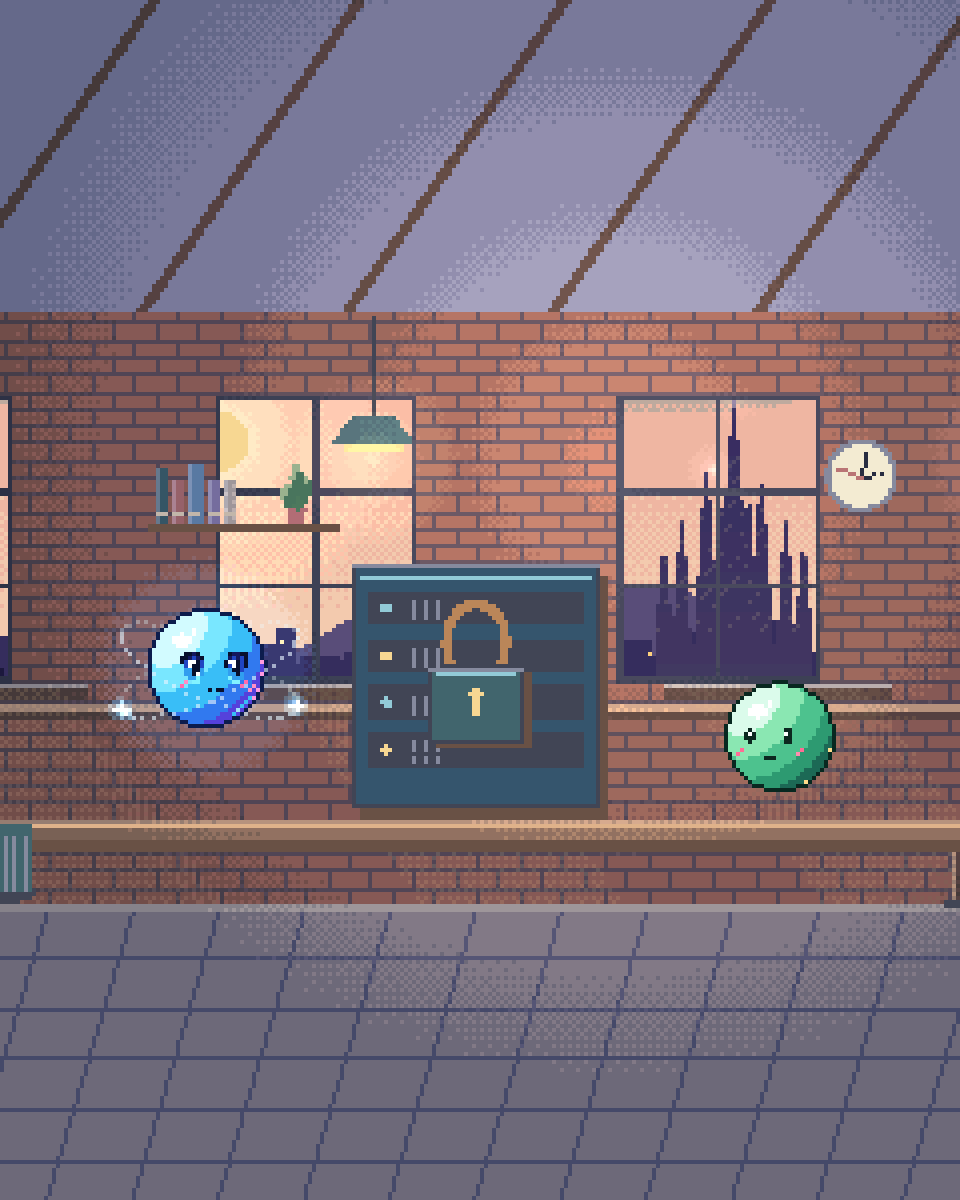
Pixel illustration for Post-Quantum Cryptography: a closed lock protecting a document vault.

Harvest now, decrypt later

The threat model is simple enough to explain to a board in two sentences. An adversary with storage and patience intercepts encrypted traffic today and keeps it. When a cryptographically relevant quantum computer exists, they decrypt it.

What that means practically is that the relevant question is not when will quantum computers break RSA. It is how long does our data need to stay confidential. If the answer is a decade or more — medical records, government material, legal files, trade secrets, long-term contracts, biometric data that cannot be reissued — then your exposure is already live regardless of what date the machine arrives. Waiting for certainty about the date is choosing to be exposed for the interval.

The algorithms at risk are the public-key ones: RSA, and the elliptic-curve algorithms underpinning most key exchange and digital signatures on the internet today. Symmetric encryption such as AES is affected far less severely — the practical guidance there is to use longer keys rather than to replace the algorithm.

What replaces them

NIST completed the first round of its standardisation process and published three final standards in August 2024. Unlike most of this subject, these are settled, implementable and shipping in mainstream libraries.

FIPS 203 — ML-KEM, a lattice-based key-encapsulation mechanism derived from CRYSTALS-Kyber, for establishing shared keys. This is the one that matters for the harvest-now problem, because it protects the confidentiality of traffic.

FIPS 204 — ML-DSA, a lattice-based digital signature scheme derived from CRYSTALS-Dilithium, and the general-purpose signature standard.

FIPS 205 — SLH-DSA, a stateless hash-based signature scheme derived from SPHINCS+. Larger and slower, and valuable precisely because its security rests on different mathematical assumptions — a hedge in case the lattice family is weakened.

NIST's draft transition guidance deprecates the algorithms offering roughly 112 bits of classical security — RSA-2048 among them — around 2030, and disallows all quantum-vulnerable public-key algorithms, including ECC P-256, by 2035. Further schemes are following the first three standards. Government deadlines in various jurisdictions sit inside that window. For a large estate, a migration of this kind runs two to five years, which is what makes 2030 a near date rather than a distant one.
What hybrid mode actually does

HYBRID KEY EXCHANGE
  1. 01
    Client hello

    offers both algorithms

  2. 02
    Classical KEM

    elliptic curve, as today

  3. 03
    ML-KEM

    FIPS 203, lattice-based

  4. 04
    Combine

    both secrets, one key

  5. 05
    Session

    secure unless BOTH break

  6. 06 · Branch / escalation
    Fallback path

    retire it, or it is your exposure

Solid: the hybrid handshakeDashed: the classical-only path that must eventually be removed
Hybrid is not a halfway house. An attacker has to break the classical algorithm AND the lattice one, which guards against undiscovered weaknesses in the newer scheme.

How a migration actually goes

  1. PHASE 01

    Cryptographic inventory

    Find every place you use public-key cryptography: TLS termination, VPNs, code signing, document signing, database encryption, hardware security modules, embedded devices, and every third-party dependency that does any of these on your behalf. This is the hard phase and almost nobody has a complete answer at the start.

  2. PHASE 02

    Classify by data lifetime

    Rank systems by how long their data must stay confidential and how hard they are to change. Long-lived confidentiality plus long replacement cycles — embedded devices, archives, signed records — goes first, because those are the ones where waiting is most expensive.

  3. PHASE 03

    Hybrid deployment

    Deploy classical and post-quantum algorithms together, so a weakness in either leaves you protected by the other. This is current best practice rather than a transitional compromise, and major browsers and libraries already support it for key exchange.

  4. PHASE 04

    Crypto-agility

    Refactor so the algorithm is a configuration rather than an assumption baked into code. The genuine long-term deliverable: this will not be the last migration, and organisations that build agility now pay for the next one at a fraction of the cost.

  5. PHASE 05

    Retire the vulnerable

    Remove classical-only paths once the estate supports the replacements. Verification matters here — a deprecated algorithm still reachable through a fallback is still an exposure.

Where this touches ai

Directly, in two places worth naming. First, an AI system is usually a large aggregation point: retrieval indexes, embeddings and logs concentrate data that was previously scattered across systems, which makes the transport and storage protecting them a higher-value target than any individual source. Second, model weights and training data are themselves long-lived confidential assets — a proprietary fine-tune captured in transit today has a decade of value to an adversary.

The practical implication is unremarkable and easy to act on: when you build AI infrastructure now, include it in the cryptographic inventory from the start and prefer hybrid key exchange where your stack supports it. It is a configuration decision at build time and an expensive retrofit later. It is also, incidentally, one more argument for keeping the data path short — a system that never transmits data outside your building has a much smaller surface for anyone to harvest in the first place.

Questions

Questions about Post-Quantum Cryptography.

How urgent is this really?

The inventory is urgent; the full migration is a multi-year programme you should be planning rather than panicking about. The test is your data lifetime: if nothing you protect needs to stay confidential beyond a couple of years, you have time. If you hold medical, legal, governmental or trade-secret material, the harvest-now exposure is live today and we would suggest starting the inventory now.

Can we just wait for our vendors?

Partly, and not entirely. Your TLS libraries, browsers and cloud providers will handle a great deal of this for you, and that is genuine leverage. What no vendor can do for you is find the places your own systems and processes depend on public-key cryptography — code signing, document archives, embedded devices, bespoke integrations. That inventory is irreducibly yours.

What is hybrid mode and why use it?

Running a classical and a post-quantum algorithm together so that breaking the channel requires breaking both. It guards against the possibility that the newer algorithms have undiscovered weaknesses — a reasonable concern for schemes that have had far less cryptanalytic attention than RSA. It is the current default recommendation, not a halfway house.

Do you do this work?

We build AI systems, and we make sure the ones we build are crypto-agile and inventoried. A full enterprise cryptographic migration is a specialist security engagement and we would introduce you to people who do it properly rather than pretend it is adjacent to what we do.

Start with the
inventory.

It is the cheapest step and the one everything else depends on. We build the AI systems we deliver to be crypto-agile.

30-minute technical call · no deck

Shipped & in build

Real work. Check it yourself.

What we built, what stage it is at, and a link to the live thing wherever there is one.

The updated yourOS homepage: Roxy’s open ring surrounded by bento cards for calls, voice, translation, building, design, apps and more.
The yourOS homepage on a phone, with its compact navigation, welcome film button and bento cards.
youros.tech — the homepage bento hero
Our own · coming soon

yourOS

yourOS is an operating system with an AI at its heart. You talk to it like a person, out loud or typed. It makes your calls, plans your days and works on your projects with a crew of agents, on your own private server. Our own product, built from the first commit; the waitlist is open.

What we built
  • Operating system
  • Roxy
  • Agent crew
  • Voice calls
  • App store
  • Website
Meet yourOS →
The Sonora homepage on desktop: a full-bleed dune landscape behind the headline “Transform Your Life with Sound”, with App Store and Google Play download buttons.
The Sonora homepage on a mobile viewport, showing the same hero reflowed to a single column.
sonora.com — homepage, 1440×900
Live · iOS · Android

Sonora

Website, backend and app assets for Sonora, a free AI sound-therapy app on iOS and Android published by Cognitive AI.

What we built
  • Website
  • Backend
  • App assets
Read the case study →
The updated Podswap homepage on desktop: “Grow on Instagram and TikTok for free, with real engagement from creators your size”, beside a tilted wall of exchange, tool and guide cards on a violet gradient.
The updated Podswap homepage on a phone, with its floating navigation, Instagram and TikTok engagement headline and tilted tool cards.
podswap.app — homepage, 1440×900
Five platforms

Podswap

Brand, website, prototype, apps on five platforms, the AI backend and the algorithm-intelligence pipeline for Podswap, a social growth engine that runs without a human in the loop.

What we built
  • Brand
  • Website
  • Prototype
  • Apps on five platforms
  • AI backend
  • Algorithm pipeline
Read the case study →
The unOpen.AI homepage introducing Roxy, a private AI assistant that remembers who you are.
The unOpen.AI homepage on a mobile viewport.
unopen.ai — homepage, 1440×900
Prototype · closed beta

unOpen.AI

In closed beta: Roxy, a private AI assistant with permanent memory running on infrastructure the user owns. Brand, site, product, backend and conversational design.

What we built
  • Brand
  • Site
  • Product
  • Backend
  • Conversational design
Read the case study →
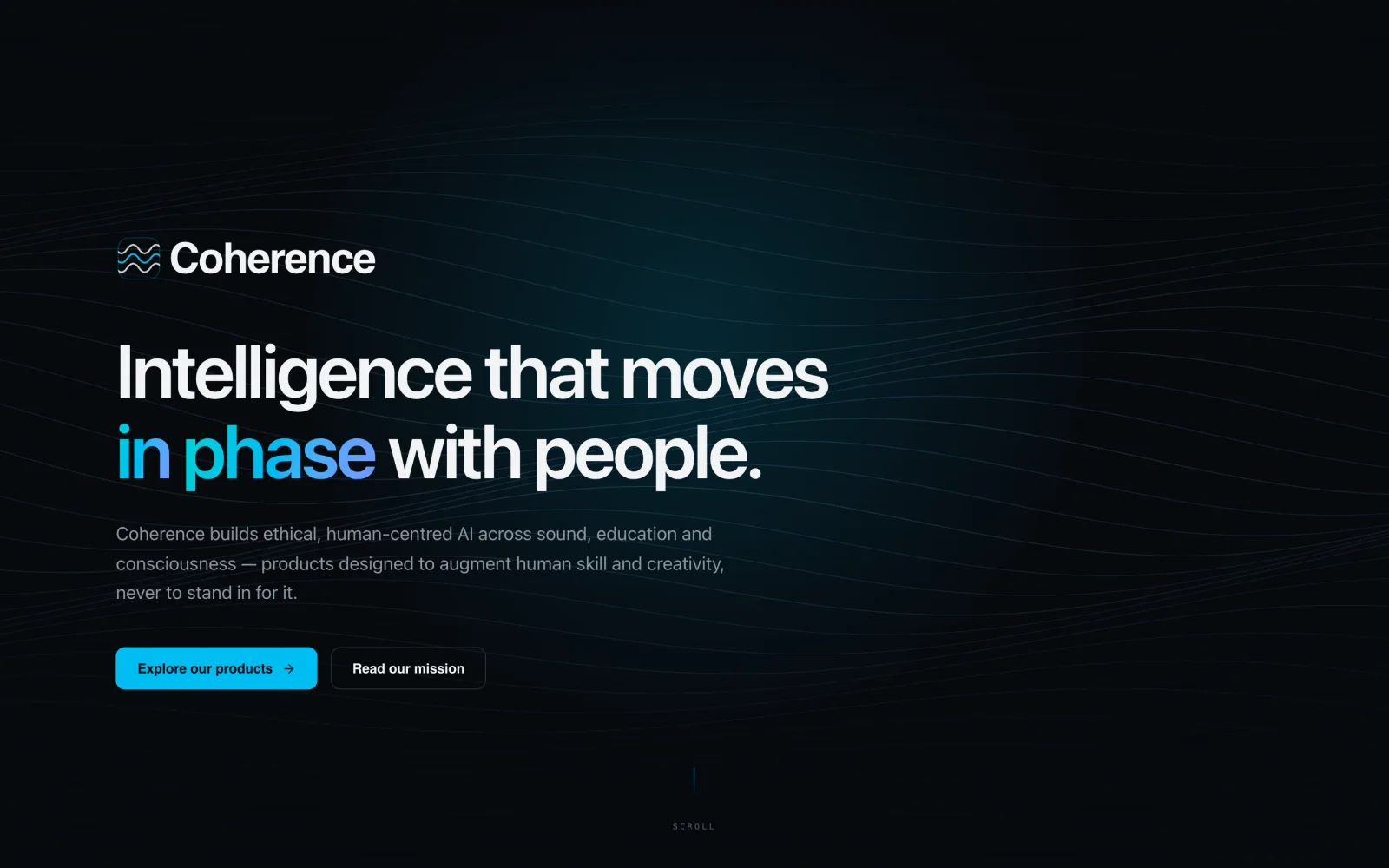
coherence.com on desktop, headed "Intelligence that moves in phase with people".
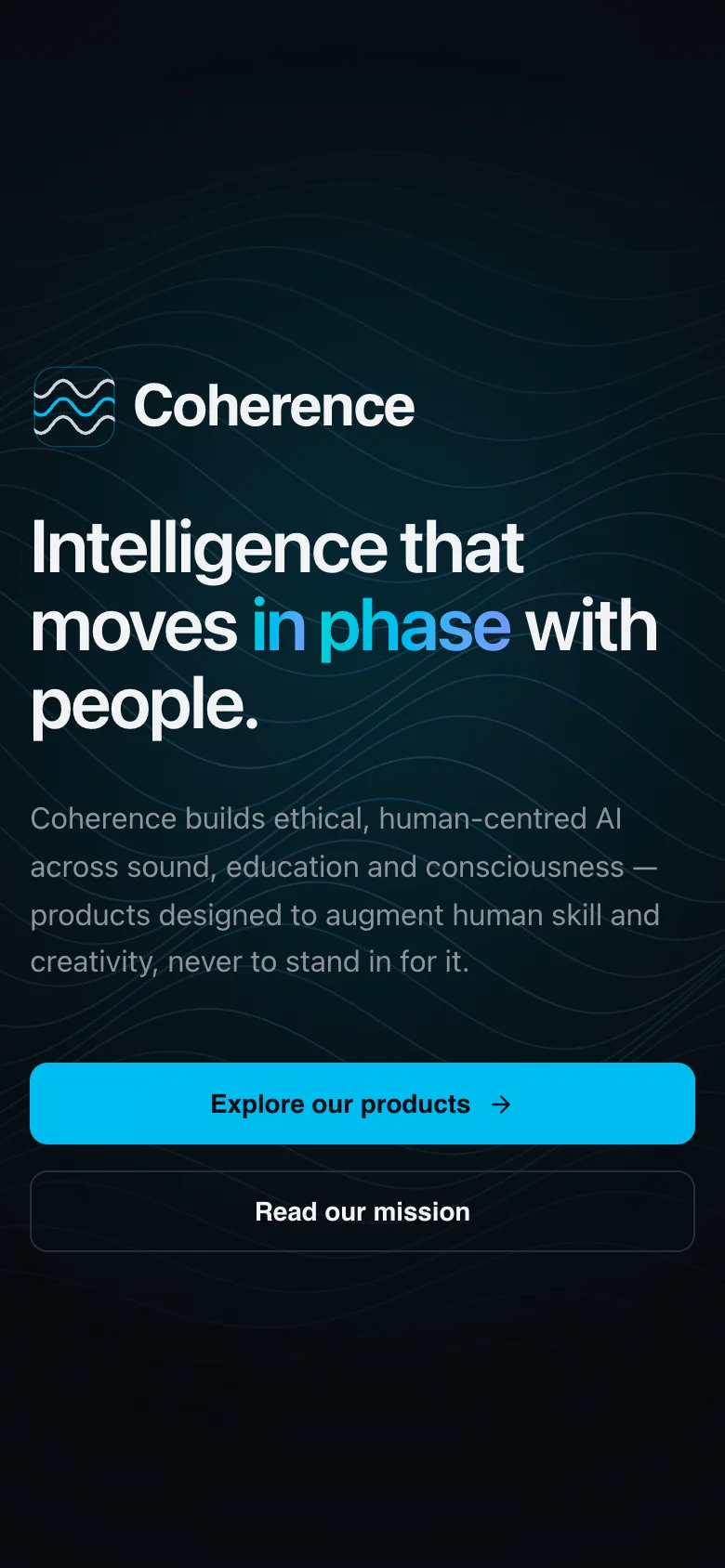
coherence.com on a mobile viewport, reflowed to a single column.
coherence.com — homepage, 1440×900
Live

Coherence

Live at coherence.com: brand identity generated with AI agents we directed, the motion system and website for the group behind Sonora, AboutAI, WakeUp and MudShadows. Agent work remains in build.

What we built
  • Brand identity
  • Motion system
  • Live website
  • Agent work — in build
Read the case study →
The new Domain Booth homepage on desktop: the headline “Premium Domains. Serious Buyers. Proven Results.” beside the animated DB monogram.
The new Domain Booth homepage on a phone, reflowed to a single column.
Our build of the Domain Booth homepage — 1440×900
Live

Domain Booth

Live at domainbooth.com for DomainBooth, a premium domain brokerage: a new animated mark, every page redesigned and rebuilt with designed mobile layouts, and a custom CMS for its sales record, featured names, press and enquiries.

What we built
  • Animated mark
  • Every page redesigned
  • Designed mobile layouts
  • Custom CMS
Read the case study →
Who we have built for

Twenty-one years. Names you know.

Apps, platforms and campaigns for these teams, long before the AI work. Every one is written up on the work page — what we did, and where our part ended.

See all of our work →
  • BBC Good Food logo
  • Charities Aid Foundation logo
  • GAME logo
  • NatWest logo
  • Next logo
  • NSPCC logo
  • Tesco logo
  • Worldpay logo
  • Samsung logo
  • Sony logo
  • Land Rover logo
  • UAP Limited logo
  • Netflix logo
  • Amazon Prime Video logo
  • Mercedes-Benz dealerships logo
  • San Miguel logo
  • Biovene Barcelona logo
  • Seventy7 logo
  • Littlewoods logo
  • Smile logo
  • The Co-operative Bank logo