LEG.01
Contract Review
Clause extraction and deviation detection against your playbook, with the source span shown for every finding.
Open pageReview, research and discovery, built so that every finding links to the span it came from and the judgement stays with a lawyer. An uncited proposition is worse than no answer at all.

Legal work is governed by language, which makes it a natural fit for language models and an unforgiving one. We build retrieval-grounded systems over your own corpus — contracts, precedent, briefs, licensed authority — so that answers are generated only from retrieved passages and every claim links to the span it came from. A lawyer starts from candidate issues with the evidence in front of them rather than from the whole document.
That does not make hallucination impossible; no architecture does. It makes an unsupported claim visible, because it has no citation, and it makes a citation that does not resolve structurally unable to reach a user. A real passage can still be misread, which is why the span is shown and the proposition is read at source. The judgement stays with a lawyer.
Citation-enforced retrieval over your matter history and licensed authority, where a citation that does not resolve cannot reach the user and every proposition links to the passage it rests on.
SEE RAG SYSTEMS →Review of NDAs, MSAs and DPAs against your own playbook, reporting each deviation with the position, the quoted language and the exact span, for a lawyer to confirm or dismiss.
SEE CONTRACT REVIEW →On-premise or sovereign-cloud deployment, so client litigation data has no route to a public endpoint and cannot reach a third party's training data. That is a property of the network topology rather than a promise.
SEE SECURE PIPELINES →Extraction of change-of-control provisions and financial liabilities across data rooms containing tens of thousands of PDFs, each finding anchored to its page, for the deal team to review.
SEE WORKFLOW AUTOMATION →These are engineering controls we build into the architecture, not certifications. QQuantum.ai holds no security certifications, and whether privilege is preserved in a given deployment is a question for your counsel — see our trust centre.
Clause extraction and deviation detection against your playbook, with the source span shown for every finding.
Open pageReview at document volumes where sampling is the only defensible method, and the defensibility is the deliverable.
Open pageRetrieval over authority where an uncited proposition is worse than no answer at all.
Open pageWe build retrieval-grounded systems over your own corpus. Instead of generating answers from model memory, the system retrieves passages from your indexed contracts, briefs and licensed authority, and every claim links to the passage it came from. That does not make hallucination impossible — no architecture does — but it makes it visible: an unsupported claim has no citation, and a citation that does not resolve is blocked before it reaches a user. A real passage can still be misread, which is why the span is shown for the lawyer to check.
On an on-premise or sovereign-cloud deployment, client litigation data has no egress path — it is not sent to public endpoints and is not used to train public models. That is a property of the network topology. Whether privilege is preserved in how a review is conducted is a legal question for your firm, and we design the deployment so it does not get in the way of that answer.
Review NDAs, MSAs and DPAs against your own playbook, flag clauses that deviate from your stated positions, extract change-of-control and liability provisions in a data room, and retrieve authority with a citation that resolves. The judgement stays with a lawyer — what changes is that they start from candidate issues with the evidence attached rather than from the whole document.
Yes. Purpose-built extraction pipelines process data rooms containing tens of thousands of PDFs, surfacing change-of-control provisions, liabilities and anomalous terms with a source citation on each finding. How much associate time that compresses depends on the data room; we measure it on a sample before quoting rather than promising hours in place of weeks.
Start with an architecture review of your review, research or discovery workflow — and the positions your team already holds.
30-minute technical call · no deck
What we built, what stage it is at, and a link to the live thing wherever there is one.


yourOS is an operating system with an AI at its heart. You talk to it like a person, out loud or typed. It makes your calls, plans your days and works on your projects with a crew of agents, on your own private server. Our own product, built from the first commit; the waitlist is open.


Website, backend and app assets for Sonora, a free AI sound-therapy app on iOS and Android published by Cognitive AI.


Brand, website, prototype, apps on five platforms, the AI backend and the algorithm-intelligence pipeline for Podswap, a social growth engine that runs without a human in the loop.


In closed beta: Roxy, a private AI assistant with permanent memory running on infrastructure the user owns. Brand, site, product, backend and conversational design.
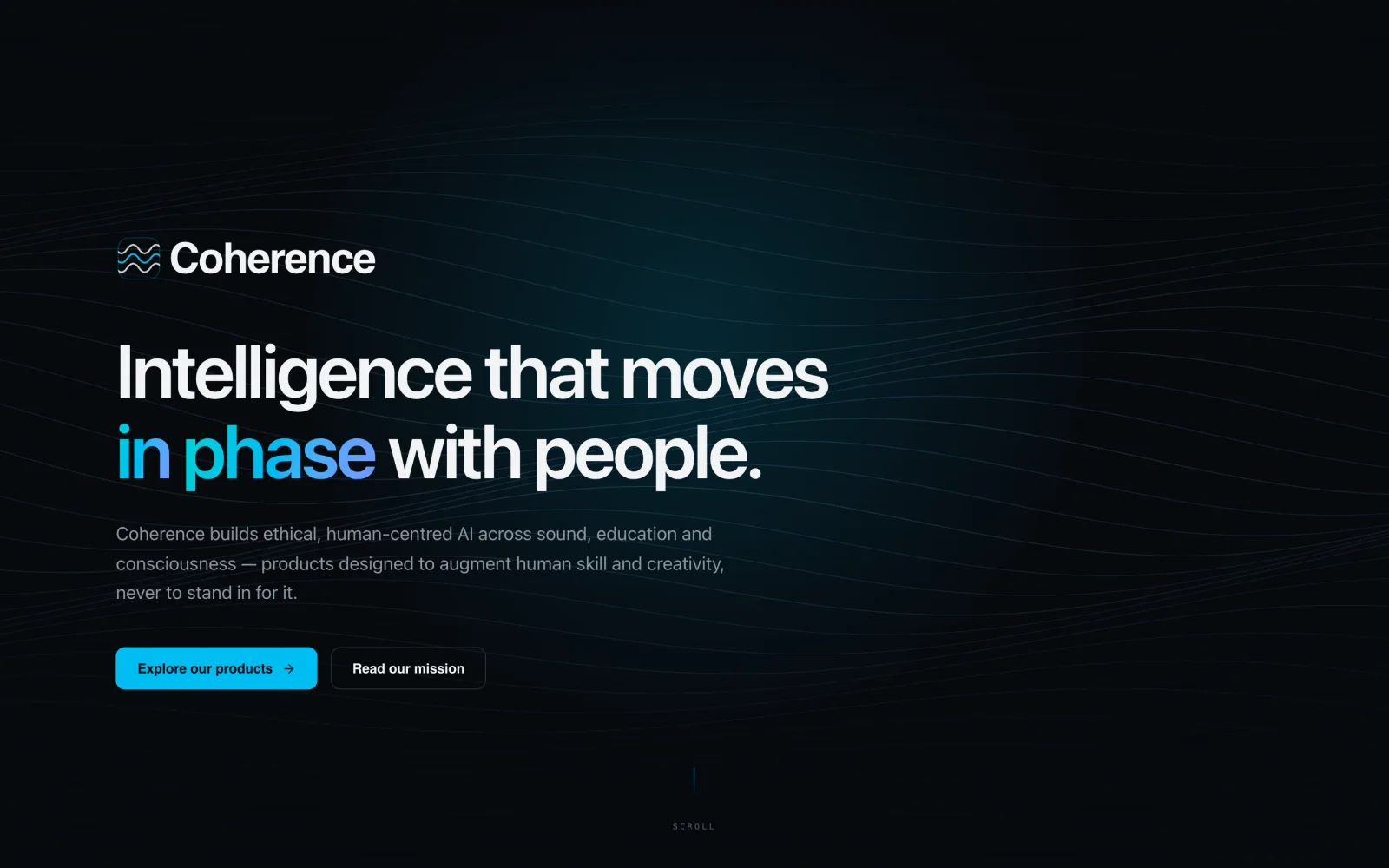
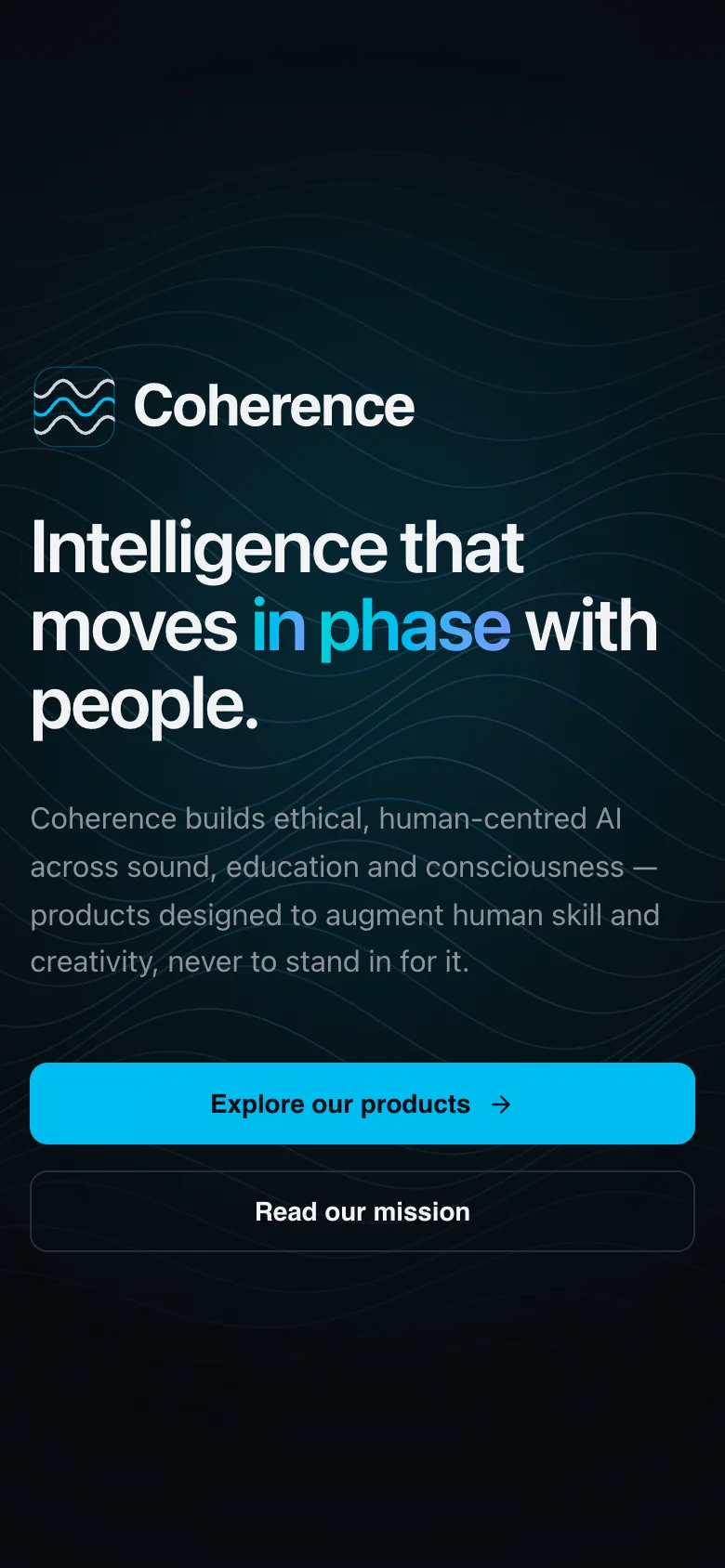
Live at coherence.com: brand identity generated with AI agents we directed, the motion system and website for the group behind Sonora, AboutAI, WakeUp and MudShadows. Agent work remains in build.


Live at domainbooth.com for DomainBooth, a premium domain brokerage: a new animated mark, every page redesigned and rebuilt with designed mobile layouts, and a custom CMS for its sales record, featured names, press and enquiries.
Apps, platforms and campaigns for these teams, long before the AI work. Every one is written up on the work page — what we did, and where our part ended.




















