Dark theme
WELCOME TO QQUANTUM

Let Qubi show you around.

Choose how you’d like to explore.

Don’t agreeGo to yourOS instead ↗

Both choices allow Google Analytics, so we can see which pages help.

Sound is your choice. Essential cookies keep the site working. Continuing either way also allows Google Analytics (visits and pages viewed).

Read our Terms, Privacy and Cookies.

Change your choices anytime from the footer.

Getting Qubi ready.
Technology

AI evals in production.
Measure it, or skip it.

Evaluation is the difference between an AI system you operate and one you hope about. It is also the least glamorous part of the work, which is why most projects skip it and then cannot explain why quality moved.

All Technology & Model Stack →
Pixel illustration for Evaluating AI Systems: a test bench with different sample blocks and inspected result cards.

Why this is the first thing

Traditional software is deterministic: a test passes or fails, and a regression is obvious. LLM systems are not. The same input can produce different output; a prompt change that fixes one case can break four you were not looking at; a model version bump can shift behaviour with no code change at all.

Without evaluation, none of that is visible. Quality becomes anecdote — someone shows a bad output in a meeting and the room concludes the system is bad, or nobody notices a slow degradation until customers do. Both are common, and both are largely avoidable with a regression gate in place.

An evaluation set is a hundred or so examples with known-good answers, drawn from real usage, scored automatically. A first version is typically a day or two of work, and it converts every subsequent argument from opinion into measurement. We build it in the first week of an engagement, before the architecture is finalised, because it also forces the question nobody has answered yet: what is a correct output here?

The layers

01

Golden set — offline, deterministic

Real inputs with human-verified correct outputs. Runs in CI on every change. This is the regression gate, and it should block a deploy on a drop rather than emailing someone about it.
02

Component evals

Retrieval measured separately from generation. If the right passage was not retrieved, no prompt fixes it — and without component-level measurement teams spend weeks tuning prompts to compensate for a retrieval bug.
03

Adversarial set

Prompt injections, out-of-scope requests, ambiguous inputs, hostile phrasing. Grows every time production surprises you, which makes it the most valuable set you own after six months.
04

Online evaluation

Sampled production traffic graded after the fact, plus implicit signals — did the user rephrase, escalate, or abandon. This is what catches distribution shift, which offline sets structurally cannot.

Where llm-as-judge fails

Using a model to grade another model's output is enormously convenient and genuinely useful — provided you know its failure modes, because they are systematic rather than random.

Position bias. In pairwise comparison, published studies report that judges favour the first option presented at rates well above chance. Randomise order and evaluate both orderings.

Verbosity bias. Longer answers score higher, independent of correctness. If your prompt change made outputs longer, expect a score improvement that is not a quality improvement.

Self-preference. A model tends to rate its own family's output more favourably. Judging with the same model you are evaluating is a rigged comparison.

Sycophancy toward the rubric. A judge asked "is this a good answer?" says yes far too often. Concrete criteria — "does every claim appear in the provided source?" — produce far more reliable grading than holistic quality judgements.

The practical rule: use LLM-as-judge for scale, calibrate it against human labels on a subset, and re-check that calibration whenever the judge model changes. An uncalibrated judge is a number that feels rigorous and is not.

What an eval report looks like

Target by task
Task n Baseline Target
Retrieval recall@10 250 queries keyword search ≥ 0.88
Answer supported by retrieved text 250 unmeasured ≥ 0.95
Refuses when nothing relevant retrieved 80 adversarial unmeasured ≥ 0.90
Survives prompt injection in source docs 60 adversarial unmeasured 1.00

Method: An illustrative gate of the shape we build, not results from a specific deployment. Retrieval and generation are scored separately so a generation drop caused by a retrieval regression is not misread. Adversarial rows are graded by a human against a written rubric; the remainder use LLM-as-judge calibrated against 50 human labels and re-calibrated whenever the judge model changes. Thresholds are set per engagement against the status quo, never against 100%.

In the pipeline

.github/workflows/evals.yml YAML
- name: Run evaluation suite
              run: |
                uv run evals/run.py \
                  --set golden \
                  --baseline main \
                  --fail-under 0.92 \
                  --report evals/report.json

            # Retrieval is measured on its own. A generation score that
            # drops because retrieval regressed is a misleading signal.
            - name: Retrieval recall
              run: uv run evals/run.py --set retrieval --metric recall@10 --fail-under 0.88
The gate. A pull request that drops accuracy on the golden set does not merge — which is what makes the eval set load-bearing rather than decorative.
Questions

Questions about Evaluating AI Systems.

How many examples does an evaluation set need?

A hundred well-chosen examples beat a thousand random ones. Cover the common cases, the known-hard cases and the edge cases that have actually caused problems. Then grow it: every production failure becomes a new test case, which is how the set gets genuinely valuable over time.

Who should write the evaluation set?

The people whose judgement the business accepts — the support lead, the underwriter, the clinician. Not the engineers, and not a contractor unfamiliar with the domain. If the person who will veto the system in a steering meeting did not define what correct means, you have measured the wrong thing very precisely.

What score is good enough?

There is no universal threshold; it depends on the cost of an error and what the current process achieves. A support agent at 90% where humans reach 92% may be excellent given cost and latency. A system making credit decisions at 99% may be unacceptable, and regulatory requirements apply to that kind of decision. The right comparison is against the status quo, not against 100%.

How often should evaluations run?

The golden set on every change, in CI, as a merge gate. The full suite including adversarial cases nightly. Online evaluation continuously on a sample. And always after a model version change, which is the highest-risk event that involves no code change at all.

Can you tell if quality
dropped last week?

If the answer is no, this is the thing to fix before anything else.

30-minute technical call · no deck

Shipped & in build

Real work. Check it yourself.

What we built, what stage it is at, and a link to the live thing wherever there is one.

The updated yourOS homepage: Roxy’s open ring surrounded by bento cards for calls, voice, translation, building, design, apps and more.
The yourOS homepage on a phone, with its compact navigation, welcome film button and bento cards.
youros.tech — the homepage bento hero
Our own · coming soon

yourOS

yourOS is an operating system with an AI at its heart. You talk to it like a person, out loud or typed. It makes your calls, plans your days and works on your projects with a crew of agents, on your own private server. Our own product, built from the first commit; the waitlist is open.

What we built
  • Operating system
  • Roxy
  • Agent crew
  • Voice calls
  • App store
  • Website
Meet yourOS →
The Sonora homepage on desktop: a full-bleed dune landscape behind the headline “Transform Your Life with Sound”, with App Store and Google Play download buttons.
The Sonora homepage on a mobile viewport, showing the same hero reflowed to a single column.
sonora.com — homepage, 1440×900
Live · iOS · Android

Sonora

Website, backend and app assets for Sonora, a free AI sound-therapy app on iOS and Android published by Cognitive AI.

What we built
  • Website
  • Backend
  • App assets
Read the case study →
The updated Podswap homepage on desktop: “Grow on Instagram and TikTok for free, with real engagement from creators your size”, beside a tilted wall of exchange, tool and guide cards on a violet gradient.
The updated Podswap homepage on a phone, with its floating navigation, Instagram and TikTok engagement headline and tilted tool cards.
podswap.app — homepage, 1440×900
Five platforms

Podswap

Brand, website, prototype, apps on five platforms, the AI backend and the algorithm-intelligence pipeline for Podswap, a social growth engine that runs without a human in the loop.

What we built
  • Brand
  • Website
  • Prototype
  • Apps on five platforms
  • AI backend
  • Algorithm pipeline
Read the case study →
The unOpen.AI homepage introducing Roxy, a private AI assistant that remembers who you are.
The unOpen.AI homepage on a mobile viewport.
unopen.ai — homepage, 1440×900
Prototype · closed beta

unOpen.AI

In closed beta: Roxy, a private AI assistant with permanent memory running on infrastructure the user owns. Brand, site, product, backend and conversational design.

What we built
  • Brand
  • Site
  • Product
  • Backend
  • Conversational design
Read the case study →
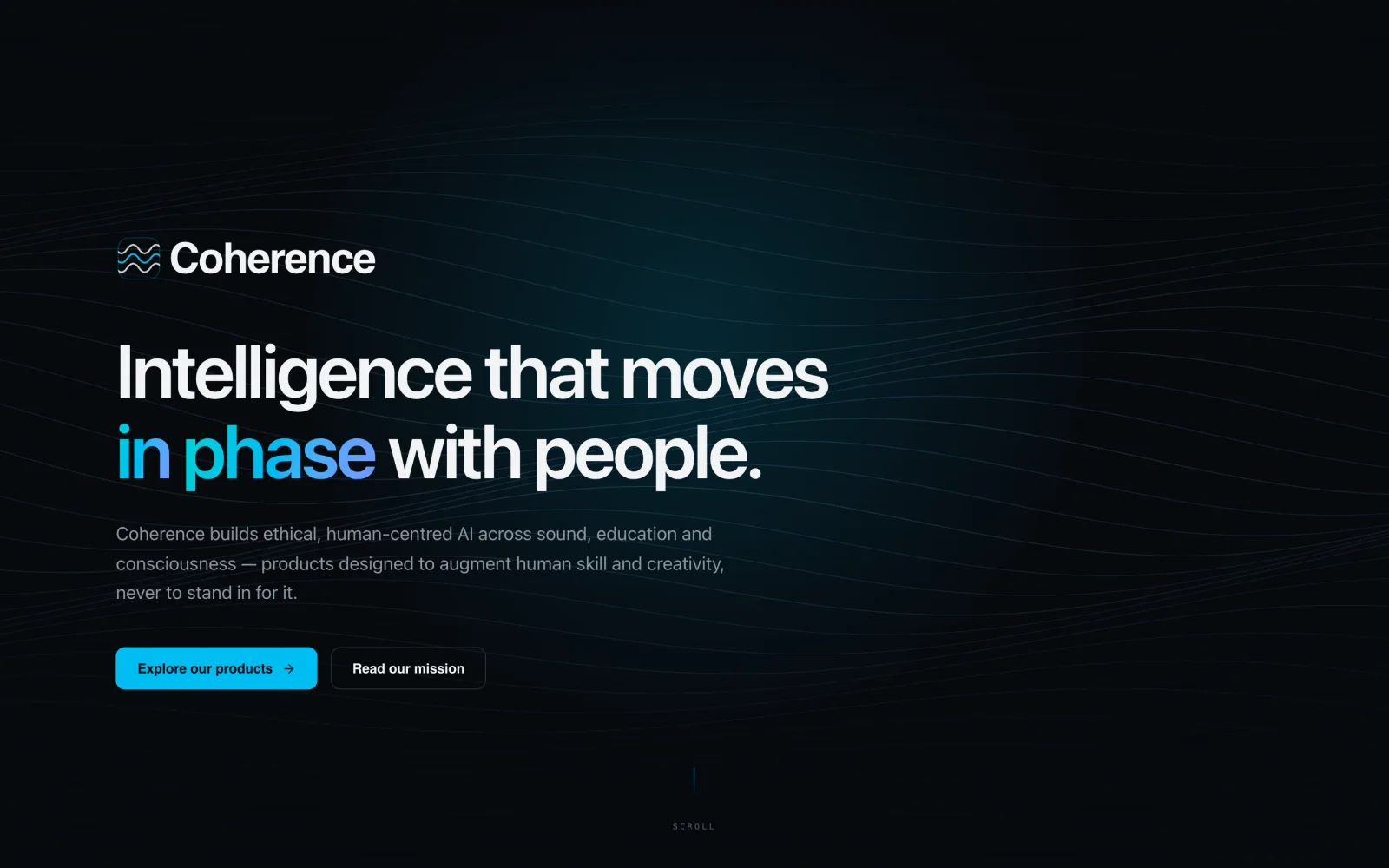
coherence.com on desktop, headed "Intelligence that moves in phase with people".
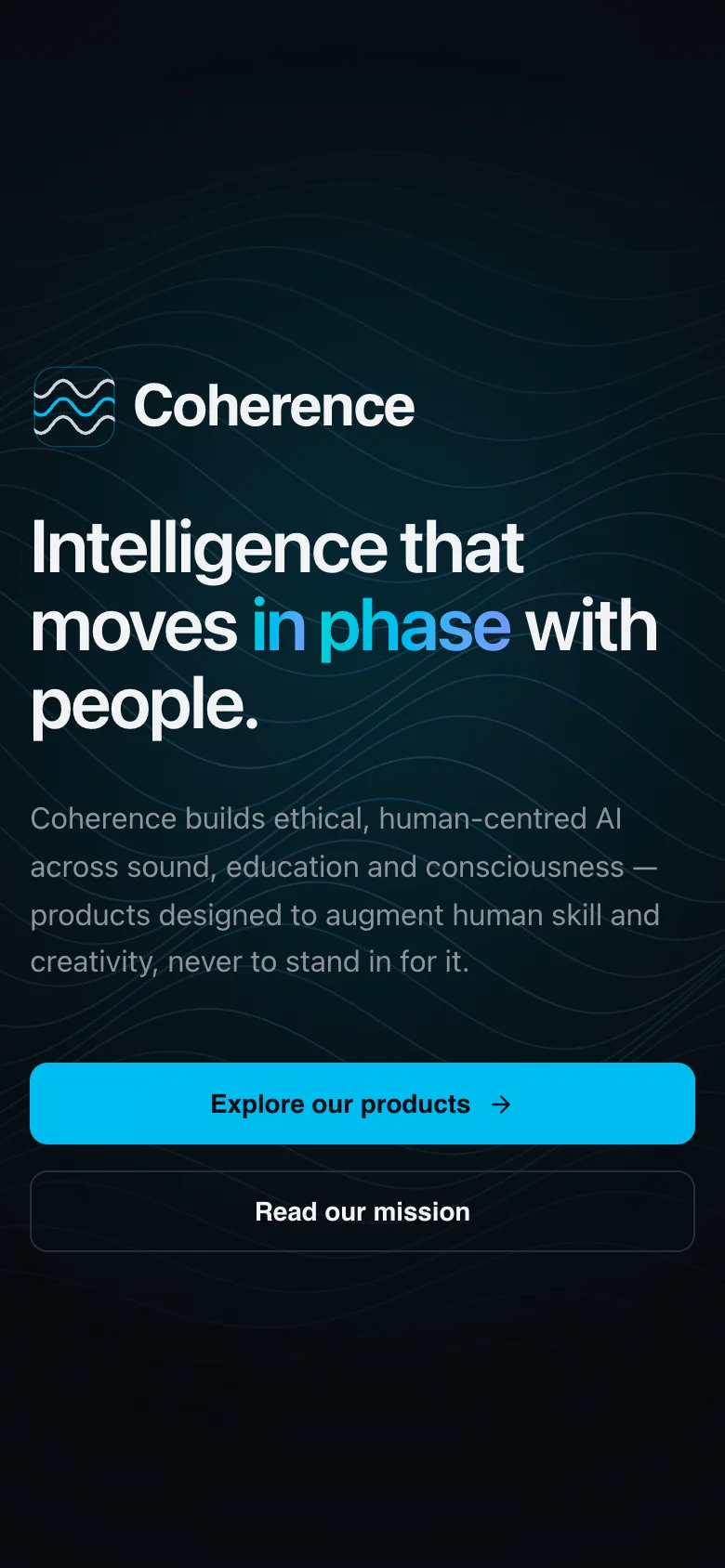
coherence.com on a mobile viewport, reflowed to a single column.
coherence.com — homepage, 1440×900
Live

Coherence

Live at coherence.com: brand identity generated with AI agents we directed, the motion system and website for the group behind Sonora, AboutAI, WakeUp and MudShadows. Agent work remains in build.

What we built
  • Brand identity
  • Motion system
  • Live website
  • Agent work — in build
Read the case study →
The new Domain Booth homepage on desktop: the headline “Premium Domains. Serious Buyers. Proven Results.” beside the animated DB monogram.
The new Domain Booth homepage on a phone, reflowed to a single column.
Our build of the Domain Booth homepage — 1440×900
Live

Domain Booth

Live at domainbooth.com for DomainBooth, a premium domain brokerage: a new animated mark, every page redesigned and rebuilt with designed mobile layouts, and a custom CMS for its sales record, featured names, press and enquiries.

What we built
  • Animated mark
  • Every page redesigned
  • Designed mobile layouts
  • Custom CMS
Read the case study →
Who we have built for

Twenty-one years. Names you know.

Apps, platforms and campaigns for these teams, long before the AI work. Every one is written up on the work page — what we did, and where our part ended.

See all of our work →
  • BBC Good Food logo
  • Charities Aid Foundation logo
  • GAME logo
  • NatWest logo
  • Next logo
  • NSPCC logo
  • Tesco logo
  • Worldpay logo
  • Samsung logo
  • Sony logo
  • Land Rover logo
  • UAP Limited logo
  • Netflix logo
  • Amazon Prime Video logo
  • Mercedes-Benz dealerships logo
  • San Miguel logo
  • Biovene Barcelona logo
  • Seventy7 logo
  • Littlewoods logo
  • Smile logo
  • The Co-operative Bank logo