Dark theme
WELCOME TO QQUANTUM

Let Qubi show you around.

Choose how you’d like to explore.

Don’t agreeGo to yourOS instead ↗

Both choices allow Google Analytics, so we can see which pages help.

Sound is your choice. Essential cookies keep the site working. Continuing either way also allows Google Analytics (visits and pages viewed).

Read our Terms, Privacy and Cookies.

Change your choices anytime from the footer.

Getting Qubi ready.
Munich

Munich.
Industrial AI systems.

Munich sends us older problems than most cities do. Automotive, industrial manufacturing, insurance and reinsurance all sit on twenty or thirty years of operational data held in systems that were never built to be asked questions. The work is rarely the model; it is reaching the data at all, and doing it in a way the plant, the works council and the auditor can all live with.

  • Worked from Barcelona
  • BayLDA supervises the private sector
  • Same hour as us
Last reviewed 5 September 2026 · Engineering guidance, not legal advice.
All Where We Work →
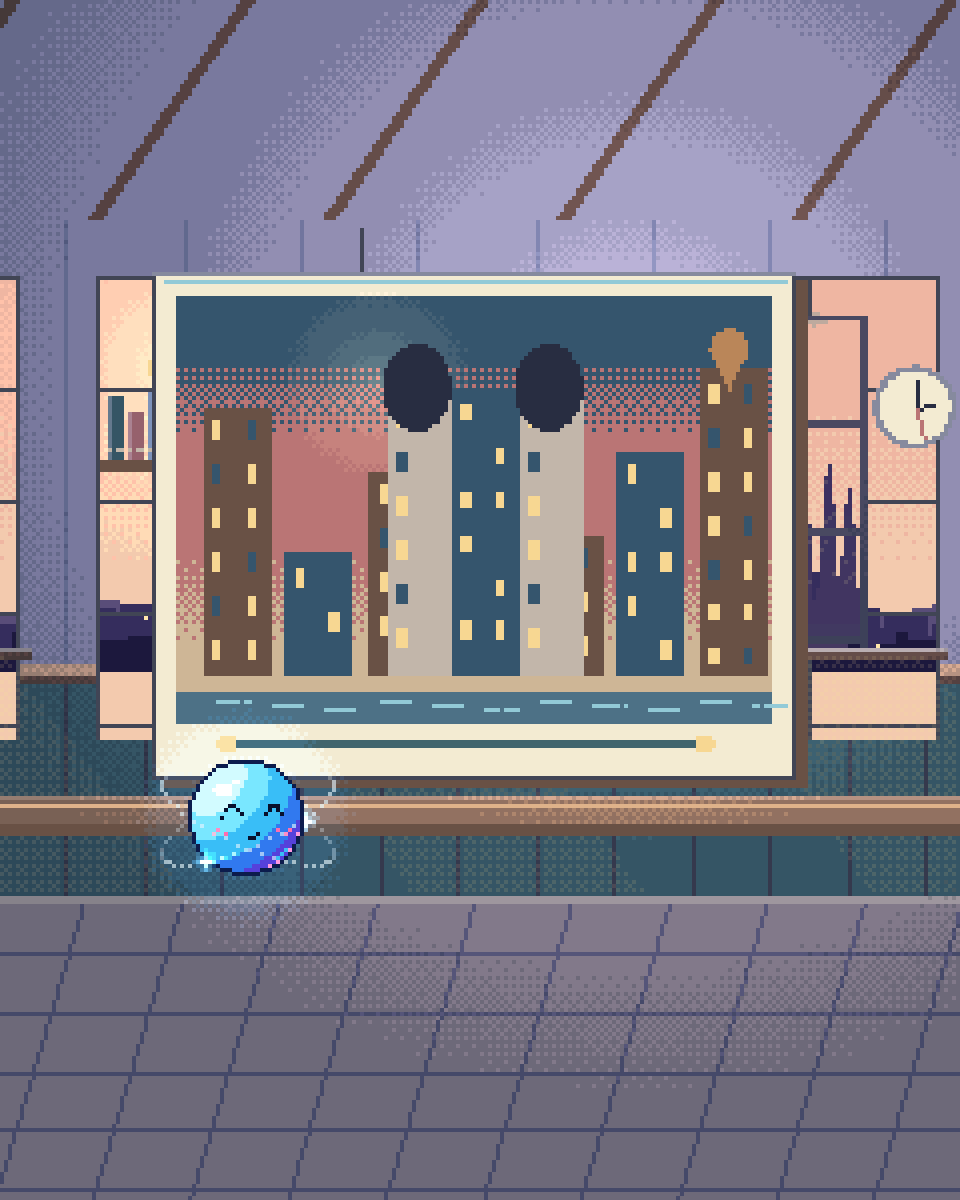
Pixel illustration for Munich AI Engineering: a destination postcard for Munich, with an illustrative city silhouette and a travel route.

What is actually different here

01

Bavaria splits supervision in two

Most German Länder run a single data protection authority. Bavaria runs two: the Bayerisches Landesamt für Datenschutzaufsicht supervises the private sector, while public bodies answer to the Bayerischer Landesbeauftragter für den Datenschutz. For a Munich company that means the BayLDA, an authority with a reputation for engaging with the technical detail rather than only the paperwork. That is genuinely good news for a well-built system and uncomfortable for a vague one, which is a reasonable summary of why we write design documents that describe what the system does rather than what it is called.
02

The data is in systems older than the project

The interesting material in a Munich engagement usually lives in an ERP installation with a decade of custom fields, a manufacturing execution system, a process historian, a PLM archive and a shared drive that everyone swears is the real source of truth. None of it has an API anyone is proud of. The first phase of the work is almost always extraction and reconciliation, and quoting a project as though that phase is free is the single most common way these builds go wrong. We cost it separately and visibly.
03

Frankfurt is the region, the plant is the constraint

Frankfurt carries most German cloud workloads and Microsoft also runs a region in the west of the country, roughly three hundred kilometres from Munich. For office and back-office systems that distance is irrelevant. For anything reading from a line in real time it is not, and the answer is usually to keep inference near the equipment and send only what has to travel. Cloud region availability changes; confirm what is offered against the provider's current documentation before you design around it.
04

Insurance pricing is a regulated use, not a feature

The EU AI Act treats risk assessment and pricing in life and health insurance as a high-risk use, which puts documentation, human oversight and record-keeping duties on the system rather than on a policy binder somewhere. In a city with this much insurance and reinsurance in it, that changes what we build: the trace of how a figure was produced becomes a deliverable in its own right, not a log we can add later. Your compliance function owns the classification; we own building something that can survive it.

The work that comes out of this city

Munich's industrial and financial concentration produces four fairly distinct kinds of request, and they behave differently enough that it is worth naming them separately.

Automotive and industrial groups arrive with maintenance, quality or supplier problems and a data estate that spans four decades of acquisitions. The engineering that pays for itself is usually unglamorous: getting sensor histories, work orders and inspection records into one place where a question can be asked across all three. Once that exists, prediction is comparatively easy. Before it exists, no model helps. Both halves are described under legacy modernisation and predictive maintenance.

Insurers and reinsurers arrive with documents — claims files, treaty wordings, loss reports, medical evidence — and a process where a person reads for an hour and then makes a decision that has to be defensible years later. The valuable system does not make the decision. It assembles the file, cites where each fact came from, and leaves the judgement with the underwriter, which is also the only version a regulator is comfortable with.

Aerospace and semiconductor suppliers arrive with material they cannot let out of their own network, sometimes for contractual reasons and sometimes for export-control ones. That resolves to a deployment inside their own perimeter rather than a hosted endpoint, which we cover under on-premise AI.

Everyone eventually asks the same question about scope: whether the pilot that worked on one line will work on eleven. It is the right question, and the honest answer usually depends on whether the eleven lines record data the same way. They rarely do.
How a munich project actually runs

01

Discovery happens at the site, not at head office

Barcelona to Munich is under two hours, and for industrial work the first workshop belongs wherever the machines and the maintenance records are. Head office knows what the process is meant to be; the line knows what it is. On a normal engagement the travel is not a separate line item.
02

Then remote, with no offset to manage

Munich and Barcelona share a clock, so there is no morning-only window and no waiting overnight for an answer. For work that depends on a plant engineer being available for twenty minutes, that turns out to matter more than any amount of process.
03

And back for handover

Handover to your own engineers is done in person, with the runbook written in front of them rather than sent afterwards. The system then lives in your infrastructure and your repositories.
Questions

Questions about Munich AI Engineering.

Do you have a Munich office?

No. We have one office and it is in Barcelona. We travel to Munich for discovery and handover and for site visits where being at the machine is the point. We would rather say that than describe a registered address as a presence.

Can a system run without anything leaving the factory network?

Yes, and for a meaningful share of Munich work that is the right architecture. Open-weight models can be self-hosted on your own hardware, retrieval runs against your own storage, and nothing egresses. The trade-off is real and we will state it: self-hosted models are behind the best hosted ones on some tasks, and you take on the operational burden. Whether that trade is worth making depends on the task, and we would rather test it than argue about it.

Our works council will need to be involved. Does that break the project?

No, but it changes the sequence. Any system that can be used to monitor employee performance or behaviour normally requires a works agreement, so the sensible order is to describe what the system logs and what it cannot do before anyone builds it, rather than presenting a finished thing for approval. In practice the councils we have encountered object to unbounded logging and vague purposes, both of which are also bad engineering. Your legal and HR functions own the agreement itself.

Who supervises us for data protection in Bavaria?

For a private-sector company, the Bayerisches Landesamt für Datenschutzaufsicht. Public bodies in Bavaria answer to a separate authority instead. The BayLDA has historically been willing to get into technical specifics, which is worth knowing before you write a two-page answer to a question that deserved a diagram.

What does a Munich engagement cost?

Our ranges are on the pricing page, in euros and exclusive of VAT, and they do not change by city. The variable that actually moves the number here is integration: reaching data in older systems is where the effort goes, and we would rather scope that honestly in week one than discover it in month three.

In Munich, with data
stuck in an old system?

Thirty minutes on what you actually have and whether it can be reached.

30-minute technical call · no deck

Shipped & in build

Real work. Check it yourself.

What we built, what stage it is at, and a link to the live thing wherever there is one.

The updated yourOS homepage: Roxy’s open ring surrounded by bento cards for calls, voice, translation, building, design, apps and more.
The yourOS homepage on a phone, with its compact navigation, welcome film button and bento cards.
youros.tech — the homepage bento hero
Our own · coming soon

yourOS

yourOS is an operating system with an AI at its heart. You talk to it like a person, out loud or typed. It makes your calls, plans your days and works on your projects with a crew of agents, on your own private server. Our own product, built from the first commit; the waitlist is open.

What we built
  • Operating system
  • Roxy
  • Agent crew
  • Voice calls
  • App store
  • Website
Meet yourOS →
The Sonora homepage on desktop: a full-bleed dune landscape behind the headline “Transform Your Life with Sound”, with App Store and Google Play download buttons.
The Sonora homepage on a mobile viewport, showing the same hero reflowed to a single column.
sonora.com — homepage, 1440×900
Live · iOS · Android

Sonora

Website, backend and app assets for Sonora, a free AI sound-therapy app on iOS and Android published by Cognitive AI.

What we built
  • Website
  • Backend
  • App assets
Read the case study →
The updated Podswap homepage on desktop: “Grow on Instagram and TikTok for free, with real engagement from creators your size”, beside a tilted wall of exchange, tool and guide cards on a violet gradient.
The updated Podswap homepage on a phone, with its floating navigation, Instagram and TikTok engagement headline and tilted tool cards.
podswap.app — homepage, 1440×900
Five platforms

Podswap

Brand, website, prototype, apps on five platforms, the AI backend and the algorithm-intelligence pipeline for Podswap, a social growth engine that runs without a human in the loop.

What we built
  • Brand
  • Website
  • Prototype
  • Apps on five platforms
  • AI backend
  • Algorithm pipeline
Read the case study →
The unOpen.AI homepage introducing Roxy, a private AI assistant that remembers who you are.
The unOpen.AI homepage on a mobile viewport.
unopen.ai — homepage, 1440×900
Prototype · closed beta

unOpen.AI

In closed beta: Roxy, a private AI assistant with permanent memory running on infrastructure the user owns. Brand, site, product, backend and conversational design.

What we built
  • Brand
  • Site
  • Product
  • Backend
  • Conversational design
Read the case study →
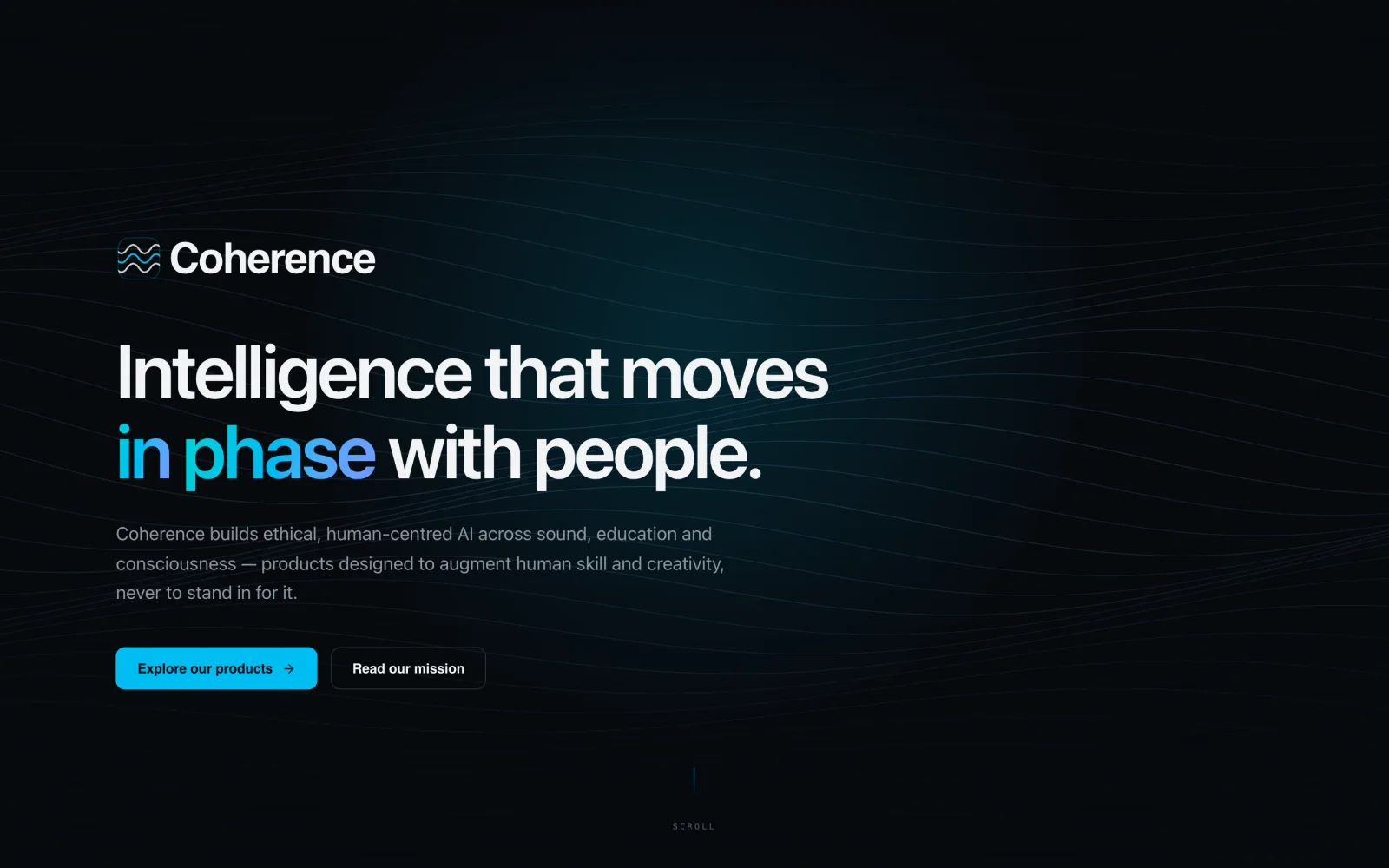
coherence.com on desktop, headed "Intelligence that moves in phase with people".
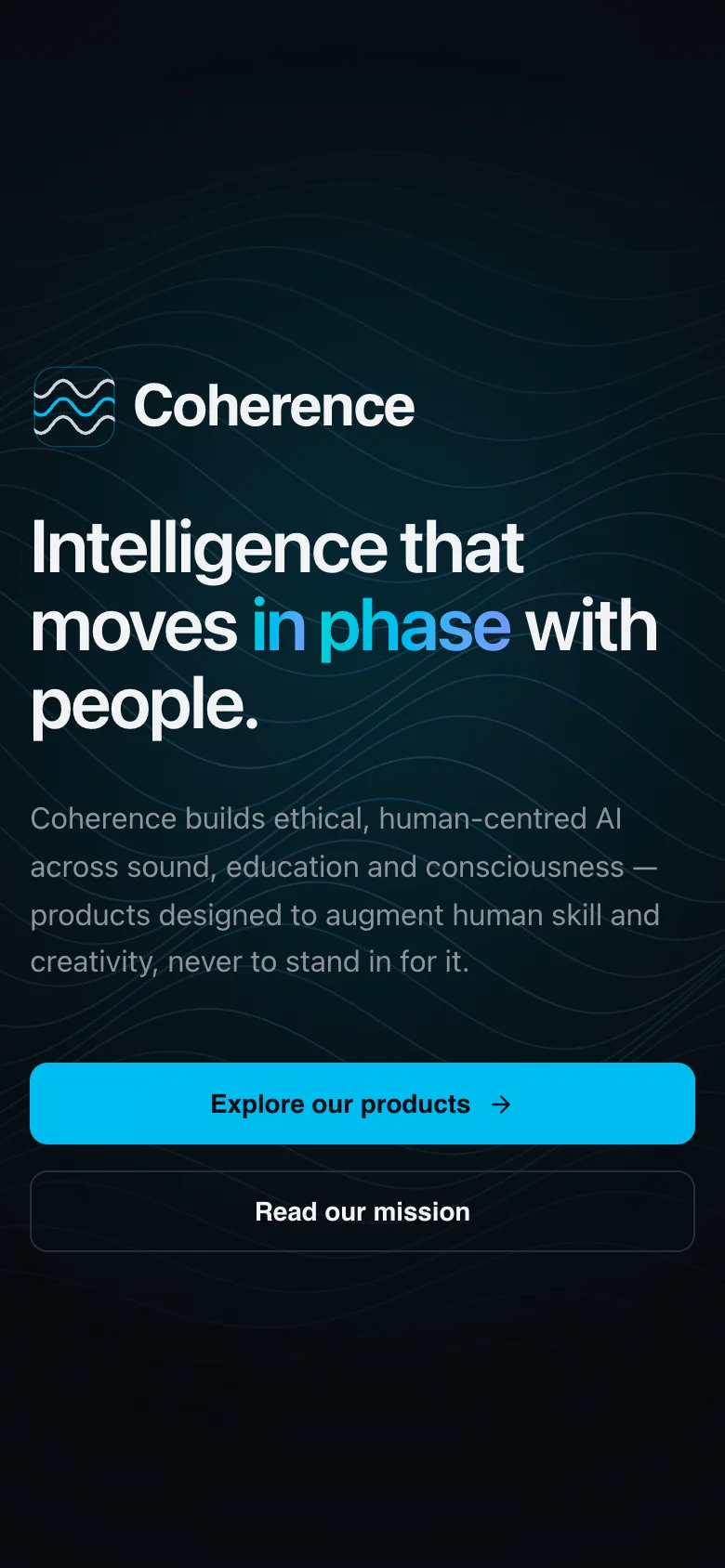
coherence.com on a mobile viewport, reflowed to a single column.
coherence.com — homepage, 1440×900
Live

Coherence

Live at coherence.com: brand identity generated with AI agents we directed, the motion system and website for the group behind Sonora, AboutAI, WakeUp and MudShadows. Agent work remains in build.

What we built
  • Brand identity
  • Motion system
  • Live website
  • Agent work — in build
Read the case study →
The new Domain Booth homepage on desktop: the headline “Premium Domains. Serious Buyers. Proven Results.” beside the animated DB monogram.
The new Domain Booth homepage on a phone, reflowed to a single column.
Our build of the Domain Booth homepage — 1440×900
Live

Domain Booth

Live at domainbooth.com for DomainBooth, a premium domain brokerage: a new animated mark, every page redesigned and rebuilt with designed mobile layouts, and a custom CMS for its sales record, featured names, press and enquiries.

What we built
  • Animated mark
  • Every page redesigned
  • Designed mobile layouts
  • Custom CMS
Read the case study →
Who we have built for

Twenty-one years. Names you know.

Apps, platforms and campaigns for these teams, long before the AI work. Every one is written up on the work page — what we did, and where our part ended.

See all of our work →
  • BBC Good Food logo
  • Charities Aid Foundation logo
  • GAME logo
  • NatWest logo
  • Next logo
  • NSPCC logo
  • Tesco logo
  • Worldpay logo
  • Samsung logo
  • Sony logo
  • Land Rover logo
  • UAP Limited logo
  • Netflix logo
  • Amazon Prime Video logo
  • Mercedes-Benz dealerships logo
  • San Miguel logo
  • Biovene Barcelona logo
  • Seventy7 logo
  • Littlewoods logo
  • Smile logo
  • The Co-operative Bank logo