Dark theme
WELCOME TO QQUANTUM

Let Qubi show you around.

Choose how you’d like to explore.

Don’t agreeGo to yourOS instead ↗

Both choices allow Google Analytics, so we can see which pages help.

Sound is your choice. Essential cookies keep the site working. Continuing either way also allows Google Analytics (visits and pages viewed).

Read our Terms, Privacy and Cookies.

Change your choices anytime from the footer.

Getting Qubi ready.
Quantum computing

Quantum in the cloud.
Rented, not owned.

Nobody buys one. Access is a cloud service, priced in ways that look nothing like renting a CPU, and the practical constraints on what you can run are set by circuit depth and queue time rather than by your budget.

All Quantum Computing →
Pixel illustration for Quantum Computing in the Cloud: a quantum sphere connected to a remote instrument.

The three pricing models

Quantum results are statistical. A circuit is executed many times — each execution is a shot — and the distribution of outcomes is the answer. That single fact shapes every pricing model in the market, and it is why quantum billing does not resemble cloud compute billing at all.

Per-shot, used by AWS Braket, charges a task fee plus a fee for each execution. Cost scales directly with how many shots your statistics require, which for a noisy device can be a lot. It makes small experiments genuinely cheap and makes precision expensive.

Per-minute, used by IBM Quantum, charges for time on the processor, typically metered in seconds with substantially different rates across access tiers. It rewards efficient circuits and punishes idle connections. IBM has also offered a free open plan on real hardware, which is where most people should start — check current availability.

Per-program, used by Azure Quantum, varies by hardware provider within the marketplace; some meter per gate operation, which makes circuit structure directly visible in the bill.

Indicative figures move constantly and we would rather not publish numbers that are wrong within a quarter. As of September 2026 the shape is: free tiers on real hardware exist and are usable; pay-as-you-go experimentation runs from single-digit to low-hundreds of currency units for a meaningful experiment; and sustained serious use is a subscription negotiated in the thousands per month. Check the provider's own pricing page before budgeting anything.

Who offers what

01

IBM Quantum

Superconducting processors accessed through Qiskit, with a free open plan on real hardware and paid tiers metered per QPU minute. The most mature software stack and documentation, and the usual first stop for anyone learning.
02

AWS Braket

A broker rather than a manufacturer: one API over several third-party machines including trapped-ion, superconducting and neutral-atom devices. Per-shot pricing, and the easiest way to run the same circuit across fundamentally different hardware.
03

Azure Quantum

Similarly a marketplace across multiple hardware providers, with per-program pricing and integration into the wider Azure identity and governance model — which for an enterprise already on Azure is the practical differentiator.
04

Google Quantum AI

Research-led, with access historically more restricted and oriented toward collaboration than toward general availability. Notable for error-correction milestones rather than for commercial access.

What you can realistically run

The binding constraint is not qubit count. It is circuit depth — how many operations you can apply before decoherence and accumulated gate error make the result indistinguishable from noise. On current hardware that number is modest, which means the algorithms that actually complete are shallow ones: variational circuits, small simulations, benchmark problems, and demonstrations.

The second constraint is queue time. Shared hardware means your job waits. For interactive work this is the difference between an afternoon and a week, and simulators — classical machines pretending to be quantum ones, up to around thirty qubits — are where most development sensibly happens. You debug on a simulator and spend hardware time only on runs that matter.

The honest summary for a business evaluating this: you can learn on it, you can benchmark on it, you can build genuine internal capability on it. You cannot currently put it in a production path and get an advantage over a classical machine, and the pages that follow explain why for the two applications most often proposed.

Questions

Questions about Quantum Computing in the Cloud.

Can we try one for free?

At the time of writing, yes. IBM has offered a free open plan on real hardware — check current availability and confirm against the provider's current terms — and every major platform provides simulators at no or low cost. An afternoon on a simulator plus a small run on real hardware is enough to make quantum computing concrete for a technical team, and it is a better use of a learning budget than a vendor workshop.

Which platform should we start with?

IBM if the goal is learning, because in our view the free hardware tier and the documentation are the strongest. Braket if you want to compare hardware types through one interface. Azure if your governance and identity story has to match an existing Azure estate.

Do we need a quantum expert to use it?

To run tutorials, no — the SDKs are approachable and a competent engineer can get results in a day. To design a circuit that does something novel and to know whether the result means anything, yes, and that is a research skill rather than an engineering one. Being clear about which of the two you are buying prevents a lot of disappointment.

Is our data safe on a quantum cloud?

It is a cloud service and the usual questions apply: jurisdiction, tenancy, retention, what the provider logs. What you send is a circuit rather than a corpus, so the sensitivity profile is generally low — but if the circuit itself encodes something proprietary, treat it as you would any other workload sent to a third party.

Learn on it before
you budget for it.

A free tier and an afternoon will teach your team more than any vendor session. We can point you at the right starting point.

30-minute technical call · no deck

Shipped & in build

Real work. Check it yourself.

What we built, what stage it is at, and a link to the live thing wherever there is one.

The updated yourOS homepage: Roxy’s open ring surrounded by bento cards for calls, voice, translation, building, design, apps and more.
The yourOS homepage on a phone, with its compact navigation, welcome film button and bento cards.
youros.tech — the homepage bento hero
Our own · coming soon

yourOS

yourOS is an operating system with an AI at its heart. You talk to it like a person, out loud or typed. It makes your calls, plans your days and works on your projects with a crew of agents, on your own private server. Our own product, built from the first commit; the waitlist is open.

What we built
  • Operating system
  • Roxy
  • Agent crew
  • Voice calls
  • App store
  • Website
Meet yourOS →
The Sonora homepage on desktop: a full-bleed dune landscape behind the headline “Transform Your Life with Sound”, with App Store and Google Play download buttons.
The Sonora homepage on a mobile viewport, showing the same hero reflowed to a single column.
sonora.com — homepage, 1440×900
Live · iOS · Android

Sonora

Website, backend and app assets for Sonora, a free AI sound-therapy app on iOS and Android published by Cognitive AI.

What we built
  • Website
  • Backend
  • App assets
Read the case study →
The updated Podswap homepage on desktop: “Grow on Instagram and TikTok for free, with real engagement from creators your size”, beside a tilted wall of exchange, tool and guide cards on a violet gradient.
The updated Podswap homepage on a phone, with its floating navigation, Instagram and TikTok engagement headline and tilted tool cards.
podswap.app — homepage, 1440×900
Five platforms

Podswap

Brand, website, prototype, apps on five platforms, the AI backend and the algorithm-intelligence pipeline for Podswap, a social growth engine that runs without a human in the loop.

What we built
  • Brand
  • Website
  • Prototype
  • Apps on five platforms
  • AI backend
  • Algorithm pipeline
Read the case study →
The unOpen.AI homepage introducing Roxy, a private AI assistant that remembers who you are.
The unOpen.AI homepage on a mobile viewport.
unopen.ai — homepage, 1440×900
Prototype · closed beta

unOpen.AI

In closed beta: Roxy, a private AI assistant with permanent memory running on infrastructure the user owns. Brand, site, product, backend and conversational design.

What we built
  • Brand
  • Site
  • Product
  • Backend
  • Conversational design
Read the case study →
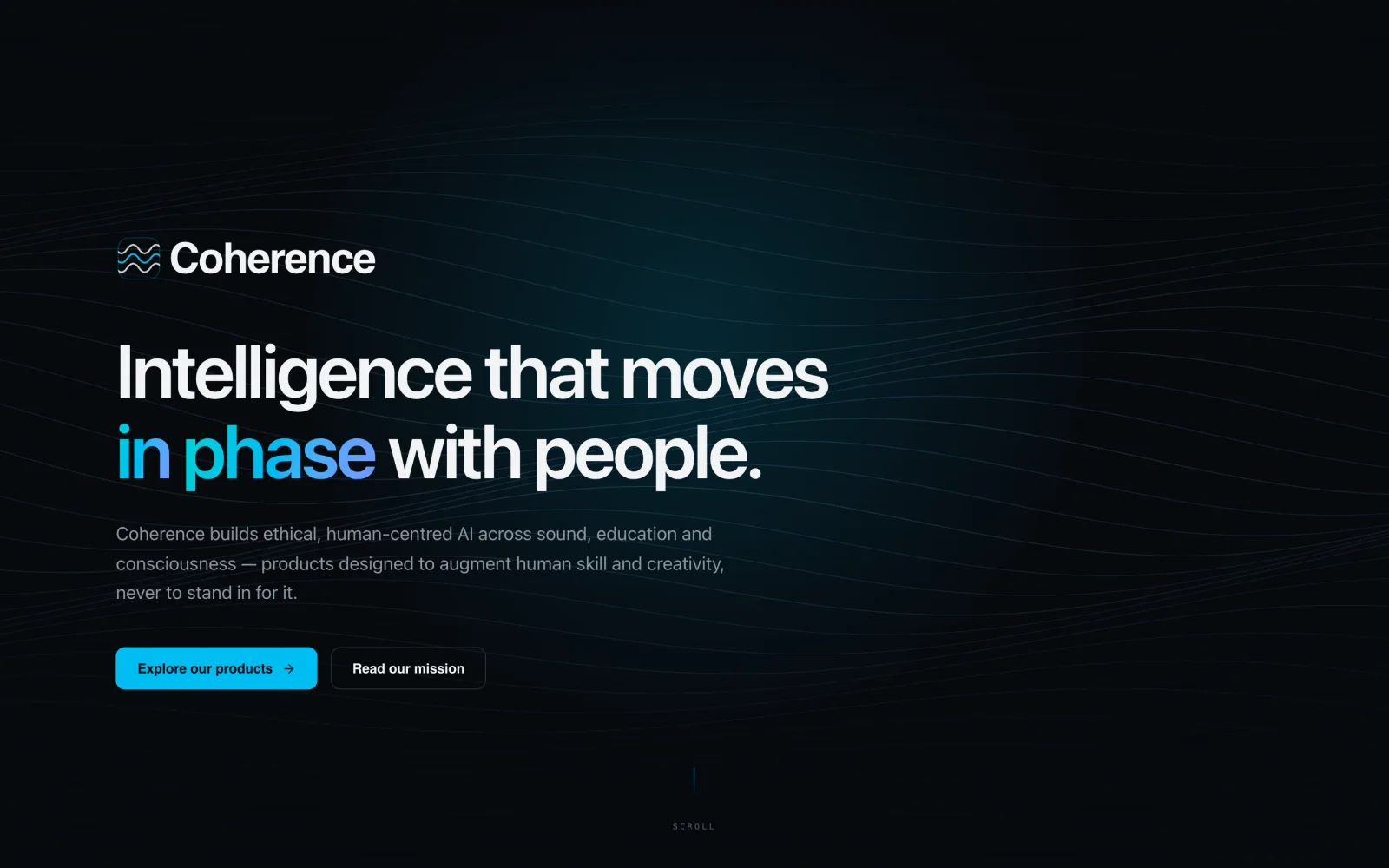
coherence.com on desktop, headed "Intelligence that moves in phase with people".
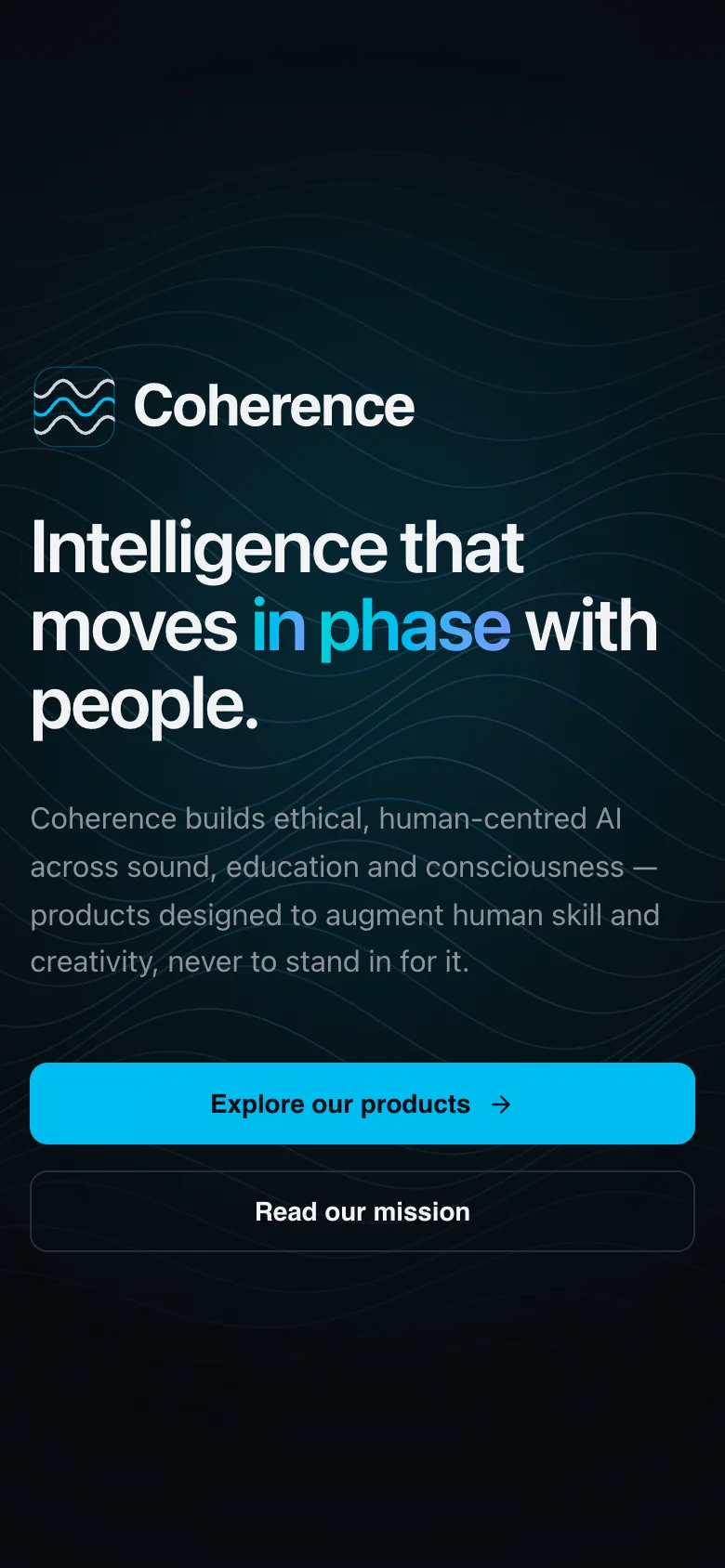
coherence.com on a mobile viewport, reflowed to a single column.
coherence.com — homepage, 1440×900
Live

Coherence

Live at coherence.com: brand identity generated with AI agents we directed, the motion system and website for the group behind Sonora, AboutAI, WakeUp and MudShadows. Agent work remains in build.

What we built
  • Brand identity
  • Motion system
  • Live website
  • Agent work — in build
Read the case study →
The new Domain Booth homepage on desktop: the headline “Premium Domains. Serious Buyers. Proven Results.” beside the animated DB monogram.
The new Domain Booth homepage on a phone, reflowed to a single column.
Our build of the Domain Booth homepage — 1440×900
Live

Domain Booth

Live at domainbooth.com for DomainBooth, a premium domain brokerage: a new animated mark, every page redesigned and rebuilt with designed mobile layouts, and a custom CMS for its sales record, featured names, press and enquiries.

What we built
  • Animated mark
  • Every page redesigned
  • Designed mobile layouts
  • Custom CMS
Read the case study →
Who we have built for

Twenty-one years. Names you know.

Apps, platforms and campaigns for these teams, long before the AI work. Every one is written up on the work page — what we did, and where our part ended.

See all of our work →
  • BBC Good Food logo
  • Charities Aid Foundation logo
  • GAME logo
  • NatWest logo
  • Next logo
  • NSPCC logo
  • Tesco logo
  • Worldpay logo
  • Samsung logo
  • Sony logo
  • Land Rover logo
  • UAP Limited logo
  • Netflix logo
  • Amazon Prime Video logo
  • Mercedes-Benz dealerships logo
  • San Miguel logo
  • Biovene Barcelona logo
  • Seventy7 logo
  • Littlewoods logo
  • Smile logo
  • The Co-operative Bank logo