ENT.01
AI Readiness Assessment
A structured assessment of whether your data, systems and processes can support the AI you want to build.
Open pageMost enterprise AI never leaves the pilot. Not because the model was wrong, but because nobody owned integration, security review, evaluation or the change in how people work. That gap is the job.
Introduction transcript. Client: Our pilot works. Why can’t we ship it? Qubi: There’s a little gap. Let’s build across it. Qubi: Integration, security review, evaluation, and your team’s way of working. Client: So we need more than a clever model? Qubi: We need a system somebody can own and operate. Qubi: Let’s make the next step a real one.
A demo built against a CSV export cannot reach the system of record. Nobody scoped the integration, the permissions model or the failure path — so the pilot succeeds and then stops.
The architecture is chosen, then infosec asks where data flows, which sub-processors are involved and how prompt injection is handled. The answers require a rebuild.
Without an evaluation set agreed up front, “is it good enough” becomes a matter of opinion, and the loudest sceptic in the steering committee decides.
The constraints that kill enterprise AI projects are known in advance: where data may live, which models are approved, what has to be logged, who signs off on an automated decision. Treating them as an afterthought almost always means rework; treating them as the initial design input is close to free.
So we start from the deployment target and work backwards. If inference has to run in your VPC, that decides the model options before any prompt is written. If decisions get audited, the trace format is designed before the agent is. If your data cannot leave the EU, that is settled in week one rather than discovered in month four.
The result is usually a less exotic system than a greenfield demo — and one that reaches production, which is the only comparison that matters.
The systems, the data, the constraints, and the decision the AI is meant to support. Ends with a written architecture and an evaluation plan you can circulate internally.
A narrow slice built against real systems and real data — not a sandbox. Measured against the evaluation set agreed in discovery.
Monitoring, regression gates, runbooks and handover. Either your team owns it or we support it under a defined arrangement — decided explicitly, not by default.
Each row is a part of the answer to the vendor-review question below, with its status today.
Data flows, storage and retention.
The list for any third-party model provider involved.
Our approach to prompt injection, tool permissioning and secrets handling.
Completed responses to your questionnaire. Where a control is not yet in place, we say so explicitly rather than answering aspirationally.
We can sign a DPA.
Drawn from the answer to “What do you provide for our vendor security review?” below.
Agents that act in your CRM, ticketing and ERP through scoped, audited tool access rather than screen-scraping or a parallel database.
Autonomous employees →Decision support where the reasoning has to be reconstructable months later, with immutable traces and mandatory human review above a materiality threshold.
Fintech risk agents →Reaching the data inside systems that cannot be replaced, without a migration programme that outlives the AI project.
Legacy modernisation →Facts about how we work, not measured client outcomes.
Yes. We deploy into a client VPC on AWS, Azure or GCP, and we can run entirely on open-weight models on your own hardware where no data may leave the perimeter at all. The trade-off is real — self-hosted open models are behind frontier APIs on the hardest reasoning tasks — so we scope which parts of a system genuinely require that constraint rather than applying it uniformly.
An architecture document covering data flows, storage and retention; the sub-processor list for any third-party model provider involved; our approach to prompt injection, tool permissioning and secrets handling; and completed responses to your security questionnaire. We can sign a DPA. Where a control is not yet in place we say so explicitly rather than answering aspirationally.
Any external model provider is a sub-processor and gets named as one. We configure zero-retention endpoints where the provider offers them, keep the provider list explicit in the architecture document, and design so a provider can be swapped without rewriting the system — which matters both for procurement and for the day a model gets deprecated.
You do. Code is delivered into your repositories, infrastructure is defined as code in your accounts, and any fine-tuned weights are yours. We do not retain a runtime dependency on us; if you want your team to take over at the end of an engagement, that is a supported outcome we plan for rather than a threat.
Discovery is typically two to four weeks. A pilot against real systems is usually six to ten weeks depending on how many integrations are in scope and how long access provisioning takes — which is genuinely often the critical path. Production hardening adds four to eight weeks. Anyone quoting you a firm figure before seeing your systems is guessing.
A structured assessment of whether your data, systems and processes can support the AI you want to build.
Open pageWhy most enterprise AI pilots never ship, and the specific gaps that stop them.
Open pagePolicy, oversight and controls for AI systems that make or influence decisions.
Open pageWhat we provide for vendor security questionnaires, DPAs and architecture review.
Open pageTell us the job you would hand over if you trusted a machine with it. In one 30-minute call we will tell you whether it should, what it would take — and if it should not, we will say so.
What we built, what stage it is at, and a link to the live thing wherever there is one.


yourOS is an operating system with an AI at its heart. You talk to it like a person, out loud or typed. It makes your calls, plans your days and works on your projects with a crew of agents, on your own private server. Our own product, built from the first commit; the waitlist is open.


Website, backend and app assets for Sonora, a free AI sound-therapy app on iOS and Android published by Cognitive AI.


Brand, website, prototype, apps on five platforms, the AI backend and the algorithm-intelligence pipeline for Podswap, a social growth engine that runs without a human in the loop.


In closed beta: Roxy, a private AI assistant with permanent memory running on infrastructure the user owns. Brand, site, product, backend and conversational design.
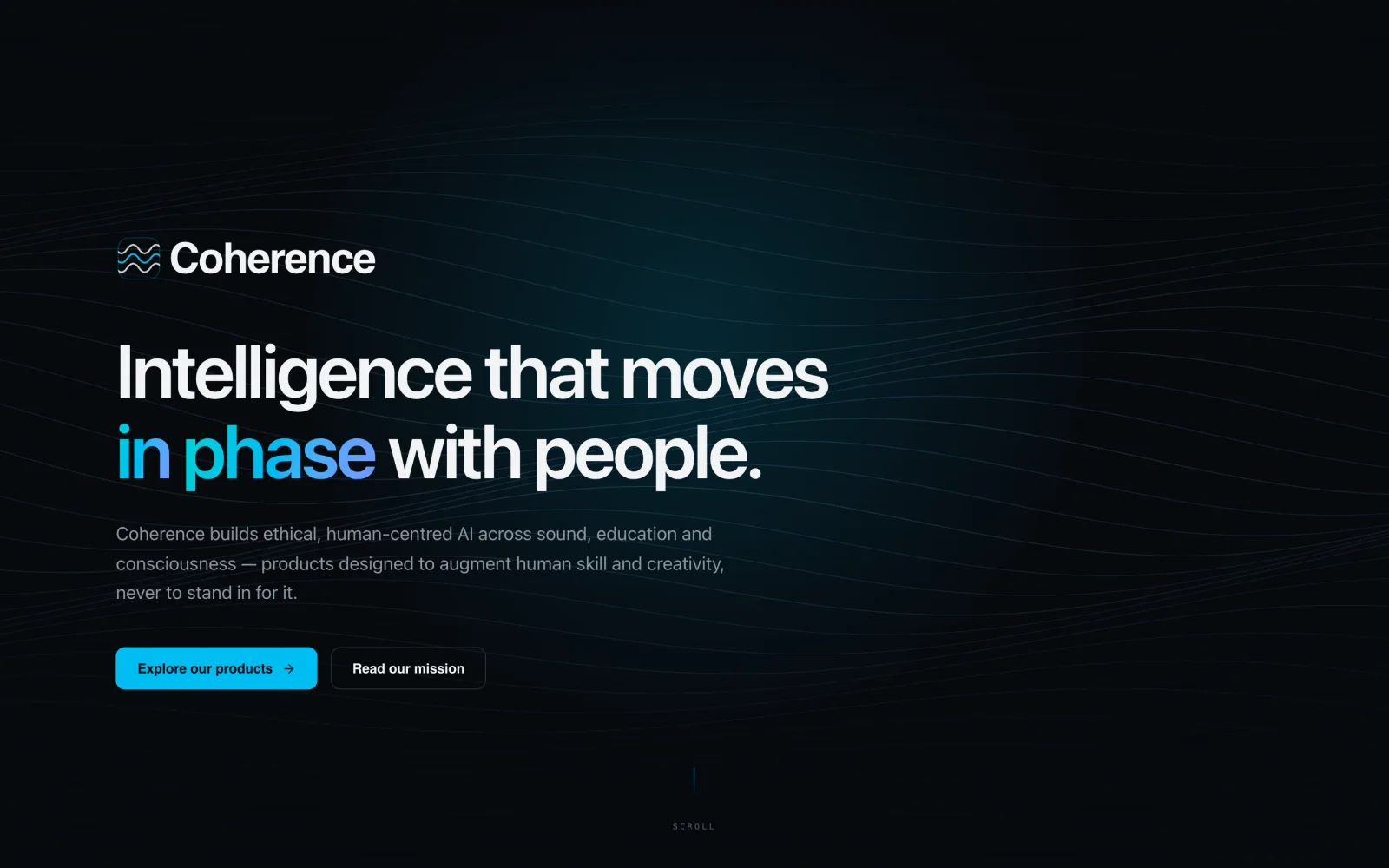
Live at coherence.com: brand identity generated with AI agents we directed, the motion system and website for the group behind Sonora, AboutAI, WakeUp and MudShadows. Agent work remains in build.


Live at domainbooth.com for DomainBooth, a premium domain brokerage: a new animated mark, every page redesigned and rebuilt with designed mobile layouts, and a custom CMS for its sales record, featured names, press and enquiries.
Apps, platforms and campaigns for these teams, long before the AI work. Every one is written up on the work page — what we did, and where our part ended.




















