MFG.01
Predictive Maintenance
Failure prediction from sensor histories, and the alarm-fatigue problem that decides whether anyone acts on it.
Open pageA person commits each order. Maintenance, inspection, planning and reconciliation for industrial operations — the system reads telemetry and correspondence, prepares the work order or the purchase order, and a person commits it.

Maintenance, inspection, planning and reconciliation for industrial operations — the system reads telemetry and correspondence, prepares the work order or the purchase order, and a person commits it.
Where language models add capability in an industrial setting is the unstructured half of the operation: the correspondence, the shipping documents, the maintenance notes, the invoice that does not match the purchase order. We extract those into structured signals and feed them to the systems that already run the plant — the ERP, the maintenance system, the optimiser — rather than replacing any of them.
The boundary is consistent. The system predicts a failure window and raises a ranked work order; a technician decides. It reads a delay notice and proposes rerouting or reallocation; a planner confirms. It prepares a purchase order when a threshold is crossed; a buyer commits it. An agent placing orders unsupervised converts a data error into a financial one, and we do not build that.
AI data analysts that read logistics feeds, supplier correspondence and public risk sources, connect them to the parts and lines they affect, and propose rerouting or reallocation for a planner to confirm.
SEE SUPPLY CHAIN PLANNING →Internal Ops agents that monitor inventory levels, prepare purchase orders when thresholds are crossed, handle routine supplier correspondence and write structured results back into SAP or Oracle. The conversation and the commitment stay with your buyers.
SEE INTERNAL OPS AGENTS →Cross-platform workflows that link sensor telemetry to your maintenance system, raising a ranked work order with the evidence attached ahead of a predicted failure window.
SEE PREDICTIVE MAINTENANCE →Low-touch financial automation that extracts line items from Bills of Lading and freight invoices and reconciles them against the original POs, with discrepancies routed to a person rather than discarded.
SEE FINANCIAL AUTOMATION →These are engineering controls we build into the architecture, not certifications. QQuantum.ai holds no security certifications, and the audits and attestations your sector requires remain yours to run — see our trust centre.
Failure prediction from sensor histories, and the alarm-fatigue problem that decides whether anyone acts on it.
Open pageVision models on the line, where lighting, fixturing and a rare defect class matter more than the architecture.
Open pagePlanning under disruption, supplier risk signals, and why the optimiser is rarely the missing piece.
Open pageBy reading what the planning system cannot. Order confirmations, delay notices, shipping documents and public risk sources are parsed into structured events and cross-referenced against your shipment schedules and bill of materials. When a delay becomes probable, the system propagates the consequences — which lines, which orders, what the options are — and proposes rerouting or reallocation for a planner to confirm. Detecting that something has happened and propagating it quickly is achievable; predicting the next unprecedented shock is not, and we do not claim it.
Agents monitor inventory levels, prepare purchase orders when thresholds are crossed, handle routine supplier correspondence and write structured results back into SAP or Oracle. A person still commits the order — an agent placing orders unsupervised converts a data error into a financial one, which is not a trade we would recommend.
It is the automated link between machine health and human action. Sensor telemetry connects to your maintenance system, so a degrading vibration, temperature or throughput signal becomes a ranked work order with the evidence attached — a predicted window, not a moment. Whether it reduces downtime is measured on your assets and your outcome log, not asserted in advance.
Multimodal extraction reads line items from Bills of Lading and freight invoices — across formats and carriers — and reconciles them against the original POs. Clean matches flow through to your ERP; discrepancies are typed and routed to a person for review, never discarded.
Start with an architecture review of your maintenance, planning or reconciliation workflow — and the master data underneath it.
30-minute technical call · no deck
What we built, what stage it is at, and a link to the live thing wherever there is one.


yourOS is an operating system with an AI at its heart. You talk to it like a person, out loud or typed. It makes your calls, plans your days and works on your projects with a crew of agents, on your own private server. Our own product, built from the first commit; the waitlist is open.


Website, backend and app assets for Sonora, a free AI sound-therapy app on iOS and Android published by Cognitive AI.


Brand, website, prototype, apps on five platforms, the AI backend and the algorithm-intelligence pipeline for Podswap, a social growth engine that runs without a human in the loop.


In closed beta: Roxy, a private AI assistant with permanent memory running on infrastructure the user owns. Brand, site, product, backend and conversational design.

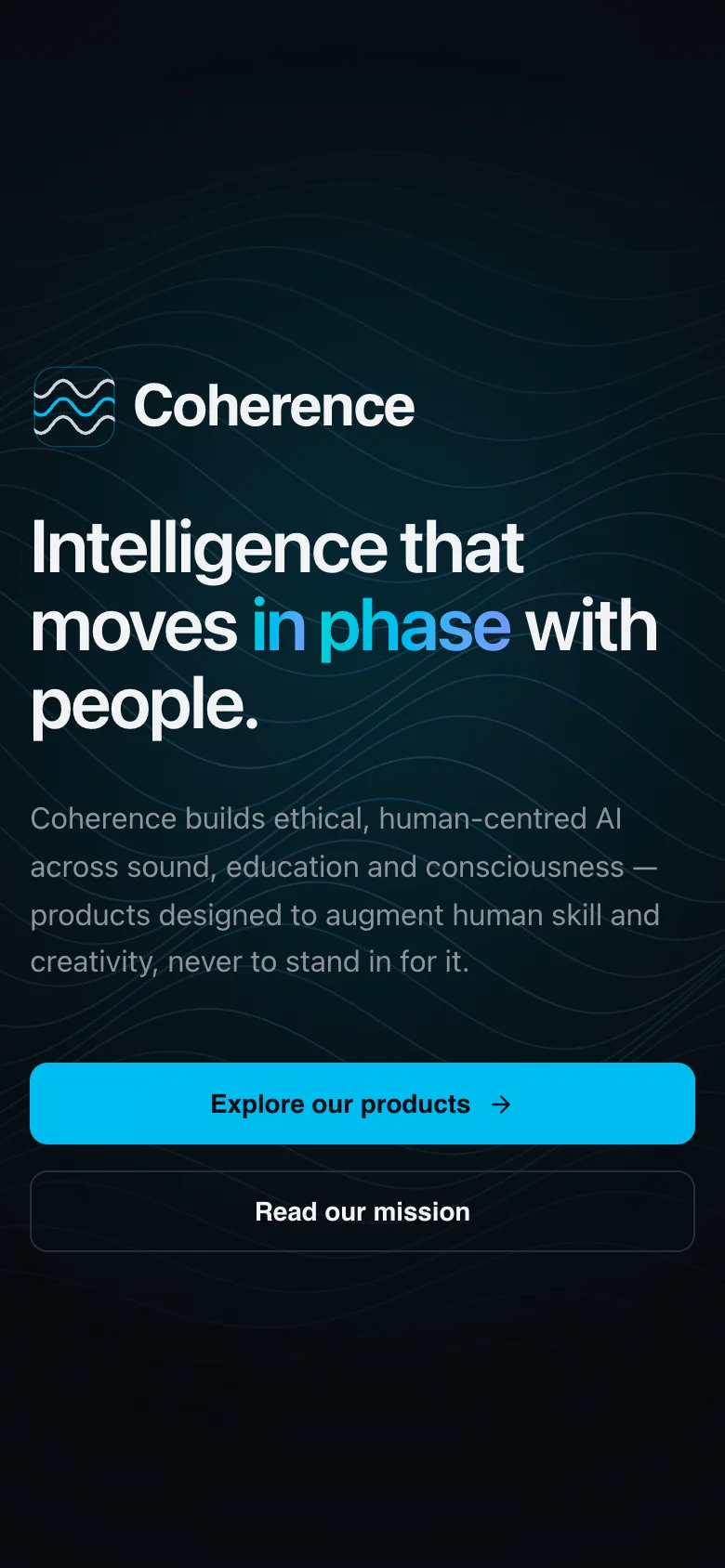
Live at coherence.com: brand identity generated with AI agents we directed, the motion system and website for the group behind Sonora, AboutAI, WakeUp and MudShadows. Agent work remains in build.


Live at domainbooth.com for DomainBooth, a premium domain brokerage: a new animated mark, every page redesigned and rebuilt with designed mobile layouts, and a custom CMS for its sales record, featured names, press and enquiries.
Apps, platforms and campaigns for these teams, long before the AI work. Every one is written up on the work page — what we did, and where our part ended.




















