Dark theme
WELCOME TO QQUANTUM

Let Qubi show you around.

Choose how you’d like to explore.

Don’t agreeGo to yourOS instead ↗

Both choices allow Google Analytics, so we can see which pages help.

Sound is your choice. Essential cookies keep the site working. Continuing either way also allows Google Analytics (visits and pages viewed).

Read our Terms, Privacy and Cookies.

Change your choices anytime from the footer.

Getting Qubi ready.
Technology

OpenAI GPT,
deployed your way.

The broadest ecosystem, the most mature tooling, and an Azure deployment path that solves a lot of enterprise procurement problems. Here is where it is the right call.

All Model Families →
Pixel illustration for OpenAI GPT Integration: two complementary connectors joined through a visible adapter.

Specification

Provider
OpenAI, United States
Current frontier model
gpt-6-astra, released 3 September 2026
Weights
Closed for the frontier line; OpenAI has released some open-weight models separately
Context window
1,050,000 tokens on the current frontier model — 922,000 in, 128,000 out. Smaller and tier-dependent below it
Modalities
Text and image in, text out. No realtime, audio, embedding or fine-tuning endpoint on the frontier model
Access paths
OpenAI API, Azure OpenAI inside your own tenancy and region, or Amazon Bedrock
Published price
USD 10 per million input tokens and USD 50 per million output. A request above 272,000 input tokens moves in full to higher long-context rates
Cost levers
Model tiering, prompt caching at a tenth of the input price, batch endpoints, and structured outputs to cut retry traffic
Vendor access gating
OpenAI designates the frontier model Critical for cybersecurity under its Preparedness Framework. Standard access refuses advanced offensive-security work, and OpenAI states requests may be slowed or paused
Where we use it
Broad general capability, computer use, and the deepest third-party integration ecosystem

Provider-published specifications as of 5 September 2026, not figures we measured. Model families move quickly — check the provider's own documentation before committing to a number.

What the current generation makes buildable

The September 2026 frontier release moved two things that decide what is worth scoping. The model operates software directly — browsers, spreadsheets, desktop applications, a shell — and it holds roughly a million tokens of context. Each takes a category of work that used to be an integration project and makes it something a model can attempt end to end.

01

Systems with no API

The old answer to a system that cannot be integrated was a scripted browser agent that broke whenever the markup moved. A model that drives the interface the way an operator does fails differently — it adapts to a moved button rather than dying on a changed selector. Same territory as our cross-platform workflows work, with a wider reach and the same terms-of-service check during scoping.
02

Whole-corpus reasoning

A million-token window holds an entire codebase, a full contract set or a year of tickets in a single pass. It does not retire retrieval; it moves the boundary, and it is priced such that the boundary is now a cost decision rather than a capability one.
03

Long-running desk work

Multi-step tasks that span applications — reconciling a report against a source system, working a queue, assembling a filing — become one supervised agent instead of a chain of brittle point-to-point integrations.
04

Migration and audit passes

Work whose real difficulty was holding enough of a system in view at once: dependency audits, framework migrations, and tracing a business rule through a codebase nobody has owned for years.

What it does not change

  • Computer use is supervised work.

    On the provider's own published computer-use benchmark the current model completes a little under three quarters of tasks. That is a real step change, and it is also roughly one task in four failing — which describes a checkpoint-and-approval design, not something you point at a production console and walk away from. Anyone quoting that number as grounds for removing the operator has read it backwards.
  • The vendor gate is now a thing to design around.

    OpenAI has classed the frontier model Critical for cybersecurity under its Preparedness Framework, and states that standard access refuses advanced offensive-security tasks and that requests may be slowed or paused. For most business workloads this never fires. For security tooling, penetration-test support or malware analysis it is a live constraint, and a reason to keep a second family behind the same interface — which is what we would have advised regardless.
  • Price still decides most architectures.

    A million-token window billed per token is not a reason to stop retrieving. Sending a million tokens to answer a question that eight thousand would have answered is the most expensive habit available in 2026. Long context is a lever to reach for deliberately, not a default.
  • It is closed and hosted.

    None of this changes the residency answer. Where data may not leave your infrastructure, this family is out and the conversation moves to open weights.

Where it fits well

01

Azure-committed organisations

Azure OpenAI puts models inside your existing subscription, region and compliance boundary. For enterprises with Azure commitments, this frequently converts a months-long vendor onboarding into a configuration change — a practical advantage that often outweighs modest capability differences.
02

Multimodal work

Mature handling of images and audio alongside text, useful for document understanding where layout carries meaning, and for voice interfaces.
03

Structured output

Reliable schema-constrained generation, which removes a category of parsing failure when model output feeds a downstream system.
04

Small-model economics

The lower tiers are strong for the price on classification, extraction and routing — often the correct choice for the high-volume steps in a system whose hard step uses something larger.

The practical levers

  • Tier aggressively.

    The price spread across the family is large. Most production systems should route the majority of traffic to a smaller model and reserve the larger ones for steps that measurably need them — decided by evaluation, not by intuition.
  • Use structured outputs.

    Where output is consumed by code, schema-constrained generation removes the JSON-syntax class of parsing failure rather than handling it. This is strictly better than prompting for JSON and hoping.
  • Batch what is not interactive.

    Asynchronous endpoints substantially reduce cost for backfills, document processing and offline analysis.
  • Fine-tune narrowly, and only after retrieval.

    Fine-tuning a small model on a well-defined task can beat a large model on both cost and quality. It is rarely the right first move — retrieval and prompt work usually get you there faster and are far easier to change.

Where we would choose something else

Where no data may leave your infrastructure. The frontier line's weights are not offered for self-hosting, so the requirement itself decides it and the conversation moves to open weights.

Where the task is narrow, high-volume and well defined — classification, extraction against a fixed schema, reranking. A small model will frequently match quality at a fraction of the cost, and reaching for a frontier model there is the most common avoidable line on an AI bill.

Where long-document or native video and audio work dominates, Gemini has a structural advantage; where agentic tool use and instruction adherence under many simultaneous constraints dominate, we more often reach for Claude. These are workload judgements settled by benchmarking against your task, not by reputation.

We are not an OpenAI reseller and receive nothing for recommending them.

Questions

Questions about OpenAI GPT Integration.

Is Azure OpenAI different from the OpenAI API?

Same underlying models, different contractual and operational surface. Azure gives you regional deployment, your existing enterprise agreement, Entra ID authentication and Azure monitoring. Model availability has historically lagged the direct API by weeks to months. For most enterprises the procurement and residency advantages outweigh that lag comfortably.

Is our data used for training?

Under OpenAI's and Microsoft's published terms at the time of writing, API inputs are not used for training by default and Azure OpenAI processing stays within your tenancy under your existing agreement. We confirm the specific configuration in the architecture document rather than relying on a general policy statement — verify against the provider's current terms, because they change.

GPT or Claude?

Workload-dependent, and we benchmark rather than assert. As a rough tendency, Azure alignment and multimodal requirements pull toward OpenAI; very long context and complex agentic tool use pull toward Claude. But the differences on any specific task are frequently smaller than the difference between a well-engineered and a poorly engineered system around either.

Does the Critical cybersecurity designation affect us?

Probably not, but it is worth checking before you commit. OpenAI has designated its current frontier model as reaching the Critical cybersecurity threshold in its Preparedness Framework, and says standard access refuses advanced offensive-security tasks and that requests may be slowed or paused. Ordinary business workloads do not touch this. Security teams, anyone building scanning or penetration-test tooling, and anyone analysing malicious code should assume they will hit it, and should either apply for the vetted-access programme or keep a second model family behind the same interface. Confirm the current terms with OpenAI rather than relying on this page.

Should we fine-tune?

Usually not first. Fine-tuning teaches format, tone and narrow task behaviour; it does not reliably teach facts, and facts are what most people are actually trying to add — which is retrieval's job. Where a task is narrow, extremely high volume and stable, fine-tuning a small model is a genuine cost win worth pursuing after retrieval and prompting have been exhausted.

Already on Azure?

That usually simplifies the model decision considerably. Let us look at what you have.

30-minute technical call · no deck

Shipped & in build

Real work. Check it yourself.

What we built, what stage it is at, and a link to the live thing wherever there is one.

The updated yourOS homepage: Roxy’s open ring surrounded by bento cards for calls, voice, translation, building, design, apps and more.
The yourOS homepage on a phone, with its compact navigation, welcome film button and bento cards.
youros.tech — the homepage bento hero
Our own · coming soon

yourOS

yourOS is an operating system with an AI at its heart. You talk to it like a person, out loud or typed. It makes your calls, plans your days and works on your projects with a crew of agents, on your own private server. Our own product, built from the first commit; the waitlist is open.

What we built
  • Operating system
  • Roxy
  • Agent crew
  • Voice calls
  • App store
  • Website
Meet yourOS →
The Sonora homepage on desktop: a full-bleed dune landscape behind the headline “Transform Your Life with Sound”, with App Store and Google Play download buttons.
The Sonora homepage on a mobile viewport, showing the same hero reflowed to a single column.
sonora.com — homepage, 1440×900
Live · iOS · Android

Sonora

Website, backend and app assets for Sonora, a free AI sound-therapy app on iOS and Android published by Cognitive AI.

What we built
  • Website
  • Backend
  • App assets
Read the case study →
The updated Podswap homepage on desktop: “Grow on Instagram and TikTok for free, with real engagement from creators your size”, beside a tilted wall of exchange, tool and guide cards on a violet gradient.
The updated Podswap homepage on a phone, with its floating navigation, Instagram and TikTok engagement headline and tilted tool cards.
podswap.app — homepage, 1440×900
Five platforms

Podswap

Brand, website, prototype, apps on five platforms, the AI backend and the algorithm-intelligence pipeline for Podswap, a social growth engine that runs without a human in the loop.

What we built
  • Brand
  • Website
  • Prototype
  • Apps on five platforms
  • AI backend
  • Algorithm pipeline
Read the case study →
The unOpen.AI homepage introducing Roxy, a private AI assistant that remembers who you are.
The unOpen.AI homepage on a mobile viewport.
unopen.ai — homepage, 1440×900
Prototype · closed beta

unOpen.AI

In closed beta: Roxy, a private AI assistant with permanent memory running on infrastructure the user owns. Brand, site, product, backend and conversational design.

What we built
  • Brand
  • Site
  • Product
  • Backend
  • Conversational design
Read the case study →
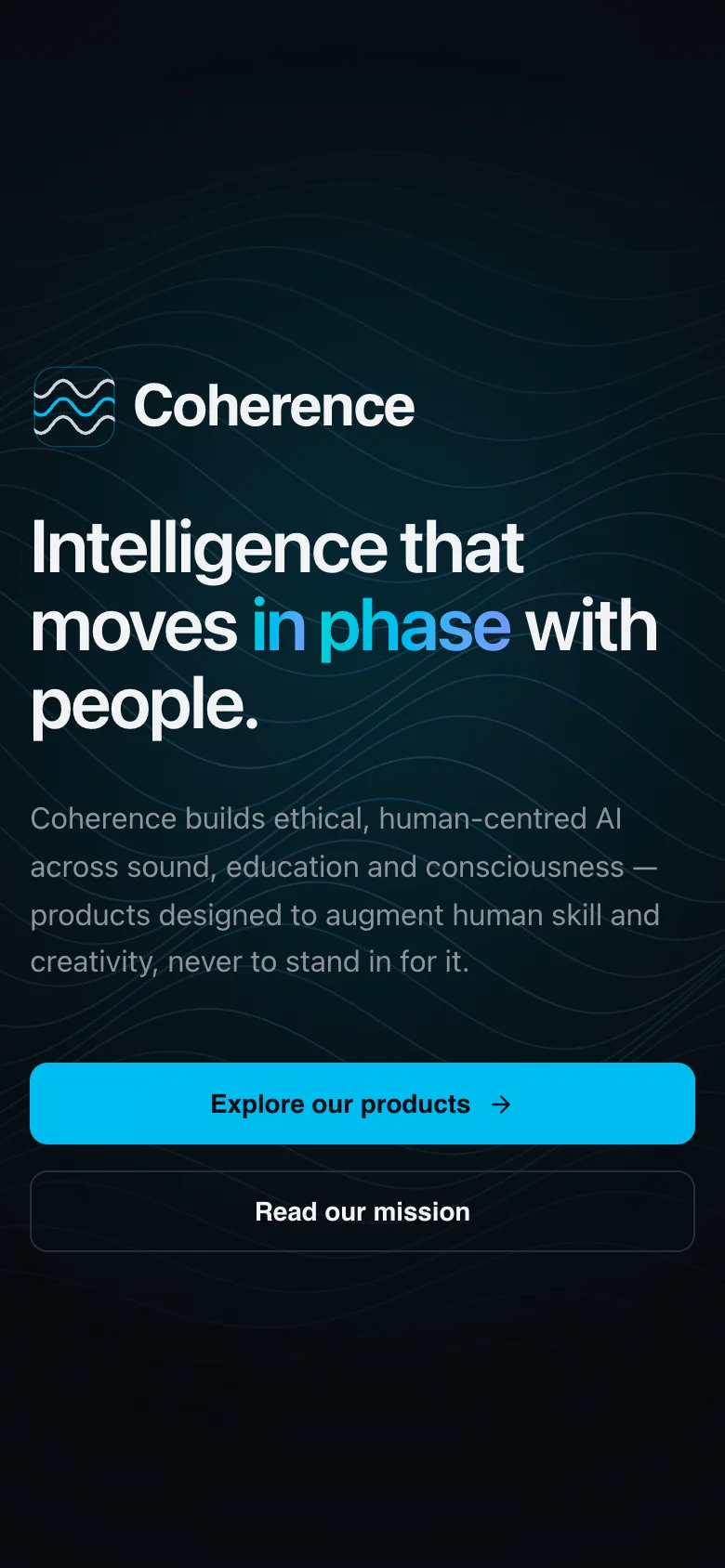
coherence.com on desktop, headed "Intelligence that moves in phase with people".
coherence.com on a mobile viewport, reflowed to a single column.
coherence.com — homepage, 1440×900
Live

Coherence

Live at coherence.com: brand identity generated with AI agents we directed, the motion system and website for the group behind Sonora, AboutAI, WakeUp and MudShadows. Agent work remains in build.

What we built
  • Brand identity
  • Motion system
  • Live website
  • Agent work — in build
Read the case study →
The new Domain Booth homepage on desktop: the headline “Premium Domains. Serious Buyers. Proven Results.” beside the animated DB monogram.
The new Domain Booth homepage on a phone, reflowed to a single column.
Our build of the Domain Booth homepage — 1440×900
Live

Domain Booth

Live at domainbooth.com for DomainBooth, a premium domain brokerage: a new animated mark, every page redesigned and rebuilt with designed mobile layouts, and a custom CMS for its sales record, featured names, press and enquiries.

What we built
  • Animated mark
  • Every page redesigned
  • Designed mobile layouts
  • Custom CMS
Read the case study →
Who we have built for

Twenty-one years. Names you know.

Apps, platforms and campaigns for these teams, long before the AI work. Every one is written up on the work page — what we did, and where our part ended.

See all of our work →
  • BBC Good Food logo
  • Charities Aid Foundation logo
  • GAME logo
  • NatWest logo
  • Next logo
  • NSPCC logo
  • Tesco logo
  • Worldpay logo
  • Samsung logo
  • Sony logo
  • Land Rover logo
  • UAP Limited logo
  • Netflix logo
  • Amazon Prime Video logo
  • Mercedes-Benz dealerships logo
  • San Miguel logo
  • Biovene Barcelona logo
  • Seventy7 logo
  • Littlewoods logo
  • Smile logo
  • The Co-operative Bank logo