Dark theme
WELCOME TO QQUANTUM

Let Qubi show you around.

Choose how you’d like to explore.

Don’t agreeGo to yourOS instead ↗

Both choices allow Google Analytics, so we can see which pages help.

Sound is your choice. Essential cookies keep the site working. Continuing either way also allows Google Analytics (visits and pages viewed).

Read our Terms, Privacy and Cookies.

Change your choices anytime from the footer.

Getting Qubi ready.
Brussels

Brussels.
Multilingual by law.

Everywhere else we spend the first meeting explaining what the AI Act says. In Brussels the client often has a better sense of it than we do, because someone down the corridor worked on it. That changes the conversation for the better: it starts at classification, obligations and dates rather than at whether any of this is allowed, and it leaves more time for the two things that are genuinely hard here — languages and record-keeping.

  • Worked from Barcelona
  • Multilingual by requirement
  • Same hour as us
Last reviewed 5 September 2026 · Engineering guidance, not legal advice.
All Where We Work →
Pixel illustration for Brussels AI Consultants: a destination postcard for Brussels, with an illustrative city silhouette and a travel route.

What is actually different here

01

Which supervisor applies depends on what you are

This is the one city where the answer is genuinely not obvious. A Belgian company or association answers to the Belgian data protection authority, the Autorité de protection des données or Gegevensbeschermingsautoriteit. EU institutions, bodies and agencies do not: they are covered by their own regulation and supervised by the European Data Protection Supervisor. If your organisation sits somewhere between the two — a body funded by an institution, or a contractor processing on its behalf — that distinction decides which rulebook the documentation has to be written against, and it is worth settling before the design work rather than during it.
02

Three official languages, plus the one everyone works in

Belgium runs in French, Dutch and German, the institutions add a further two dozen, and the working language in the room is often English. A document system here is multilingual as a starting condition, not as a phase two. The engineering consequences are concrete: retrieval quality varies by language, extraction accuracy varies by language, and an evaluation set that is ninety per cent English will tell you almost nothing about how the system behaves in Dutch. We build the test set per language or we do not claim the number.
03

Proximity to the rulemaking is a real advantage

Clients here tend to have direct access to how a rule was meant to be read, which shortens arguments considerably. It also raises the bar on what we are expected to produce: the technical documentation, the record of what the system does and the description of its limits are read by people who read that sort of thing professionally. That is a reasonable standard, and it is the standard we would want anyway.
04

In-country compute is available

Belgium hosts a long-established hyperscale region, with the main Irish and German regions a short hop away, so keeping storage and inference inside Belgium or inside the EU is a configuration decision rather than a special build. As always, region and service availability changes over time — confirm the specifics against the provider's current documentation when you commit to a design.

The work that comes out of this city

Brussels produces a kind of work that barely exists elsewhere: organisations whose core output is understanding, positioning and responding to text. Associations, federations, public affairs practices and policy teams all live in consultations, position papers, transpositions and correspondence, in several languages, on deadlines set by someone else.

The useful system for that is not a chatbot. It is retrieval done properly over a corpus that the organisation already owns — with citations back to the source paragraph, with version awareness so that a superseded draft is not quoted as current, and with an honest signal when the answer is not in the corpus at all. The failure mode that matters here is a confident synthesis of two documents that contradict each other, and the defence against it is architectural rather than a matter of prompt wording. That is covered under retrieval systems, and the regulatory frame under the EU AI Act.

Logistics is the other Brussels constant. Belgium is a transit country with major ports and air freight on either side of the capital, and the resulting document flows have the same shape as anywhere else with an extra language or two attached. That work is described in our logistics document pipeline.

Chemicals and pharmaceutical organisations here bring regulatory dossiers, safety documentation and literature review, where the requirement is traceability rather than fluency: every assertion has to point somewhere. The life sciences version of that work is under life sciences research.

How a brussels project actually runs

01

Discovery in person, on your premises

Barcelona to Brussels is under two hours. We come for the first workshop, and where the material cannot leave your building we do the corpus review on site rather than asking for a copy of it.
02

Then remote, with no offset

Same clock as Barcelona, so the working day is shared end to end. For organisations working to consultation deadlines, a same-day answer is worth more than a faster model.
03

And back for handover

Handover includes the technical description of what the system does and where its limits are, in a form your own people can put in front of a reviewer. After that it runs in your infrastructure.
Questions

Questions about Brussels AI Consultants.

Do you have a Brussels office?

No. We have one office and it is in Barcelona. We travel to Brussels for discovery and handover and for anything that has to happen in a room. In a city where a great many organisations maintain an address purely to say they have one, we would rather not add to it.

Can you be procured by an EU institution?

Not directly through the large framework contracts — we are a small firm and we are not on them, and pretending otherwise would waste your time. What does work in practice is direct engagement with associations, federations and private organisations, or subcontracting to a prime who holds the framework. If the procurement route requires something we cannot meet, we will say so in the first call rather than after four weeks of paperwork.

Do you do public affairs or policy advice?

No. We build software. We can build the system that finds, extracts, compares and tracks the documents your policy people work from, and we will not offer an opinion on what the policy should be. The division of labour is deliberate: you would not want engineering advice from a lobbyist either.

How do you handle a corpus in four languages?

By treating each language as its own quality problem. Retrieval, extraction and generation quality all differ by language, and averaging them into a single accuracy figure hides exactly the case that will embarrass you. We build a labelled evaluation set per language, report per language, and where one is materially worse we say so and either fix it or scope it out rather than shipping a number that flatters the system.

What does a Brussels engagement cost?

Our ranges are on the pricing page, in euros and exclusive of VAT. We do not price by postcode. Multilingual work sits higher in a range than a single-language equivalent, because the evaluation effort multiplies even when the build does not.

In Brussels, with a corpus
nobody can search?

Thirty minutes on the documents, the languages and what a retrieval system would honestly deliver.

30-minute technical call · no deck

Shipped & in build

Real work. Check it yourself.

What we built, what stage it is at, and a link to the live thing wherever there is one.

The updated yourOS homepage: Roxy’s open ring surrounded by bento cards for calls, voice, translation, building, design, apps and more.
The yourOS homepage on a phone, with its compact navigation, welcome film button and bento cards.
youros.tech — the homepage bento hero
Our own · coming soon

yourOS

yourOS is an operating system with an AI at its heart. You talk to it like a person, out loud or typed. It makes your calls, plans your days and works on your projects with a crew of agents, on your own private server. Our own product, built from the first commit; the waitlist is open.

What we built
  • Operating system
  • Roxy
  • Agent crew
  • Voice calls
  • App store
  • Website
Meet yourOS →
The Sonora homepage on desktop: a full-bleed dune landscape behind the headline “Transform Your Life with Sound”, with App Store and Google Play download buttons.
The Sonora homepage on a mobile viewport, showing the same hero reflowed to a single column.
sonora.com — homepage, 1440×900
Live · iOS · Android

Sonora

Website, backend and app assets for Sonora, a free AI sound-therapy app on iOS and Android published by Cognitive AI.

What we built
  • Website
  • Backend
  • App assets
Read the case study →
The updated Podswap homepage on desktop: “Grow on Instagram and TikTok for free, with real engagement from creators your size”, beside a tilted wall of exchange, tool and guide cards on a violet gradient.
The updated Podswap homepage on a phone, with its floating navigation, Instagram and TikTok engagement headline and tilted tool cards.
podswap.app — homepage, 1440×900
Five platforms

Podswap

Brand, website, prototype, apps on five platforms, the AI backend and the algorithm-intelligence pipeline for Podswap, a social growth engine that runs without a human in the loop.

What we built
  • Brand
  • Website
  • Prototype
  • Apps on five platforms
  • AI backend
  • Algorithm pipeline
Read the case study →
The unOpen.AI homepage introducing Roxy, a private AI assistant that remembers who you are.
The unOpen.AI homepage on a mobile viewport.
unopen.ai — homepage, 1440×900
Prototype · closed beta

unOpen.AI

In closed beta: Roxy, a private AI assistant with permanent memory running on infrastructure the user owns. Brand, site, product, backend and conversational design.

What we built
  • Brand
  • Site
  • Product
  • Backend
  • Conversational design
Read the case study →
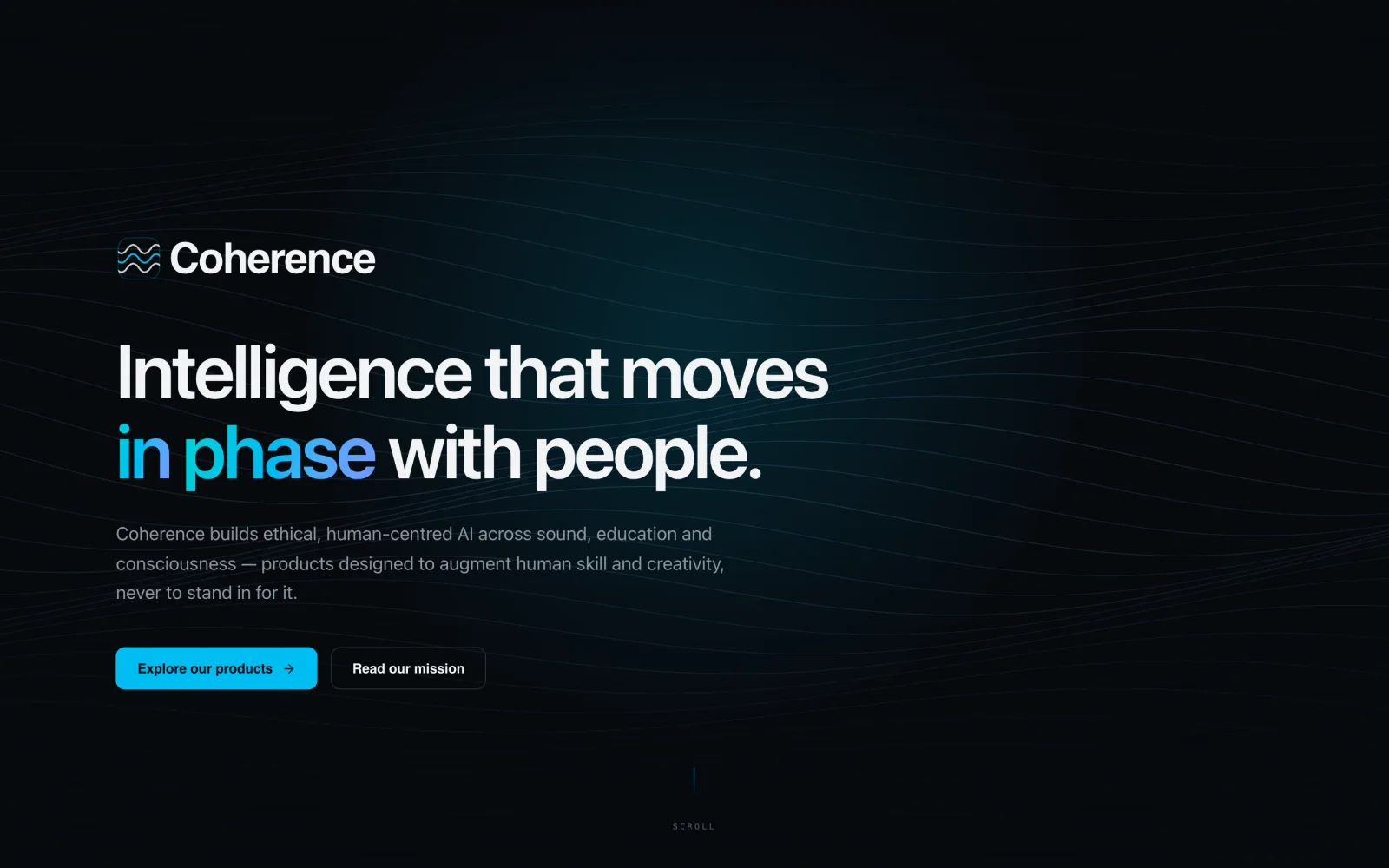
coherence.com on desktop, headed "Intelligence that moves in phase with people".
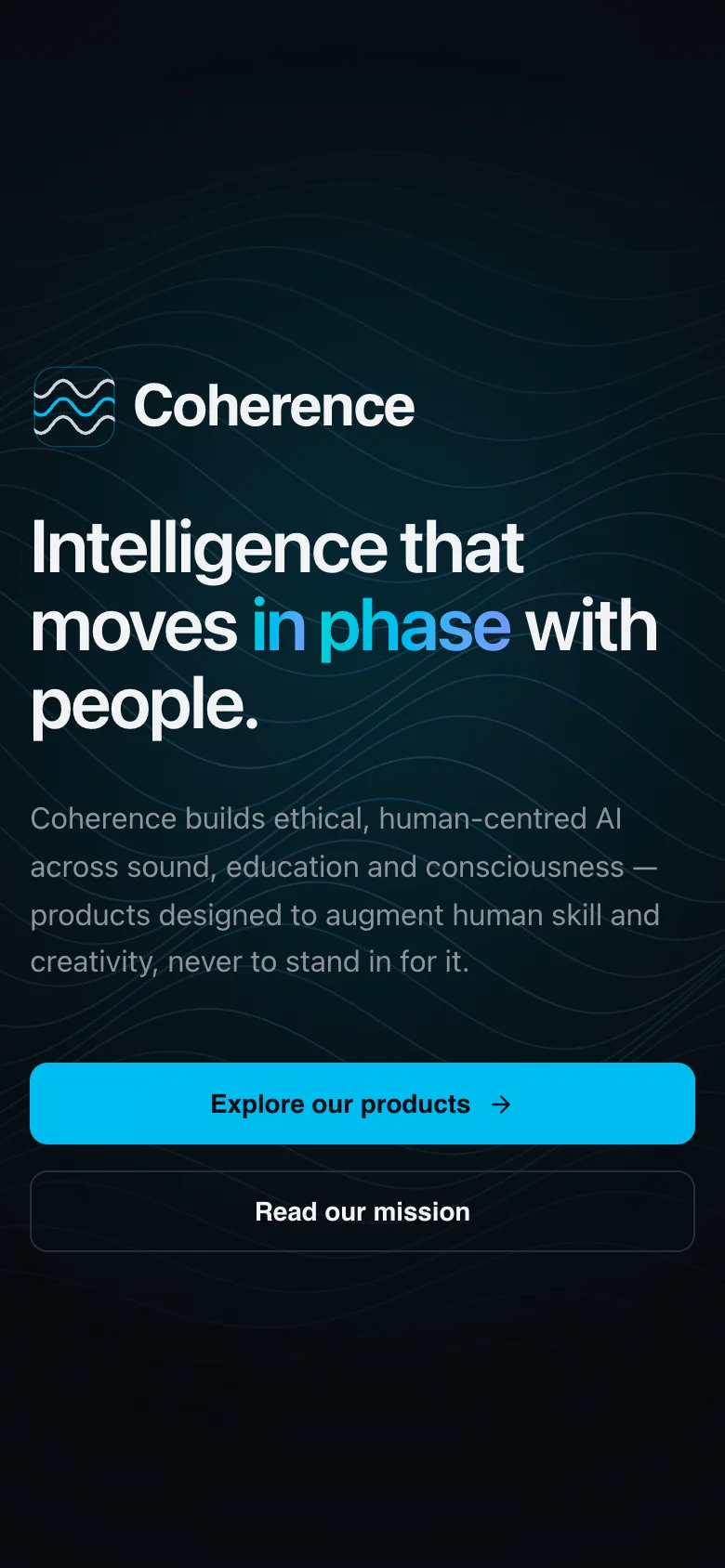
coherence.com on a mobile viewport, reflowed to a single column.
coherence.com — homepage, 1440×900
Live

Coherence

Live at coherence.com: brand identity generated with AI agents we directed, the motion system and website for the group behind Sonora, AboutAI, WakeUp and MudShadows. Agent work remains in build.

What we built
  • Brand identity
  • Motion system
  • Live website
  • Agent work — in build
Read the case study →
The new Domain Booth homepage on desktop: the headline “Premium Domains. Serious Buyers. Proven Results.” beside the animated DB monogram.
The new Domain Booth homepage on a phone, reflowed to a single column.
Our build of the Domain Booth homepage — 1440×900
Live

Domain Booth

Live at domainbooth.com for DomainBooth, a premium domain brokerage: a new animated mark, every page redesigned and rebuilt with designed mobile layouts, and a custom CMS for its sales record, featured names, press and enquiries.

What we built
  • Animated mark
  • Every page redesigned
  • Designed mobile layouts
  • Custom CMS
Read the case study →
Who we have built for

Twenty-one years. Names you know.

Apps, platforms and campaigns for these teams, long before the AI work. Every one is written up on the work page — what we did, and where our part ended.

See all of our work →
  • BBC Good Food logo
  • Charities Aid Foundation logo
  • GAME logo
  • NatWest logo
  • Next logo
  • NSPCC logo
  • Tesco logo
  • Worldpay logo
  • Samsung logo
  • Sony logo
  • Land Rover logo
  • UAP Limited logo
  • Netflix logo
  • Amazon Prime Video logo
  • Mercedes-Benz dealerships logo
  • San Miguel logo
  • Biovene Barcelona logo
  • Seventy7 logo
  • Littlewoods logo
  • Smile logo
  • The Co-operative Bank logo