Dark theme
WELCOME TO QQUANTUM

Let Qubi show you around.

Choose how you’d like to explore.

Don’t agreeGo to yourOS instead ↗

Both choices allow Google Analytics, so we can see which pages help.

Sound is your choice. Essential cookies keep the site working. Continuing either way also allows Google Analytics (visits and pages viewed).

Read our Terms, Privacy and Cookies.

Change your choices anytime from the footer.

Getting Qubi ready.
Technology

Inference optimisation.
What serving costs.

On a self-hosted deployment, inference efficiency is the difference between one GPU and four. These are the levers, in roughly the order of return we see when we apply them.

All Technology & Model Stack →
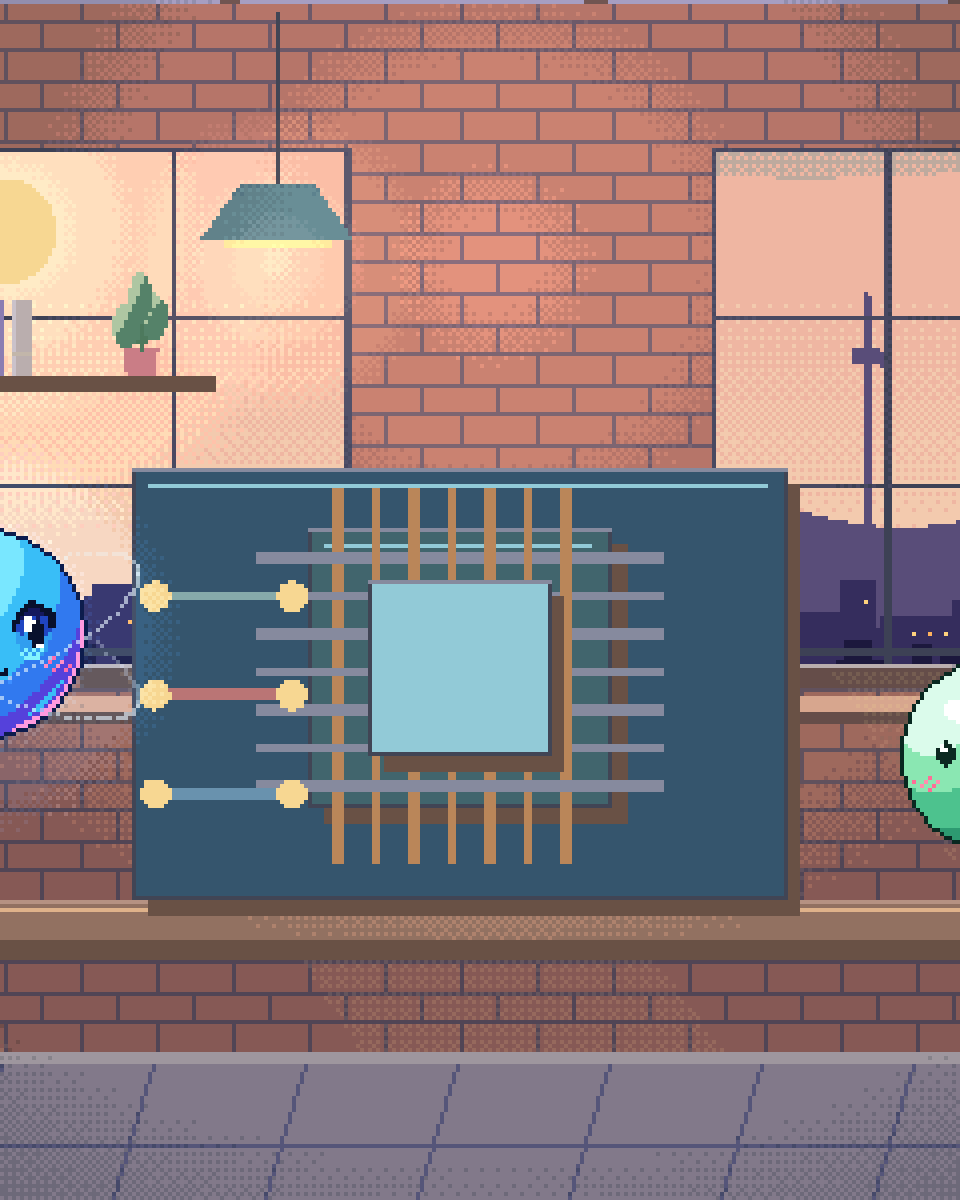
Pixel illustration for Inference Optimisation: a compact processing mechanism with parallel tracks.

The levers, in order

01

Continuous batching

The single largest throughput win, and mostly free — a modern serving stack processes many requests together and admits new ones as slots free rather than waiting for a batch to complete. If you are running a naive one-request-at-a-time loop, this alone is typically a multiple.
02

Quantisation

Running weights at eight or four bits rather than sixteen cuts memory proportionally, which often means fitting on smaller or fewer accelerators. Quality cost is task-dependent and frequently unmeasurable — but it must be measured, not assumed.
03

KV cache management

The per-request attention cache dominates memory at high concurrency. Paged attention, prefix sharing across requests with a common system prompt, and eviction policy decide how many concurrent users a node supports far more than raw compute does.
04

Speculative decoding

A small model drafts tokens that the large model verifies in parallel, cutting latency without changing the output distribution. Real gains on latency-sensitive paths; extra complexity, and the draft model has to be well matched to be worth it.

Measure the right thing

Throughput and latency pull against each other and optimising one blindly damages the other. Larger batches raise tokens per second and raise the time an individual user waits. Which matters depends on whether a person is watching, and that answer differs per endpoint in the same system.

For interactive work the metric users actually feel is time to first token, not total generation time — streaming means they start reading immediately, and a fast first token with a moderate rate feels better than a slow first token with a fast rate. For batch work, only total throughput matters and latency is irrelevant.

Measure at realistic concurrency. Single-request benchmarks are close to useless for capacity planning, because the whole point of continuous batching is that per-request cost falls as concurrency rises. A node that looks marginal on a single-request test frequently serves the whole department.

The cheapest optimisation

None of the above. It is sending fewer tokens. Context that is re-sent unchanged on every turn, retrieved passages nobody needed, verbose system prompts, and reasoning enabled on requests that did not require it are all pure cost — and they are typically a larger share of the bill than any serving inefficiency.

Before tuning a serving stack, look at what is actually in the requests. In our experience context hygiene alone has often produced a material reduction before any serving change, and it requires no infrastructure change at all.

Questions

Questions about Inference Optimisation.

How much quality does quantisation cost?

Task-dependent, sometimes nothing measurable at eight bits, more noticeable at four and more so on reasoning-heavy work. It is a measurement rather than a rule: run your evaluation set at each precision and decide with the numbers in front of you.

Which serving stack should we use?

For production GPU serving, vLLM is the usual answer — mature continuous batching, paged attention and broad model support. Ollama is designed for local and development use rather than high-concurrency serving. The choice is less consequential than configuring whichever you pick properly.

Does this apply to hosted APIs too?

The serving levers are the provider's problem, but prompt caching and context hygiene are yours and behave the same way. On a hosted API, designing context so the stable part is a genuine prefix is the single largest cost lever available to you.

Fewer tokens beats
faster tokens.

We look at what is actually in your requests before we touch the serving stack.

30-minute technical call · no deck

Shipped & in build

Real work. Check it yourself.

What we built, what stage it is at, and a link to the live thing wherever there is one.

The updated yourOS homepage: Roxy’s open ring surrounded by bento cards for calls, voice, translation, building, design, apps and more.
The yourOS homepage on a phone, with its compact navigation, welcome film button and bento cards.
youros.tech — the homepage bento hero
Our own · coming soon

yourOS

yourOS is an operating system with an AI at its heart. You talk to it like a person, out loud or typed. It makes your calls, plans your days and works on your projects with a crew of agents, on your own private server. Our own product, built from the first commit; the waitlist is open.


What we built
  • Operating system
  • Roxy
  • Agent crew
  • Voice calls
  • App store
  • Website
Meet yourOS →
The Sonora homepage on desktop: a full-bleed dune landscape behind the headline “Transform Your Life with Sound”, with App Store and Google Play download buttons.
The Sonora homepage on a mobile viewport, showing the same hero reflowed to a single column.
sonora.com — homepage, 1440×900
Live · iOS · Android

Sonora

Website, backend and app assets for Sonora, a free AI sound-therapy app on iOS and Android published by Cognitive AI.

What we built
  • Website
  • Backend
  • App assets
Read the case study →
The updated Podswap homepage on desktop: “Grow on Instagram and TikTok for free, with real engagement from creators your size”, beside a tilted wall of exchange, tool and guide cards on a violet gradient.
The updated Podswap homepage on a phone, with its floating navigation, Instagram and TikTok engagement headline and tilted tool cards.
podswap.app — homepage, 1440×900
Five platforms

Podswap

Brand, website, prototype, apps on five platforms, the AI backend and the algorithm-intelligence pipeline for Podswap, a social growth engine that runs without a human in the loop.

What we built
  • Brand
  • Website
  • Prototype
  • Apps on five platforms
  • AI backend
  • Algorithm pipeline
Read the case study →
The unOpen.AI homepage introducing Roxy, a private AI assistant that remembers who you are.
The unOpen.AI homepage on a mobile viewport.
unopen.ai — homepage, 1440×900
Prototype · closed beta

unOpen.AI

In closed beta: Roxy, a private AI assistant with permanent memory running on infrastructure the user owns. Brand, site, product, backend and conversational design.

What we built
  • Brand
  • Site
  • Product
  • Backend
  • Conversational design
Read the case study →
coherence.com on desktop, headed "Intelligence that moves in phase with people".
coherence.com on a mobile viewport, reflowed to a single column.
coherence.com — homepage, 1440×900
Live

Coherence

Live at coherence.com: brand identity generated with AI agents we directed, the motion system and website for the group behind Sonora, AboutAI, WakeUp and MudShadows. Agent work remains in build.

What we built
  • Brand identity
  • Motion system
  • Live website
  • Agent work — in build
Read the case study →
The new Domain Booth homepage on desktop: the headline “Premium Domains. Serious Buyers. Proven Results.” beside the animated DB monogram.
The new Domain Booth homepage on a phone, reflowed to a single column.
Our build of the Domain Booth homepage — 1440×900
Live

Domain Booth

Live at domainbooth.com for DomainBooth, a premium domain brokerage: a new animated mark, every page redesigned and rebuilt with designed mobile layouts, and a custom CMS for its sales record, featured names, press and enquiries.

What we built
  • Animated mark
  • Every page redesigned
  • Designed mobile layouts
  • Custom CMS
Read the case study →
Who we have built for

Twenty-one years. Names you know.

Apps, platforms and campaigns for these teams, long before the AI work. Every one is written up on the work page — what we did, and where our part ended.

See all of our work →
  • BBC Good Food logo
  • Charities Aid Foundation logo
  • GAME logo
  • NatWest logo
  • Next logo
  • NSPCC logo
  • Tesco logo
  • Worldpay logo
  • Samsung logo
  • Sony logo
  • Land Rover logo
  • UAP Limited logo
  • Netflix logo
  • Amazon Prime Video logo
  • Mercedes-Benz dealerships logo
  • San Miguel logo
  • Biovene Barcelona logo
  • Seventy7 logo
  • Littlewoods logo
  • Smile logo
  • The Co-operative Bank logo





















