Dark theme
WELCOME TO QQUANTUM

Let Qubi show you around.

Choose how you’d like to explore.

Don’t agreeGo to yourOS instead ↗

Both choices allow Google Analytics, so we can see which pages help.

Sound is your choice. Essential cookies keep the site working. Continuing either way also allows Google Analytics (visits and pages viewed).

Read our Terms, Privacy and Cookies.

Change your choices anytime from the footer.

Getting Qubi ready.
Enterprise

Why most AI pilots never ship.

The pilot worked. Everyone saw the demo. Eighteen months later it is still a demo. The reasons are consistent, unglamorous, and almost never about the model.

All AI for Enterprise →
Pixel illustration for From AI Pilot to Production: wooden bridge pieces joining a prototype to a finished platform.

The pattern

A pilot is built to prove that a thing is possible. Production requires proving that it is reliable, supportable, permissioned, monitored, affordable and better than what it replaces. Those are different projects, and the second is larger than the first — which is the opposite of how the budget is usually split.

The failure is structural rather than technical. A pilot is optimised for speed of demonstration: hardcode the credentials, use the export rather than the API, skip the edge cases, run it on the ten documents that work. Every one of those shortcuts is correct for a pilot and fatal as a foundation. When the pilot succeeds, the organisation naturally asks to "just productionise it" — and the honest answer is that most of the work has not started.

Below are the five gaps we see most often, in roughly the order they kill projects — and a sixth that is worth naming.

Five gaps, and a sixth

01

Nobody agreed what 'good enough' means

Without an evaluation set defined before building, quality is decided by anecdote. One bad output in a steering meeting outweighs a thousand good ones nobody saw. Close it by agreeing a labelled evaluation set and a threshold during discovery — while expectations are still negotiable.
02

The integration was never scoped

The pilot read a CSV. Production needs authenticated, permissioned, rate-limited access to the system of record — plus whatever the security team requires before granting it. Provisioning that access is commonly the longest single item on the critical path, and it is almost never on the plan.
03

There is no owner after go-live

An AI system needs someone watching quality drift, refreshing content, tuning thresholds and handling exceptions. If that role is not named and resourced, the system degrades quietly until people stop trusting it. "The vendor will handle it" is not an operating model.
04

Unit economics were never calculated

Pilot inference costs are trivial at pilot volume. At production volume, with retries, longer contexts and higher traffic, the bill can exceed the cost of the process being replaced. Model this before committing to an architecture, because it changes which architecture you pick.
05

The workflow around it did not change

An agent that drafts a response still needs someone to have stopped writing that response by hand. Without the process change, you have added a step rather than removed one — and adoption quietly reverts to the old way.
06

The honest sixth: it should not have been built

Some pilots stall because the underlying problem did not warrant an AI system, and the pilot was the discovery. That is a legitimate and cheap outcome — provided someone is willing to say it before the production budget is committed.

What changes if you plan for it

Compare your options
The difference is not effort, it is sequencing. Everything in the right column is cheap to decide early and expensive to retrofit.
Criterion Typical pilot Pilot designed to ship
Data access Export or sample file Authenticated API against real systems
Quality bar Decided in review meetings Labelled eval set agreed up front
Security review After the build Constraint on the initial design
Failure handling Happy path only Typed exception routes with owners
Cost model Not calculated Modelled at production volume
Ownership Unassigned Named, with a runbook
Typical outcome Stalls after the demo Reaches production
Questions

Questions about From AI Pilot to Production.

Should we run a pilot at all?

Yes, but scope it to answer a specific question rather than to impress. A good pilot has a written hypothesis (“an agent can resolve at least 30% of tier-1 tickets at human-level accuracy”), a labelled evaluation set, and a pre-agreed decision on what happens at each possible outcome — including stopping. A pilot with no defined failure condition cannot fail, which means it also cannot succeed.

How much of the total effort is the pilot?

As a rule of thumb, roughly a quarter. If a pilot takes six weeks, budget the production path at eighteen to twenty-four more — integration, evaluation infrastructure, monitoring, exception handling, security sign-off and the process change. Organisations that budget production as a small increment on the pilot are the ones that stall.

Can we productionise a pilot someone else built?

Often, and it is a common starting point. The first step is an honest architectural review: some pilots are a solid foundation with gaps, and some are a prototype whose shortcuts are load-bearing. We will tell you which, including when the answer is that rebuilding is cheaper than remediating — that answer costs us revenue in the short term and saves it for you.

What is the single highest-value thing to do first?

Build the evaluation set. Before the architecture, before the model choice. A hundred labelled examples of what a correct output looks like, produced by the people who will judge the system, converts every downstream argument from opinion into measurement — and it frequently reveals that different stakeholders wanted different things, which is much cheaper to discover on day three than in month six.

Stuck between
pilot and production?

Bring us what you have. We will give you an honest read on whether it is a foundation or a prototype.

30-minute technical call · no deck

Shipped & in build

Real work. Check it yourself.

What we built, what stage it is at, and a link to the live thing wherever there is one.

The updated yourOS homepage: Roxy’s open ring surrounded by bento cards for calls, voice, translation, building, design, apps and more.
The yourOS homepage on a phone, with its compact navigation, welcome film button and bento cards.
youros.tech — the homepage bento hero
Our own · coming soon

yourOS

yourOS is an operating system with an AI at its heart. You talk to it like a person, out loud or typed. It makes your calls, plans your days and works on your projects with a crew of agents, on your own private server. Our own product, built from the first commit; the waitlist is open.


What we built
  • Operating system
  • Roxy
  • Agent crew
  • Voice calls
  • App store
  • Website
Meet yourOS →
The Sonora homepage on desktop: a full-bleed dune landscape behind the headline “Transform Your Life with Sound”, with App Store and Google Play download buttons.
The Sonora homepage on a mobile viewport, showing the same hero reflowed to a single column.
sonora.com — homepage, 1440×900
Live · iOS · Android

Sonora

Website, backend and app assets for Sonora, a free AI sound-therapy app on iOS and Android published by Cognitive AI.

What we built
  • Website
  • Backend
  • App assets
Read the case study →
The updated Podswap homepage on desktop: “Grow on Instagram and TikTok for free, with real engagement from creators your size”, beside a tilted wall of exchange, tool and guide cards on a violet gradient.
The updated Podswap homepage on a phone, with its floating navigation, Instagram and TikTok engagement headline and tilted tool cards.
podswap.app — homepage, 1440×900
Five platforms

Podswap

Brand, website, prototype, apps on five platforms, the AI backend and the algorithm-intelligence pipeline for Podswap, a social growth engine that runs without a human in the loop.

What we built
  • Brand
  • Website
  • Prototype
  • Apps on five platforms
  • AI backend
  • Algorithm pipeline
Read the case study →
The unOpen.AI homepage introducing Roxy, a private AI assistant that remembers who you are.
The unOpen.AI homepage on a mobile viewport.
unopen.ai — homepage, 1440×900
Prototype · closed beta

unOpen.AI

In closed beta: Roxy, a private AI assistant with permanent memory running on infrastructure the user owns. Brand, site, product, backend and conversational design.

What we built
  • Brand
  • Site
  • Product
  • Backend
  • Conversational design
Read the case study →
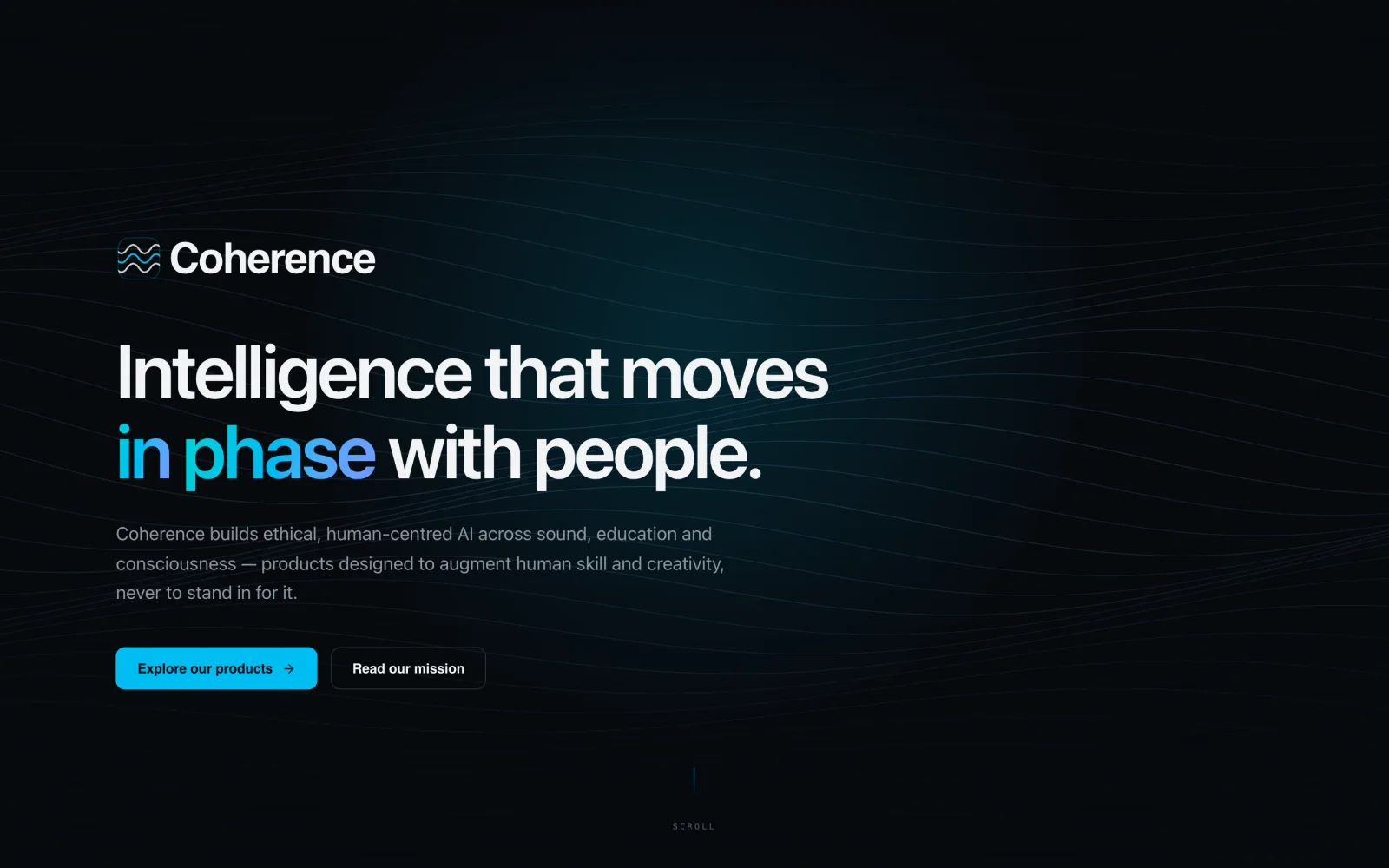
coherence.com on desktop, headed "Intelligence that moves in phase with people".
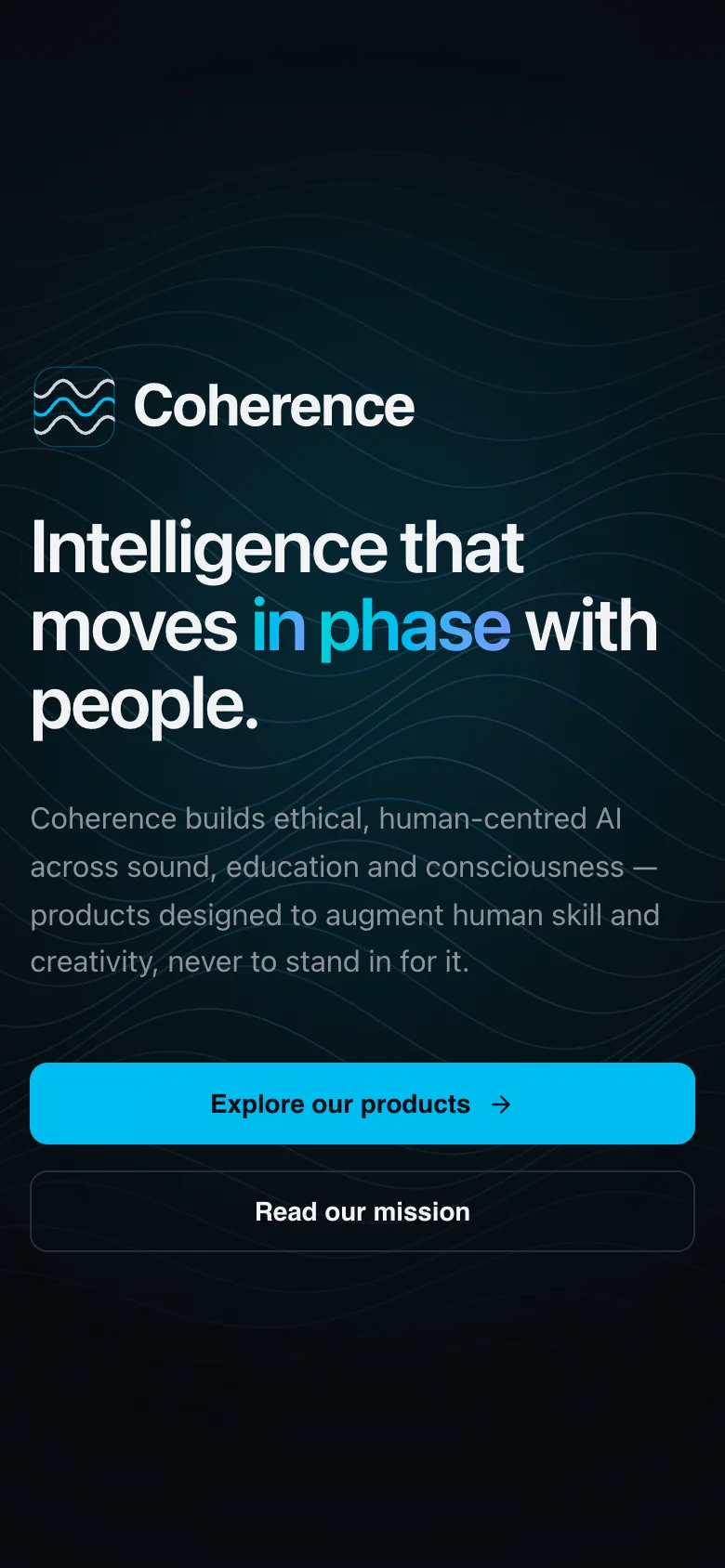
coherence.com on a mobile viewport, reflowed to a single column.
coherence.com — homepage, 1440×900
Live

Coherence

Live at coherence.com: brand identity generated with AI agents we directed, the motion system and website for the group behind Sonora, AboutAI, WakeUp and MudShadows. Agent work remains in build.

What we built
  • Brand identity
  • Motion system
  • Live website
  • Agent work — in build
Read the case study →
The new Domain Booth homepage on desktop: the headline “Premium Domains. Serious Buyers. Proven Results.” beside the animated DB monogram.
The new Domain Booth homepage on a phone, reflowed to a single column.
Our build of the Domain Booth homepage — 1440×900
Live

Domain Booth

Live at domainbooth.com for DomainBooth, a premium domain brokerage: a new animated mark, every page redesigned and rebuilt with designed mobile layouts, and a custom CMS for its sales record, featured names, press and enquiries.

What we built
  • Animated mark
  • Every page redesigned
  • Designed mobile layouts
  • Custom CMS
Read the case study →
Who we have built for

Twenty-one years. Names you know.

Apps, platforms and campaigns for these teams, long before the AI work. Every one is written up on the work page — what we did, and where our part ended.

See all of our work →
  • BBC Good Food logo
  • Charities Aid Foundation logo
  • GAME logo
  • NatWest logo
  • Next logo
  • NSPCC logo
  • Tesco logo
  • Worldpay logo
  • Samsung logo
  • Sony logo
  • Land Rover logo
  • UAP Limited logo
  • Netflix logo
  • Amazon Prime Video logo
  • Mercedes-Benz dealerships logo
  • San Miguel logo
  • Biovene Barcelona logo
  • Seventy7 logo
  • Littlewoods logo
  • Smile logo
  • The Co-operative Bank logo