Ember theme
Industry

Public sector AI
that shows its work.

Citizen services, case handling and document processing for public bodies — inside infrastructure you control, in the languages your population actually speaks, with a record of every decision that an audit, a journalist or a court can be shown.

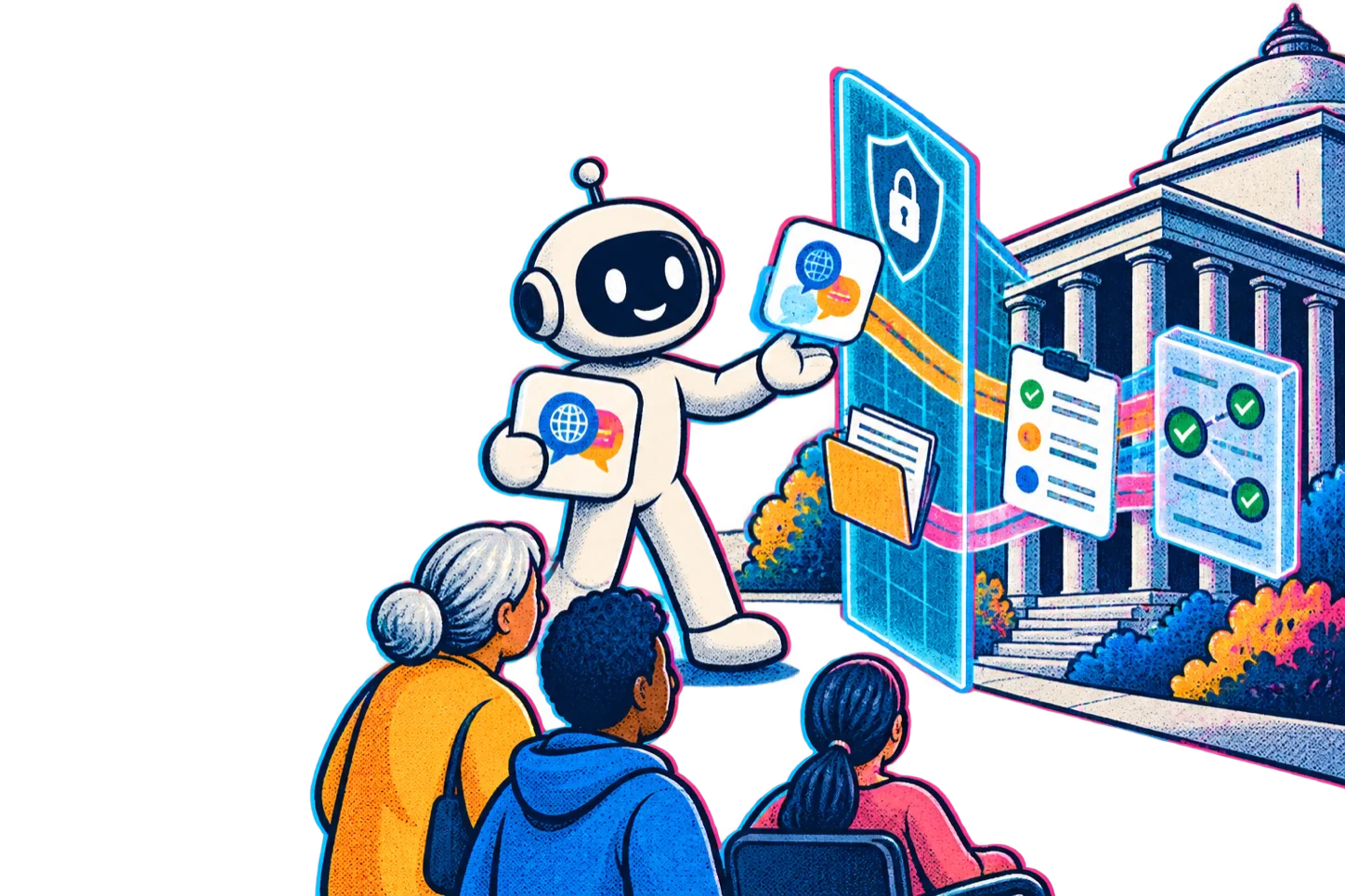
Maker routing a citizen request through a transparent public record
Last reviewed 5 September 2026 · Engineering guidance, not legal advice.
WHERE IT BREAKS TODAY
01

The answer exists, in a PDF, from 2011

Guidance, regulations, circulars and forms are published rather than structured. Staff and citizens both know the answer is somewhere on the site; neither can find it, so the telephone line absorbs the difference.
02

Backlogs that scale with population, not budget

Permits, grants, appeals and registrations arrive at a rate set by the public and are processed at a rate set by headcount. The gap is the backlog, and it is politically expensive long before it is operationally interesting.
03

Procurement moves slower than the technology

A tender written eighteen months ago specifies a stack that has moved twice since. Meanwhile the pilot everyone liked cannot go live because nobody can evidence where the data went.
OUR APPROACH

Built to be explained in public

A private company that cannot explain a system faces an awkward meeting. A public body that cannot explain one faces a parliamentary question, a freedom-of-information request and a newspaper. That asymmetry is the design brief, and it makes the public sector one of the more interesting places to build: the requirement to show the working is not friction bolted onto the project, it is the project.

So we build the record first. Which source document an answer came from, which version of the guidance was in force on the day, who reviewed it, what the system was asked and what it replied. Retrieval rather than recall, because a citation is reviewable and a memory is not. Deployment inside infrastructure the administration controls, because residency questions are usually settled by architecture rather than by contract.

And a narrow scope. The systems that work in administration are the ones that find, extract, draft and route — not the ones that decide. A caseworker keeps the decision, an official signs it, and the system’s contribution is that the file arrived complete and the guidance was quoted rather than remembered.

HOW IT DEPLOYS
PHASE 01

Settle residency first

Where the data sits, which jurisdiction holds it, which models may see it and under what terms. This is decided before scoping rather than during procurement, because it changes the design.
PHASE 02

Build on your infrastructure

Sovereign cloud, national data centre or on-premise. Code lands in your repositories and runs in your accounts, so nothing about the deployment depends on our continued existence.
PHASE 03

Hand it over deliberately

Documentation, evaluation sets, runbooks and training for the team who will own it. A public body that cannot maintain a system without its supplier has bought a dependency, not a capability.
WHAT WE BUILD
01

Citizen Information Services

Retrieval over published guidance, forms and regulations, answering in the languages your population uses and citing the source document and its version. Anything touching eligibility, entitlement or a deadline is answered with the rule quoted, not paraphrased.

SEE RAG SYSTEMS →
02

Case and Document Processing

Applications, permits and submissions read at volume, with completeness checks, typed exception queues and structured output into the case management system. The caseworker receives a prepared file rather than a scanned bundle.

SEE THE DOCUMENT PIPELINE →
03

Sovereign Deployment

Open-weight models running on infrastructure inside the jurisdiction, including air-gapped environments where that is the requirement. No inference traffic leaves the network, and the capability trade-off is stated up front rather than discovered later.

SEE AIR-GAPPED DEPLOYMENT →
04

Internal Knowledge and Drafting

Search and drafting support over internal circulars, precedent decisions and procedure manuals, scoped to what each official is already entitled to see. The system cannot retrieve a document its user could not open.

SEE INTERNAL OPS →
THE REGULATORY SHAPE

Public bodies sit under the general AI rules and under a set of additional ones aimed specifically at them. How these apply to a particular system is a determination for your own legal service; what follows is how they change the engineering.

Prohibited practices bind everyone. The EU AI Act’s prohibitions — social scoring of natural persons leading to detrimental treatment in unrelated contexts among them — apply to public and private actors alike. The prohibition on social scoring is often described as an administration-specific rule; it is not, and reading it that way is how a well-meaning risk-stratification project ends up on the wrong side of a line.

Several Annex III categories cover public services. The high-risk list includes systems used by, or on behalf of, public authorities to evaluate eligibility for essential public assistance benefits and services, and to evaluate and classify emergency calls and dispatch emergency services, alongside categories covering law enforcement, migration and asylum, and the administration of justice. If a system you are commissioning sits in one of those, the obligations are substantial and they land on the engineering: risk management, data governance, logging over the lifetime of the system, technical documentation, human oversight and demonstrated robustness.

Deployers who are public bodies carry extra duties. Public authorities deploying a high-risk system face obligations beyond those of a private deployer, including registration in the EU database and, for the relevant categories, a fundamental rights impact assessment carried out before the system is put into use. A fundamental rights impact assessment is not a document a supplier can write for you — it is an assessment of your process, your population and your safeguards. What we can do is supply the artefacts it needs: what the system does, on what data, with what human involvement, what happens when it is wrong, and what the affected person can do about it. The EU AI Act page covers the classification questions in more detail.

Transparency, records and accessibility. Assume every interaction may be disclosed. That means the log has to be complete enough to answer a question about a specific case months later, and readable by someone who was not there. It also means the citizen-facing surface has to be accessible in earnest — the EU Web Accessibility Directive obligations do not pause because the interface now has a language model behind it. Our approach to that is set out on the accessibility page.

PROCUREMENT, HONESTLY

Public procurement favours suppliers who can evidence controls, and it is worth being direct about where that leaves us. QQuantum.ai holds no security certifications. Not ISO 27001, not anything else. If your framework requires a certified supplier of record for this scope, we are not it, and we would rather say so in the first conversation than in the tender response.

What we do instead is make the controls inspectable rather than attested. The system runs in your infrastructure under your identity provider. The code is in your repositories from the first commit. The architecture document states where every category of data goes and which model sees it. The evaluation harness and its method are handed over with the system. Access is scoped to what the triggering official already holds. Every prompt, retrieval and action is logged with an identity. Your auditor tests those directly, which is a stronger position than reading our certificate — and we say that knowing it does not always satisfy a scoring matrix.

Two other patterns are worth naming. Working as a subcontractor to a certified prime is a normal arrangement and one we are comfortable with. And a small, scoped first engagement — one workflow, evaluated, handed over — usually tells a procurement team more about a supplier than any framework can, and it is easier to place under most thresholds. The procurement and security review page sets out what we can answer and what we cannot.

CONTROLS WE IMPLEMENT
GDPR-ALIGNED CONTROLS SOVEREIGN INFRASTRUCTURE REPLAYABLE AUDIT TRAIL ROLE-SCOPED ACCESS NO TRAINING ON YOUR DATA CODE IN YOUR REPOSITORIES

These are engineering controls we build into the architecture, not certifications. QQuantum.ai holds no security certifications, and the audits and attestations your framework requires remain yours — see our trust centre.

DESIGN TARGETS
0
INFERENCE TRAFFIC LEAVING THE JURISDICTION
1+
CITED SOURCE PER CITIZEN-FACING ANSWER
100%
OF INTERACTIONS RECONSTRUCTABLE FROM LOG

Properties we design and build to on a sovereign deployment, not measured client outcomes.

QUESTIONS
QUESTIONS — 5

Yes, and it is usually the first thing we settle. An open-weight model running on infrastructure inside the jurisdiction — sovereign cloud, national data centre or your own hardware — keeps inference traffic on your network, and an air-gapped variant exists where that is the requirement. The trade-off is capability: the best open-weight models are strong and are not always the strongest available, and we will tell you where that gap shows up in your specific workload rather than after the pilot.

No. We hold none, and we will not imply otherwise to win a tender. What we offer instead is a system your own auditors can inspect directly: running in your infrastructure, under your identity provider, with the code in your repositories, the architecture documented, access scoped by role and every action logged. Where a framework requires a certified supplier of record, subcontracting to a certified prime is a normal route and one we are happy with.

The system carries on. It runs in your accounts, on your infrastructure, from code in your repositories, and the handover includes the documentation, the evaluation sets and the runbooks. That is a deliberate design choice rather than a reassurance: a public body that cannot maintain a system without its supplier has bought a dependency, and dependencies of that kind end up in the audit report.

Yes. The systems we build for administrations find, extract, draft and route. They do not determine eligibility, grant a permit or refuse an application. That is partly a legal position — GDPR Article 22 restricts decisions based solely on automated processing where they significantly affect a person, and the EU AI Act requires meaningful human oversight of high-risk systems — and partly an engineering one: the review step is where a model’s errors are caught, so removing it removes the control that makes the rest defensible.

Usually by scoping to the outcome rather than the stack. Where a specification names a technology that has since moved, we will say so plainly and describe what the current equivalent is, so the evaluation panel is comparing like with like. Where the specification asks for accuracy figures against a benchmark we have not run on your data, we will decline to invent one and offer an evaluation plan instead — which is the answer the more experienced panels are looking for anyway.

Keep reading
30-minute technical call · no deck

Show the working.
Keep the record.

Start with one service and one backlog. We settle residency, scope the assembly, and hand over something your own team can maintain.

CASE STUDIES

Shipped work.
Go and check it.

The work we can name, with the live site, our scope and the boundary made explicit. Select a project to see the evidence; each is a full case study, not a logo or a claim.

sonora.com
The Sonora homepage on desktop: a full-bleed dune landscape behind the headline “Transform Your Life with Sound”, with App Store and Google Play download buttons.
sonora.com — homepage, 1440×900 sonora.com →
Live Consumer wellness · Mobile + web

Sonora

Cognitive AI Ltd · 2026

A free sound-wellness app, described by its publisher as AI sound therapy that reads a short vocal sample at the start of a session and generates a soundscape for that moment. We designed and built the website and its backend, produced assets for the iOS and Android apps, and supported the application prototype.

Read the case study →

See every published project →

WHO WE HAVE BUILT FOR

Twenty-one years of applications, platforms and campaigns for names you know.

See all of our work →