Dark theme
WELCOME TO QQUANTUM

Let Qubi show you around.

Choose how you’d like to explore.

Don’t agreeGo to yourOS instead ↗

Both choices allow Google Analytics, so we can see which pages help.

Sound is your choice. Essential cookies keep the site working. Continuing either way also allows Google Analytics (visits and pages viewed).

Read our Terms, Privacy and Cookies.

Change your choices anytime from the footer.

Getting Qubi ready.
Comparison

On-premise or cloud?

Framed as a binary this is a bad question, because most mature deployments end up using both. Framed as “which requests go where”, it has a clean answer that falls out of four constraints.

  • Reviewed September 2026
All Comparisons →
Pixel illustration for On-Premise vs Cloud AI: a balanced comparison of a local server cabinet with an ownership key and linked globes and differently shaped document cards.

Side by side

Compare your options
Structural properties, not vendor claims. Cost positions depend on volume, which is why the crossover is arithmetic rather than a preference.
Criterion Cloud API On-premise
Best available model capability Yes No
Data stays inside your perimeter No Yes
Time to a working prototype Days Weeks
Cost at low volume Lower Higher
Cost at high sustained volume Higher, and linear Lower, and flat
Marginal cost of one more request Per token Near zero
Survives vendor deprecation No Yes
Works without connectivity No Yes
Requires people to operate No Yes
New sub-processor for your customers Usually yes No

The four constraints that decide it

  • Sensitivity.

    If the data cannot leave, the decision is made and nothing else in the comparison matters. This is the constraint that most often settles it, and it settles it absolutely.
  • Volume.

    Per-token pricing is linear forever; hardware is a fixed cost. Above a sustained threshold, ownership wins on cost and keeps winning. Below it, hardware sits idle and the API is cheaper. The threshold is calculable from your numbers.
  • Capability ceiling.

    Some workloads genuinely need the frontier. Most do not, and the honest way to find out is to test rather than to assume — teams are often surprised by how much moves down.
  • Operational capacity.

    The one that quietly decides more of these than the other three combined. Self-hosting is a standing commitment. If there is no team and no budget for managed operation, choose the cloud and revisit when that changes.

Why it is usually both

Request difficulty and sensitivity both have long tails. Most requests are routine and non-sensitive; a minority are one or the other. Routing on those two axes lets the bulk run locally at near-zero marginal cost while a small, non-sensitive remainder escalates to a frontier API — and confidential work is structurally prevented from escalating at all.

That arrangement gets you most of the cost profile of self-hosting and most of the capability ceiling of the cloud, at the price of building and maintaining a routing gate. For most organisations at meaningful scale it is, in our view, the right answer, and the reason the either-or framing is worth abandoning early.

Questions

Questions about On-Premise vs Cloud AI.

Is private cloud a middle ground?

Consuming a frontier model inside your own cloud tenancy and region resolves data residency and is often the fastest path through procurement, because the agreement already exists. It does not give you fixed costs, hardware control or independence from deprecation. It is a genuine middle option on one axis only, and it is worth being precise about which.

How do we know our volume justifies hardware?

Take projected monthly tokens at the API rate you would actually pay, against hardware amortised over three years plus power plus a realistic fraction of an engineer. The last term is the one usually omitted and frequently the one that decides it.

Can we start on the cloud and move later?

Yes, and it is often the right sequence — provided the system is built for it: model behind an interface, no provider-specific dependencies, prompts and evaluation sets portable. Retrofitting that onto a system welded to one provider is where the cost actually lands.

Usually both,
deliberately.

The useful question is which requests go where. We can answer it against your workload in a session.

30-minute technical call · no deck

Shipped & in build

Real work. Check it yourself.

What we built, what stage it is at, and a link to the live thing wherever there is one.

The updated yourOS homepage: Roxy’s open ring surrounded by bento cards for calls, voice, translation, building, design, apps and more.
The yourOS homepage on a phone, with its compact navigation, welcome film button and bento cards.
youros.tech — the homepage bento hero
Our own · coming soon

yourOS

yourOS is an operating system with an AI at its heart. You talk to it like a person, out loud or typed. It makes your calls, plans your days and works on your projects with a crew of agents, on your own private server. Our own product, built from the first commit; the waitlist is open.


What we built
  • Operating system
  • Roxy
  • Agent crew
  • Voice calls
  • App store
  • Website
Meet yourOS →
The Sonora homepage on desktop: a full-bleed dune landscape behind the headline “Transform Your Life with Sound”, with App Store and Google Play download buttons.
The Sonora homepage on a mobile viewport, showing the same hero reflowed to a single column.
sonora.com — homepage, 1440×900
Live · iOS · Android

Sonora

Website, backend and app assets for Sonora, a free AI sound-therapy app on iOS and Android published by Cognitive AI.

What we built
  • Website
  • Backend
  • App assets
Read the case study →
The updated Podswap homepage on desktop: “Grow on Instagram and TikTok for free, with real engagement from creators your size”, beside a tilted wall of exchange, tool and guide cards on a violet gradient.
The updated Podswap homepage on a phone, with its floating navigation, Instagram and TikTok engagement headline and tilted tool cards.
podswap.app — homepage, 1440×900
Five platforms

Podswap

Brand, website, prototype, apps on five platforms, the AI backend and the algorithm-intelligence pipeline for Podswap, a social growth engine that runs without a human in the loop.

What we built
  • Brand
  • Website
  • Prototype
  • Apps on five platforms
  • AI backend
  • Algorithm pipeline
Read the case study →
The unOpen.AI homepage introducing Roxy, a private AI assistant that remembers who you are.
The unOpen.AI homepage on a mobile viewport.
unopen.ai — homepage, 1440×900
Prototype · closed beta

unOpen.AI

In closed beta: Roxy, a private AI assistant with permanent memory running on infrastructure the user owns. Brand, site, product, backend and conversational design.

What we built
  • Brand
  • Site
  • Product
  • Backend
  • Conversational design
Read the case study →
coherence.com on desktop, headed "Intelligence that moves in phase with people".
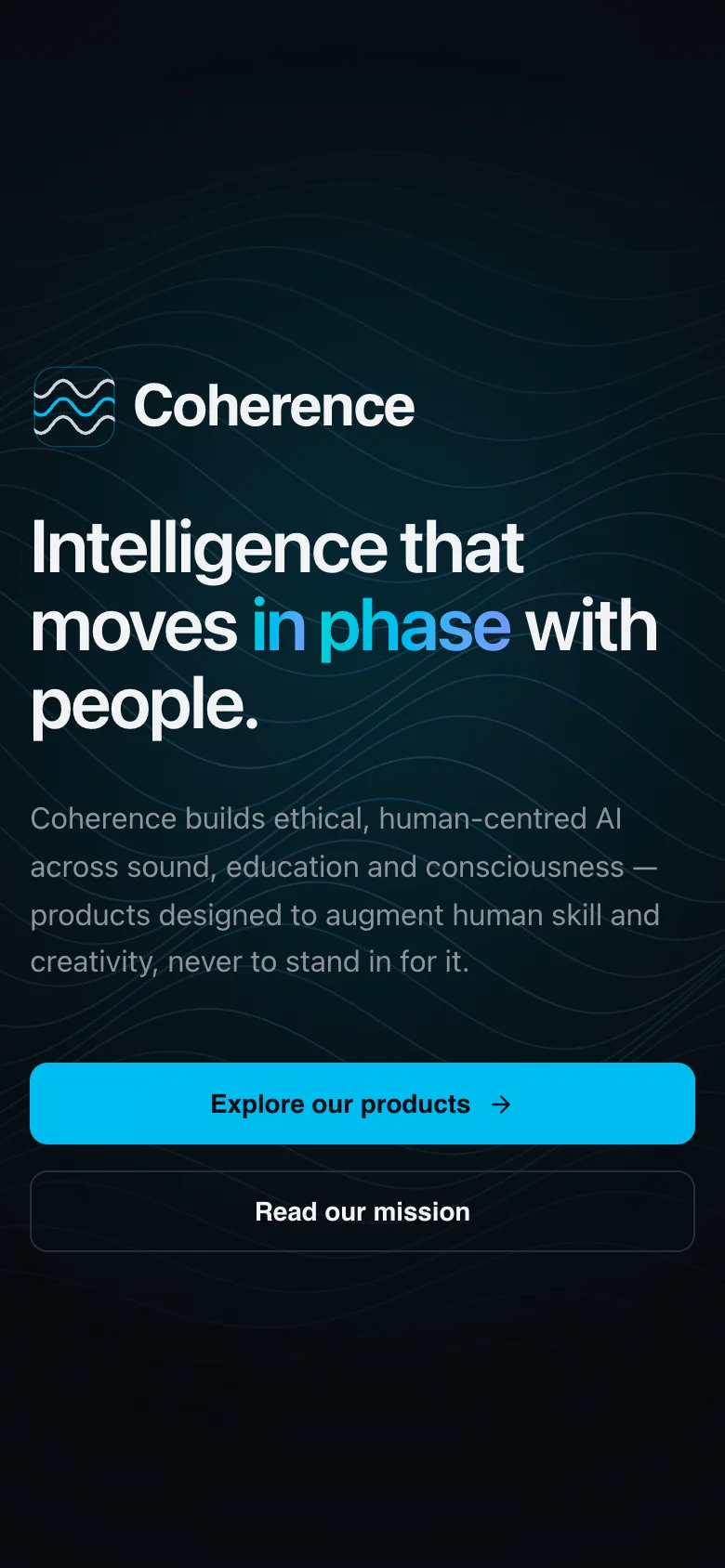
coherence.com on a mobile viewport, reflowed to a single column.
coherence.com — homepage, 1440×900
Live

Coherence

Live at coherence.com: brand identity generated with AI agents we directed, the motion system and website for the group behind Sonora, AboutAI, WakeUp and MudShadows. Agent work remains in build.

What we built
  • Brand identity
  • Motion system
  • Live website
  • Agent work — in build
Read the case study →
The new Domain Booth homepage on desktop: the headline “Premium Domains. Serious Buyers. Proven Results.” beside the animated DB monogram.
The new Domain Booth homepage on a phone, reflowed to a single column.
Our build of the Domain Booth homepage — 1440×900
Live

Domain Booth

Live at domainbooth.com for DomainBooth, a premium domain brokerage: a new animated mark, every page redesigned and rebuilt with designed mobile layouts, and a custom CMS for its sales record, featured names, press and enquiries.

What we built
  • Animated mark
  • Every page redesigned
  • Designed mobile layouts
  • Custom CMS
Read the case study →
Who we have built for

Twenty-one years. Names you know.

Apps, platforms and campaigns for these teams, long before the AI work. Every one is written up on the work page — what we did, and where our part ended.

See all of our work →
  • BBC Good Food logo
  • Charities Aid Foundation logo
  • GAME logo
  • NatWest logo
  • Next logo
  • NSPCC logo
  • Tesco logo
  • Worldpay logo
  • Samsung logo
  • Sony logo
  • Land Rover logo
  • UAP Limited logo
  • Netflix logo
  • Amazon Prime Video logo
  • Mercedes-Benz dealerships logo
  • San Miguel logo
  • Biovene Barcelona logo
  • Seventy7 logo
  • Littlewoods logo
  • Smile logo
  • The Co-operative Bank logo