Dark theme
WELCOME TO QQUANTUM

Let Qubi show you around.

Choose how you’d like to explore.

Don’t agreeGo to yourOS instead ↗

Both choices allow Google Analytics, so we can see which pages help.

Sound is your choice. Essential cookies keep the site working. Continuing either way also allows Google Analytics (visits and pages viewed).

Read our Terms, Privacy and Cookies.

Change your choices anytime from the footer.

Getting Qubi ready.
Comparison

Open weights or proprietary?

Two years ago this was a capability question with an obvious answer. It is now a deployment and licensing question with a genuine answer on both sides, and the capability gap has narrowed to the point where it decides fewer cases than anything else on this page.

  • Reviewed September 2026
All Comparisons →
Pixel illustration for Open Weights vs Proprietary Models: a balanced comparison of an open padlock beside inspectable model components and a closed lock protecting a document vault.

Side by side

Compare your options
The structural differences. Note that most rows are not about model quality at all, which is the point.
Criterion Open weights Proprietary API
Run on your own hardware Yes No
Absolute frontier capability No Yes
Pin a version indefinitely Yes No
Fine-tune and keep the artefact Yes Platform-bound
Cost model Fixed infrastructure Per token
Zero-effort scaling No Yes
Licence complexity Varies — read it Terms of service
Adds a sub-processor No Yes

The licence is not a formality

“Open weights” covers a wide range of terms and they are not interchangeable. Some models ship under Apache-2.0, which is a standard permissive licence your legal team already recognises. Others carry bespoke community licences with attribution requirements, user-count thresholds or restrictions on training other models. A few are research-only and cannot be used commercially at all.

Check the licence for the specific model and version you intend to deploy, record which one you chose, and keep that record. “Which licence did we deploy under” is a question that gets asked eighteen months later by someone doing due diligence, and reconstructing the answer is far harder than writing it down at the time.

Note too that a model with published weights is not necessarily open source by the OSI definition. The distinction matters where procurement policy is written around recognised licences, and it is worth being precise rather than using the terms interchangeably.

The cost inversion

At low volume, proprietary APIs are cheaper — there is no hardware and no operator. At high sustained volume that inverts, because one side scales linearly with usage and the other does not. Where the crossover sits depends on your volume, your model size and your engineering costs, and it is arithmetic rather than a matter of allegiance.

What is frequently missed is the second-order effect. Once marginal cost approaches zero, the set of things worth processing expands. Work that could not justify a per-token charge — reviewing every document rather than a sample, embedding an entire archive — becomes viable. In our experience that expansion, rather than the saving on existing usage, is where the larger value sits.

Questions

Questions about Open Weights vs Proprietary Models.

How big is the capability gap now?

Narrow for the majority of production tasks and still real at the hardest end — complex multi-step agentic work and the most difficult reasoning. The practical consequence is not choosing a side but routing: open weights for the bulk, frontier for the minority that needs it.

Which open family should we choose?

Llama for ecosystem depth, Mistral for EU domicile and Apache-2.0 terms on several of its models, DeepSeek for reasoning economics, Qwen for size range and multilingual coverage. We benchmark two or three against your task rather than recommending from reputation.

Is open weights less secure?

Different, not less. You take on patching and infrastructure security; you remove an entire third party from the data path. For most regulated organisations the second outweighs the first, which is why we would expect self-hosting to concentrate at the regulated end of the market.

Read the licence,
then benchmark.

In that order. A model that fails procurement on licence terms is not a candidate however well it scores.

30-minute technical call · no deck

Shipped & in build

Real work. Check it yourself.

What we built, what stage it is at, and a link to the live thing wherever there is one.

The updated yourOS homepage: Roxy’s open ring surrounded by bento cards for calls, voice, translation, building, design, apps and more.
The yourOS homepage on a phone, with its compact navigation, welcome film button and bento cards.
youros.tech — the homepage bento hero
Our own · coming soon

yourOS

yourOS is an operating system with an AI at its heart. You talk to it like a person, out loud or typed. It makes your calls, plans your days and works on your projects with a crew of agents, on your own private server. Our own product, built from the first commit; the waitlist is open.


What we built
  • Operating system
  • Roxy
  • Agent crew
  • Voice calls
  • App store
  • Website
Meet yourOS →
The Sonora homepage on desktop: a full-bleed dune landscape behind the headline “Transform Your Life with Sound”, with App Store and Google Play download buttons.
The Sonora homepage on a mobile viewport, showing the same hero reflowed to a single column.
sonora.com — homepage, 1440×900
Live · iOS · Android

Sonora

Website, backend and app assets for Sonora, a free AI sound-therapy app on iOS and Android published by Cognitive AI.

What we built
  • Website
  • Backend
  • App assets
Read the case study →
The updated Podswap homepage on desktop: “Grow on Instagram and TikTok for free, with real engagement from creators your size”, beside a tilted wall of exchange, tool and guide cards on a violet gradient.
The updated Podswap homepage on a phone, with its floating navigation, Instagram and TikTok engagement headline and tilted tool cards.
podswap.app — homepage, 1440×900
Five platforms

Podswap

Brand, website, prototype, apps on five platforms, the AI backend and the algorithm-intelligence pipeline for Podswap, a social growth engine that runs without a human in the loop.

What we built
  • Brand
  • Website
  • Prototype
  • Apps on five platforms
  • AI backend
  • Algorithm pipeline
Read the case study →
The unOpen.AI homepage introducing Roxy, a private AI assistant that remembers who you are.
The unOpen.AI homepage on a mobile viewport.
unopen.ai — homepage, 1440×900
Prototype · closed beta

unOpen.AI

In closed beta: Roxy, a private AI assistant with permanent memory running on infrastructure the user owns. Brand, site, product, backend and conversational design.

What we built
  • Brand
  • Site
  • Product
  • Backend
  • Conversational design
Read the case study →
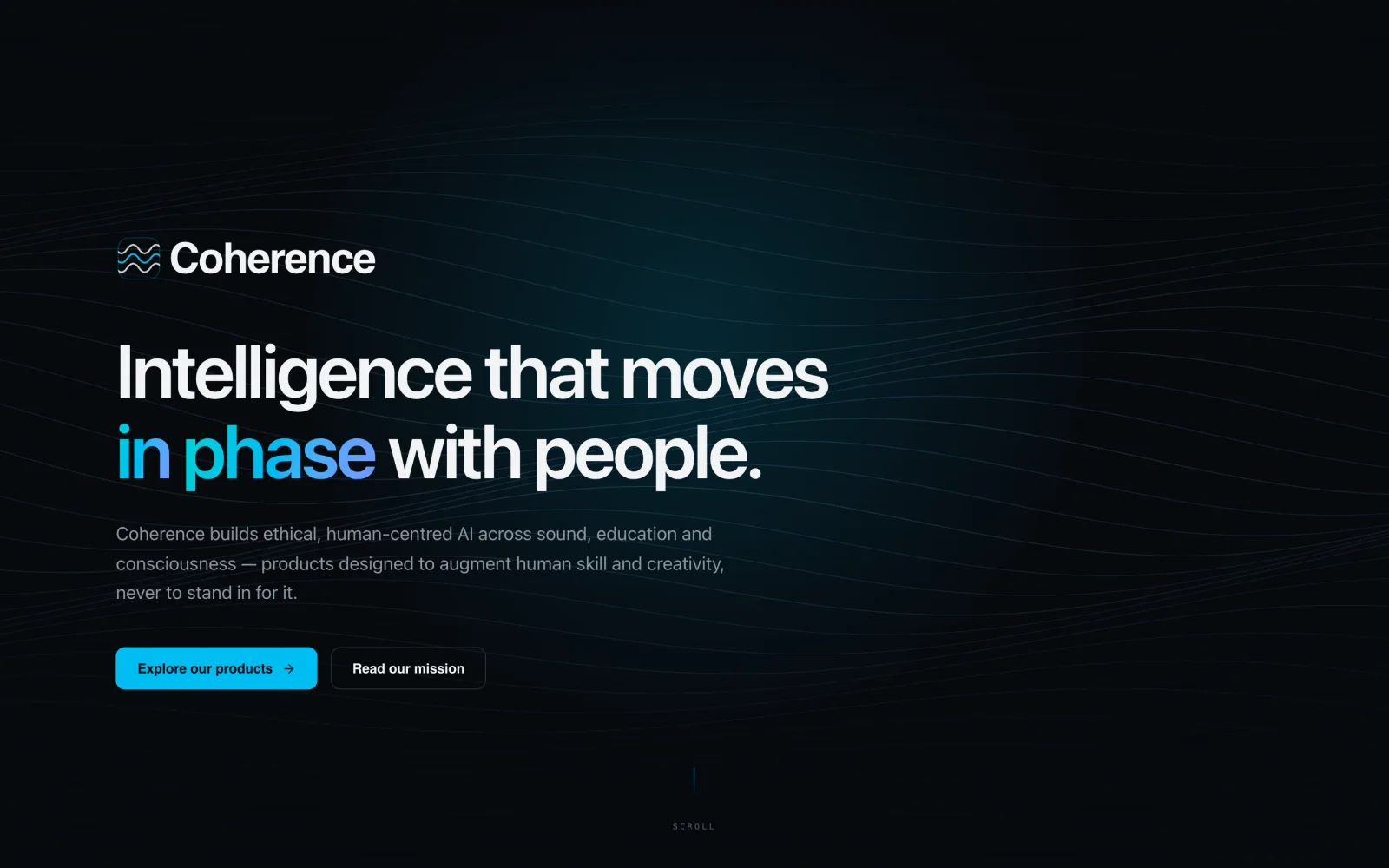
coherence.com on desktop, headed "Intelligence that moves in phase with people".
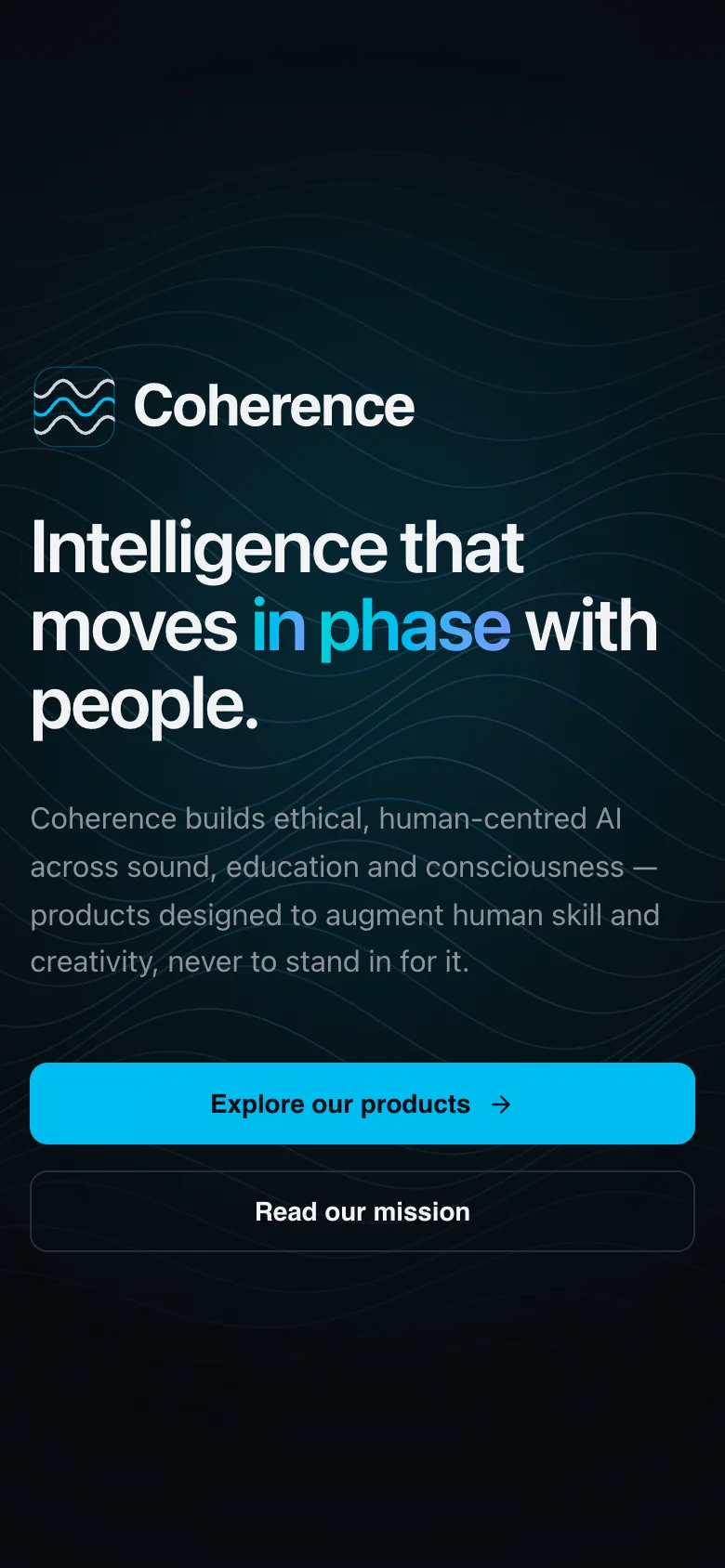
coherence.com on a mobile viewport, reflowed to a single column.
coherence.com — homepage, 1440×900
Live

Coherence

Live at coherence.com: brand identity generated with AI agents we directed, the motion system and website for the group behind Sonora, AboutAI, WakeUp and MudShadows. Agent work remains in build.

What we built
  • Brand identity
  • Motion system
  • Live website
  • Agent work — in build
Read the case study →
The new Domain Booth homepage on desktop: the headline “Premium Domains. Serious Buyers. Proven Results.” beside the animated DB monogram.
The new Domain Booth homepage on a phone, reflowed to a single column.
Our build of the Domain Booth homepage — 1440×900
Live

Domain Booth

Live at domainbooth.com for DomainBooth, a premium domain brokerage: a new animated mark, every page redesigned and rebuilt with designed mobile layouts, and a custom CMS for its sales record, featured names, press and enquiries.

What we built
  • Animated mark
  • Every page redesigned
  • Designed mobile layouts
  • Custom CMS
Read the case study →
Who we have built for

Twenty-one years. Names you know.

Apps, platforms and campaigns for these teams, long before the AI work. Every one is written up on the work page — what we did, and where our part ended.

See all of our work →
  • BBC Good Food logo
  • Charities Aid Foundation logo
  • GAME logo
  • NatWest logo
  • Next logo
  • NSPCC logo
  • Tesco logo
  • Worldpay logo
  • Samsung logo
  • Sony logo
  • Land Rover logo
  • UAP Limited logo
  • Netflix logo
  • Amazon Prime Video logo
  • Mercedes-Benz dealerships logo
  • San Miguel logo
  • Biovene Barcelona logo
  • Seventy7 logo
  • Littlewoods logo
  • Smile logo
  • The Co-operative Bank logo