Dark theme
WELCOME TO QQUANTUM

Let Qubi show you around.

Choose how you’d like to explore.

Don’t agreeGo to yourOS instead ↗

Both choices allow Google Analytics, so we can see which pages help.

Sound is your choice. Essential cookies keep the site working. Continuing either way also allows Google Analytics (visits and pages viewed).

Read our Terms, Privacy and Cookies.

Change your choices anytime from the footer.

Getting Qubi ready.
Reference architecture 02

Support deflection that knows when to stop.

The hard part of a support agent is not answering questions. It is recognising the questions it should not answer, and handing those over before it has already done damage.

  • Hybrid retrieval
  • Tunable handoff
  • Full conversation audit
All Reference Architectures →
Pixel illustration for Support Deflection Architecture: request cards organised into distinct handling trays.
THE PROBLEM

Deflection rate is the wrong headline metric.

Every support-AI vendor quotes a deflection rate. It is close to meaningless on its own, because you can drive it arbitrarily high by having the agent answer everything confidently — including the things it has no basis for. The tickets stop arriving; the damage arrives later, as churn, as a refund, or as a compliance incident.

The pair of numbers that matters is deflection rate at a fixed, measured accuracy floor. An agent that resolves 40% of tickets and is right ~always is worth more than one that resolves 75% and is confidently wrong one time in eight — because the second one destroys trust in the channel, and trust does not come back.

That reframing changes the architecture. The interesting component is not the generator. It is the gate in front of the handoff.

The design

TICKET PATH
  1. 01
    Intake

    email · chat · widget

  2. 02
    Classify

    intent + risk tier

  3. 03
    Retrieve

    docs + account state

  4. 04
    Draft

    answer + citations

  5. 05
    Gate

    evidence + risk check

  6. 06 · Branch / escalation
    Human

    with full context

  7. 07
    Send

    logged + scored

Lower box = escalation pathMarker = one ticket through the system
Risk tier is assigned at classification, before retrieval — a billing or security question is escalated on its category alone, however confident the model later becomes.
  • Two retrieval sources, not one.

    Product documentation answers "how does this work". Account state answers "why is my thing broken". Most deployments wire up only the first and then wonder why the agent deflects nothing useful — the majority of real tickets are account-specific.
  • Risk tiering happens first.

    Certain categories never get an autonomous answer regardless of confidence: billing disputes, account deletion, security reports, anything with legal exposure. This is a static policy, not a model judgement, because a model's confidence is exactly the thing you cannot trust in the tail.
  • The gate checks evidence, not certainty.

    A language model's self-reported confidence is poorly calibrated. The gate instead asks a mechanical question: does every claim in this draft trace to a retrieved passage? An answer containing an unsupported assertion is escalated even if the model is sure.
  • Handoffs carry the work.

    When the agent escalates, the human receives the retrieved context, the draft, and the reason for escalation. A handoff that dumps a raw ticket back on a person has saved nothing.
agent/gate.py PYTHON
RISK_ALWAYS_ESCALATE = {class="text-emerald-data">"billing_dispute", class="text-emerald-data">"account_deletion",
                                        class="text-emerald-data">"security_report", class="text-emerald-data">"legal"}

                def decide(ticket, draft, retrieved):
                    class="text-dim"># Policy beats confidence. Category alone can escalate.
                    if ticket.category in RISK_ALWAYS_ESCALATE:
                        return Escalate(reason=class="text-emerald-data">"risk_category")

                    class="text-dim"># Every claim must trace to something we retrieved.
                    unsupported = [c for c in draft.claims
                                   if not c.supported_by(retrieved)]
                    if unsupported:
                        return Escalate(reason=class="text-emerald-data">"unsupported_claim",
                                        detail=unsupported)

                    if draft.needs_account_data and not ticket.account_linked:
                        return Escalate(reason=class="text-emerald-data">"missing_account_context")

                    return Send(draft)
The gate is deliberately boring and inspectable. Every escalation reason is a named constant, so the escalation mix is analysable.

Where it breaks

01

Documentation that is quietly out of date

Retrieval is faithful to whatever it retrieves. If the docs describe last year's pricing, the agent will cite last year's pricing accurately. Mitigation: freshness metadata on every source, and a hard exclusion for anything past a staleness threshold.
02

Multi-turn drift

A conversation that starts in-scope wanders out of it by turn five, and the original risk classification no longer applies. Mitigation: re-classify on every turn, not just the first.
03

Users who learn to jailbreak the gate

Once customers realise a phrasing gets a human, they use it — which is rational, and which collapses your deflection rate. Mitigation: monitor escalation-reason distribution over time; a spike in one reason is a signal about user behaviour, not model quality.
04

Deflection measured at the wrong boundary

A ticket the agent "resolved" that reopens two days later was not deflected. Mitigation: measure deflection at a 7-day reopen window, which is usually 10–20 points below the number a vendor quotes on day one.

What to measure

THE EVALUATION THAT MATTERS
Target by task
Task n Baseline Target
Answer accuracy on deflected tickets weekly sample, 200+ human agent rate ≥ human
Deflection rate at 7-day reopen window all tickets 0% measured, not promised
Escalations with usable context attached all escalations n/a 100%
Unsupported claims reaching a customer all sent n/a trend to zero

Method: Deflected tickets are sampled weekly and graded by a support lead blind to whether the answer came from the agent or a human. Accuracy is scored against the same rubric used for human QA, so the comparison is like-for-like. Reopen window is 7 days — a resolution that bounces is counted as a failure, not a deflection. These are the targets we design against and instrument for; they are not results from a specific deployment.

What is your real
deflection ceiling?

Send us a week of anonymised tickets and we will tell you what share is genuinely automatable — including if the answer is 'not many'.

30-minute technical call · no deck

Shipped & in build

Real work. Check it yourself.

What we built, what stage it is at, and a link to the live thing wherever there is one.

The updated yourOS homepage: Roxy’s open ring surrounded by bento cards for calls, voice, translation, building, design, apps and more.
The yourOS homepage on a phone, with its compact navigation, welcome film button and bento cards.
youros.tech — the homepage bento hero
Our own · coming soon

yourOS

yourOS is an operating system with an AI at its heart. You talk to it like a person, out loud or typed. It makes your calls, plans your days and works on your projects with a crew of agents, on your own private server. Our own product, built from the first commit; the waitlist is open.


What we built
  • Operating system
  • Roxy
  • Agent crew
  • Voice calls
  • App store
  • Website
Meet yourOS →
The Sonora homepage on desktop: a full-bleed dune landscape behind the headline “Transform Your Life with Sound”, with App Store and Google Play download buttons.
The Sonora homepage on a mobile viewport, showing the same hero reflowed to a single column.
sonora.com — homepage, 1440×900
Live · iOS · Android

Sonora

Website, backend and app assets for Sonora, a free AI sound-therapy app on iOS and Android published by Cognitive AI.

What we built
  • Website
  • Backend
  • App assets
Read the case study →
The updated Podswap homepage on desktop: “Grow on Instagram and TikTok for free, with real engagement from creators your size”, beside a tilted wall of exchange, tool and guide cards on a violet gradient.
The updated Podswap homepage on a phone, with its floating navigation, Instagram and TikTok engagement headline and tilted tool cards.
podswap.app — homepage, 1440×900
Five platforms

Podswap

Brand, website, prototype, apps on five platforms, the AI backend and the algorithm-intelligence pipeline for Podswap, a social growth engine that runs without a human in the loop.

What we built
  • Brand
  • Website
  • Prototype
  • Apps on five platforms
  • AI backend
  • Algorithm pipeline
Read the case study →
The unOpen.AI homepage introducing Roxy, a private AI assistant that remembers who you are.
The unOpen.AI homepage on a mobile viewport.
unopen.ai — homepage, 1440×900
Prototype · closed beta

unOpen.AI

In closed beta: Roxy, a private AI assistant with permanent memory running on infrastructure the user owns. Brand, site, product, backend and conversational design.

What we built
  • Brand
  • Site
  • Product
  • Backend
  • Conversational design
Read the case study →
coherence.com on desktop, headed "Intelligence that moves in phase with people".
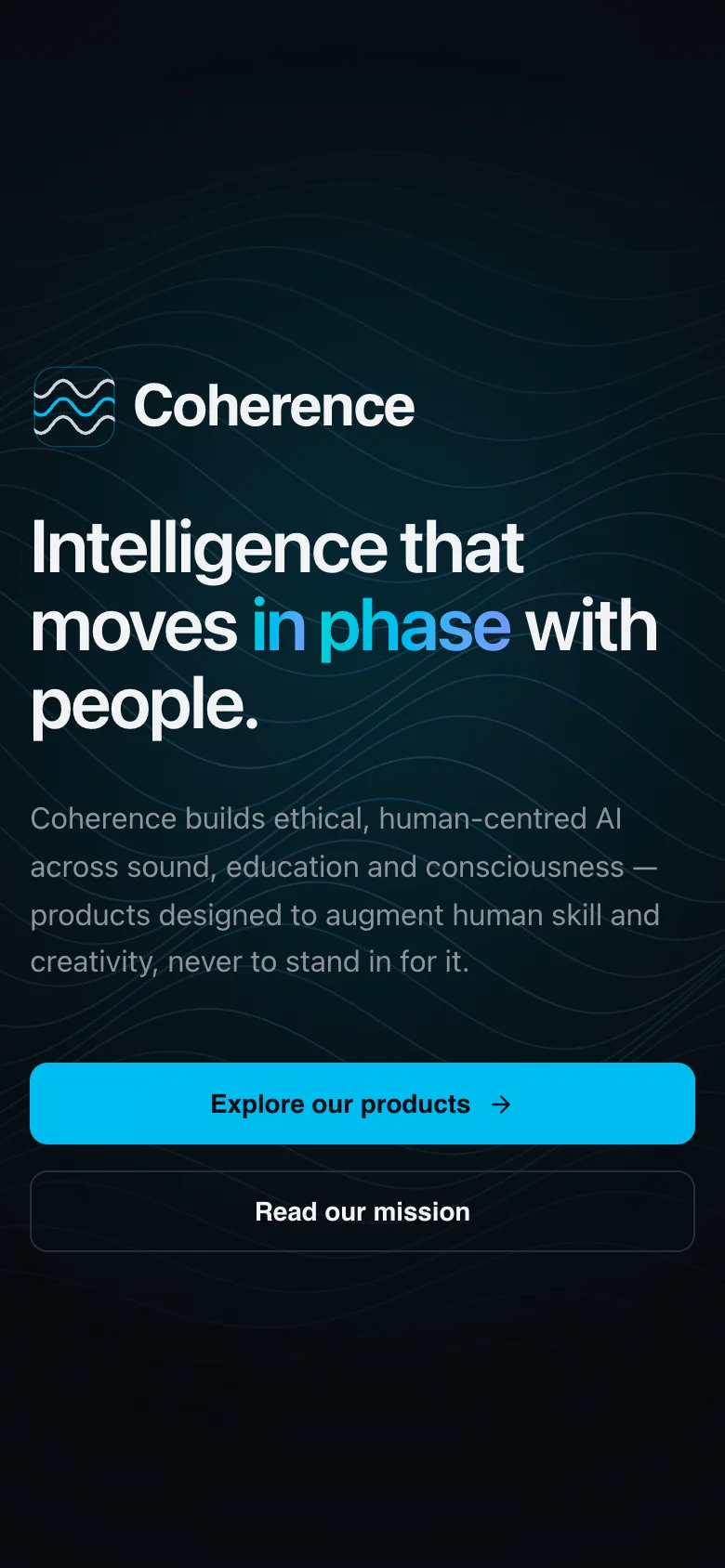
coherence.com on a mobile viewport, reflowed to a single column.
coherence.com — homepage, 1440×900
Live

Coherence

Live at coherence.com: brand identity generated with AI agents we directed, the motion system and website for the group behind Sonora, AboutAI, WakeUp and MudShadows. Agent work remains in build.

What we built
  • Brand identity
  • Motion system
  • Live website
  • Agent work — in build
Read the case study →
The new Domain Booth homepage on desktop: the headline “Premium Domains. Serious Buyers. Proven Results.” beside the animated DB monogram.
The new Domain Booth homepage on a phone, reflowed to a single column.
Our build of the Domain Booth homepage — 1440×900
Live

Domain Booth

Live at domainbooth.com for DomainBooth, a premium domain brokerage: a new animated mark, every page redesigned and rebuilt with designed mobile layouts, and a custom CMS for its sales record, featured names, press and enquiries.

What we built
  • Animated mark
  • Every page redesigned
  • Designed mobile layouts
  • Custom CMS
Read the case study →
Who we have built for

Twenty-one years. Names you know.

Apps, platforms and campaigns for these teams, long before the AI work. Every one is written up on the work page — what we did, and where our part ended.

See all of our work →
  • BBC Good Food logo
  • Charities Aid Foundation logo
  • GAME logo
  • NatWest logo
  • Next logo
  • NSPCC logo
  • Tesco logo
  • Worldpay logo
  • Samsung logo
  • Sony logo
  • Land Rover logo
  • UAP Limited logo
  • Netflix logo
  • Amazon Prime Video logo
  • Mercedes-Benz dealerships logo
  • San Miguel logo
  • Biovene Barcelona logo
  • Seventy7 logo
  • Littlewoods logo
  • Smile logo
  • The Co-operative Bank logo