Dark theme
WELCOME TO QQUANTUM

Let Qubi show you around.

Choose how you’d like to explore.

Don’t agreeGo to yourOS instead ↗

Both choices allow Google Analytics, so we can see which pages help.

Sound is your choice. Essential cookies keep the site working. Continuing either way also allows Google Analytics (visits and pages viewed).

Read our Terms, Privacy and Cookies.

Change your choices anytime from the footer.

Getting Qubi ready.
Comparisons · 12 pages

AI build decisions,
compared.

Each of these takes a position. Where our commercial interest points one way and the honest answer points the other, we have gone with the honest answer — those are the ones worth reading.

Introduction transcript. Client: Build our own, or buy something ready-made? Qubi: Two good options. Let’s put them on the table. Qubi: We compare the cost, the control, and what your team needs. Client: Even if buying means less work for you? Qubi: Of course. A good answer should help you choose. Qubi: Let’s find the trade-off that fits.

At a glance

How to read a comparison here.

01 Who wrote it
We build custom AI systems, so the pages about building custom AI systems deserve suspicion. The test is whether we argued the other side properly.
02 The standard
Each page leads with the case against the option we sell. A comparison that never concedes anything is not a comparison.
03 What decides it
Where a decision depends on your circumstances, the page names the variable that decides it: your cloud commitment, whether data may leave your perimeter, traffic volume, continuous or bounded work.
04 Figures and dates
Figures are indicative European ranges as of 2026, unsourced and labelled as such. Technology comparisons carry a review date, because a table written six months ago will mislead.
HOW TO READ THESE

Argued from both sides.

Most vendor comparisons are written by whoever benefits from one particular answer. So are these — we build custom AI systems, which means the pages about building custom AI systems deserve your suspicion. The useful test is whether we argued the other side properly.

That is the standard we hold them to. Each one leads with the case against the option we sell: the build-vs-buy page opens by telling you to buy, the agency-vs-in-house page opens with the conditions under which hiring is clearly better, and the no-code page opens by recommending you start on Zapier and stay there if it works. A comparison that never concedes anything is not a comparison.

Where a decision genuinely depends on your circumstances, we say so and name the variable that actually decides it — which cloud you are already committed to, whether data may leave your perimeter, traffic volume, whether the work is continuous or bounded. A page that resolves every trade-off in the same direction is telling you about its author rather than about the decision.

Figures are indicative European ranges as of 2026, unsourced and labelled as such. The technology comparisons carry a review date, because the major model providers ship frequently enough that a table written six months ago will mislead you. If something here has aged badly, it is a bug — tell us.

ARGUE THE OTHER SIDE

Argue the other side.

Pick a decision and read its side first. Each side is the page’s own opening argument, with the variable it turns on.

Choose a decision

Each side is drawn from its comparison page’s opening argument. Read the page for the whole case.

Build vs buy

Telling you to buy, first.

Build vs Buy AI opens by telling you to buy. It sets out when an off-the-shelf AI product is the right call, and when it structurally cannot be.

Opens with
The case for buying
Where buying stops
When an off-the-shelf product structurally cannot do the job
Build vs buy, the other side

Building is the answer when the variable points there.

We build custom AI systems, so treat this side with the suspicion the page asks for. These are the variables the comparisons name as deciding it.

Variable
Whether data may leave your perimeter
Variable
Traffic volume
Variable
Continuous or bounded work
Variable
Which cloud you are already committed to
Agency vs in-house

Hiring is clearly better under some conditions.

AI Agency vs In-House Team opens with the conditions under which hiring is clearly better, then sets out the real cost and time of hiring an AI team against engaging one.

Opens with
The conditions under which hiring is clearly better
Compares
The real cost and time of hiring an AI team, against engaging one
No-code vs custom AI

Start on Zapier, and stay there if it works.

The no-code page opens by recommending you start on Zapier and stay there if it works. It sets out where Zapier, Make and n8n stop being enough, and what replaces them.

Opens with
Start on Zapier, and stay there if it works
Stops being enough
Where Zapier, Make and n8n stop
All comparisons

Every comparison, both sides.

Flip a card for the short answer. Each comparison page holds the long one, and the case against the option we sell.

Hire your first
AI employee.

Tell us the job you would hand over if you trusted a machine with it. In one 30-minute call we will tell you whether it should, what it would take — and if it should not, we will say so.

30-minute technical call · no deck
Shipped & in build

Real work. Check it yourself.

What we built, what stage it is at, and a link to the live thing wherever there is one.

The updated yourOS homepage: Roxy’s open ring surrounded by bento cards for calls, voice, translation, building, design, apps and more.
The yourOS homepage on a phone, with its compact navigation, welcome film button and bento cards.
youros.tech — the homepage bento hero
Our own · coming soon

yourOS

yourOS is an operating system with an AI at its heart. You talk to it like a person, out loud or typed. It makes your calls, plans your days and works on your projects with a crew of agents, on your own private server. Our own product, built from the first commit; the waitlist is open.

What we built
  • Operating system
  • Roxy
  • Agent crew
  • Voice calls
  • App store
  • Website
Meet yourOS →
The Sonora homepage on desktop: a full-bleed dune landscape behind the headline “Transform Your Life with Sound”, with App Store and Google Play download buttons.
The Sonora homepage on a mobile viewport, showing the same hero reflowed to a single column.
sonora.com — homepage, 1440×900
Live · iOS · Android

Sonora

Website, backend and app assets for Sonora, a free AI sound-therapy app on iOS and Android published by Cognitive AI.

What we built
  • Website
  • Backend
  • App assets
Read the case study →
The updated Podswap homepage on desktop: “Grow on Instagram and TikTok for free, with real engagement from creators your size”, beside a tilted wall of exchange, tool and guide cards on a violet gradient.
The updated Podswap homepage on a phone, with its floating navigation, Instagram and TikTok engagement headline and tilted tool cards.
podswap.app — homepage, 1440×900
Five platforms

Podswap

Brand, website, prototype, apps on five platforms, the AI backend and the algorithm-intelligence pipeline for Podswap, a social growth engine that runs without a human in the loop.

What we built
  • Brand
  • Website
  • Prototype
  • Apps on five platforms
  • AI backend
  • Algorithm pipeline
Read the case study →
The unOpen.AI homepage introducing Roxy, a private AI assistant that remembers who you are.
The unOpen.AI homepage on a mobile viewport.
unopen.ai — homepage, 1440×900
Prototype · closed beta

unOpen.AI

In closed beta: Roxy, a private AI assistant with permanent memory running on infrastructure the user owns. Brand, site, product, backend and conversational design.

What we built
  • Brand
  • Site
  • Product
  • Backend
  • Conversational design
Read the case study →
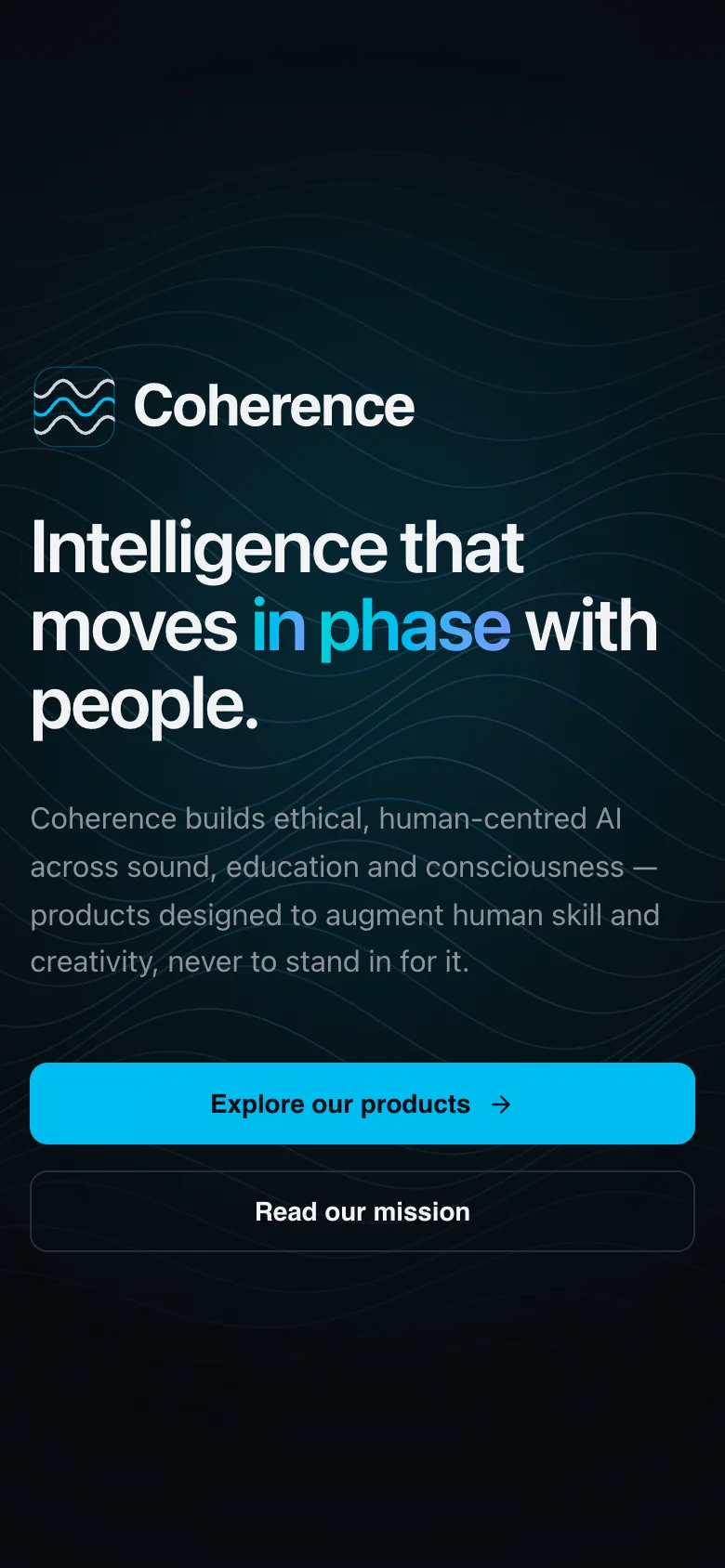
coherence.com on desktop, headed "Intelligence that moves in phase with people".
coherence.com on a mobile viewport, reflowed to a single column.
coherence.com — homepage, 1440×900
Live

Coherence

Live at coherence.com: brand identity generated with AI agents we directed, the motion system and website for the group behind Sonora, AboutAI, WakeUp and MudShadows. Agent work remains in build.

What we built
  • Brand identity
  • Motion system
  • Live website
  • Agent work — in build
Read the case study →
The new Domain Booth homepage on desktop: the headline “Premium Domains. Serious Buyers. Proven Results.” beside the animated DB monogram.
The new Domain Booth homepage on a phone, reflowed to a single column.
Our build of the Domain Booth homepage — 1440×900
Live

Domain Booth

Live at domainbooth.com for DomainBooth, a premium domain brokerage: a new animated mark, every page redesigned and rebuilt with designed mobile layouts, and a custom CMS for its sales record, featured names, press and enquiries.

What we built
  • Animated mark
  • Every page redesigned
  • Designed mobile layouts
  • Custom CMS
Read the case study →
Who we have built for

Twenty-one years. Names you know.

Apps, platforms and campaigns for these teams, long before the AI work. Every one is written up on the work page — what we did, and where our part ended.

See all of our work →
  • BBC Good Food logo
  • Charities Aid Foundation logo
  • GAME logo
  • NatWest logo
  • Next logo
  • NSPCC logo
  • Tesco logo
  • Worldpay logo
  • Samsung logo
  • Sony logo
  • Land Rover logo
  • UAP Limited logo
  • Netflix logo
  • Amazon Prime Video logo
  • Mercedes-Benz dealerships logo
  • San Miguel logo
  • Biovene Barcelona logo
  • Seventy7 logo
  • Littlewoods logo
  • Smile logo
  • The Co-operative Bank logo