Dark theme
WELCOME TO QQUANTUM

Let Qubi show you around.

Choose how you’d like to explore.

Don’t agreeGo to yourOS instead ↗

Both choices allow Google Analytics, so we can see which pages help.

Sound is your choice. Essential cookies keep the site working. Continuing either way also allows Google Analytics (visits and pages viewed).

Read our Terms, Privacy and Cookies.

Change your choices anytime from the footer.

Getting Qubi ready.
Startups

AI for founders who do not code.

You do not need to understand transformers. You do need to spot the difference between a defensible AI product and a prompt in a trench coat — including when the person telling you is your own contractor.

All AI for Startups →
Pixel illustration for AI for Non-Technical Founders: a compass guiding a small prototype across a worktable.

The five things that matter

  • 1. The model is not the product.

    Everyone can call the same models. What makes a product defensible is everything around the call: your data, the workflow it sits in, the evaluation that keeps it good, and the accumulated handling of cases where it is wrong. If a pitch is entirely about which model is used, there is no moat being described.
  • 2. "It works" is not a measurement.

    Ask how quality is measured. The right answer involves a set of test cases with known-correct answers and a score that gets tracked over time. "We tried it and it seemed good" means nobody will notice when it stops being good.
  • 3. Inference costs money per use, forever.

    Unlike normal software, every interaction has a marginal cost. Ask what a single user interaction costs today and what it becomes at ten thousand users. If nobody has calculated it, that is the finding.
  • 4. Hallucination is a property, not a bug to be fixed.

    Any vendor promising it has been eliminated is either misinformed or hoping you are. The real question is how the system makes wrongness visible — citations you can check, confidence thresholds, human review on the consequential paths.
  • 5. Your data is the asset.

    Whatever proprietary data you have — support conversations, documents, transaction history — is the part competitors cannot copy. An AI strategy that does not use it is a strategy anyone could execute.

Questions to ask a vendor

01

How will we know if quality drops?

Good answer: an evaluation set and automated checks before each deploy. Concerning answer: "we monitor it closely" with no mechanism named.
02

What does one interaction cost?

Good answer: a specific figure with the assumptions behind it. Concerning answer: "it depends" without any subsequent number.
03

What happens when it is wrong?

Good answer: a described path — thresholds, human review, how the user sees uncertainty. Concerning answer: a claim that it will not be.
04

Who owns the code?

Good answer: you do, in your repositories, from the start. Concerning answer: a proprietary platform you would need to rebuild off later.
05

What are you not going to build?

Good answer: a clear scope with named exclusions. Concerning answer: enthusiastic agreement with everything you have said.
06

Could this be an existing product instead?

Good answer: an honest comparison, sometimes recommending one. Concerning answer: reflexive dismissal of every off-the-shelf option.
Questions

Questions about AI for Non-Technical Founders.

Do I need a technical co-founder to build an AI product?

Not to start, but you need someone technical whose judgement you trust and whose incentives are not tied to the size of the build — an advisor, a fractional CTO, or a vendor willing to talk you out of things. The risk without that is not being defrauded; it is being enthusiastically agreed with by people paid by the hour.

Should I use a no-code AI tool first?

Frequently yes. If a no-code tool can test your hypothesis in a fortnight for a few hundred euros, do that before commissioning custom work. Custom development earns its cost when you hit the ceiling — usually your own data, real volume, or a workflow the tool cannot express.

How do I evaluate whether an AI engineer is any good?

Ask what they measured on their last project and what the number was. Strong AI engineers talk about evaluation, failure cases and cost almost immediately; weaker ones talk mostly about models and frameworks. Ask what they decided not to use AI for — anyone who has shipped has that story.

Is it too late to start an AI company?

The thin wrapper window has largely closed, and that is a good thing — it never had a business underneath it. What has not closed is applying this to a specific domain you understand better than a generalist team ever will. Domain knowledge plus proprietary data is still where the durable products come from.

Bring us your
hard questions.

Including the ones you suspect are naive. Those are usually the good ones.

30-minute call · no deck

Shipped & in build

Real work. Check it yourself.

What we built, what stage it is at, and a link to the live thing wherever there is one.

The updated yourOS homepage: Roxy’s open ring surrounded by bento cards for calls, voice, translation, building, design, apps and more.
The yourOS homepage on a phone, with its compact navigation, welcome film button and bento cards.
youros.tech — the homepage bento hero
Our own · coming soon

yourOS

yourOS is an operating system with an AI at its heart. You talk to it like a person, out loud or typed. It makes your calls, plans your days and works on your projects with a crew of agents, on your own private server. Our own product, built from the first commit; the waitlist is open.


What we built
  • Operating system
  • Roxy
  • Agent crew
  • Voice calls
  • App store
  • Website
Meet yourOS →
The Sonora homepage on desktop: a full-bleed dune landscape behind the headline “Transform Your Life with Sound”, with App Store and Google Play download buttons.
The Sonora homepage on a mobile viewport, showing the same hero reflowed to a single column.
sonora.com — homepage, 1440×900
Live · iOS · Android

Sonora

Website, backend and app assets for Sonora, a free AI sound-therapy app on iOS and Android published by Cognitive AI.

What we built
  • Website
  • Backend
  • App assets
Read the case study →
The updated Podswap homepage on desktop: “Grow on Instagram and TikTok for free, with real engagement from creators your size”, beside a tilted wall of exchange, tool and guide cards on a violet gradient.
The updated Podswap homepage on a phone, with its floating navigation, Instagram and TikTok engagement headline and tilted tool cards.
podswap.app — homepage, 1440×900
Five platforms

Podswap

Brand, website, prototype, apps on five platforms, the AI backend and the algorithm-intelligence pipeline for Podswap, a social growth engine that runs without a human in the loop.

What we built
  • Brand
  • Website
  • Prototype
  • Apps on five platforms
  • AI backend
  • Algorithm pipeline
Read the case study →
The unOpen.AI homepage introducing Roxy, a private AI assistant that remembers who you are.
The unOpen.AI homepage on a mobile viewport.
unopen.ai — homepage, 1440×900
Prototype · closed beta

unOpen.AI

In closed beta: Roxy, a private AI assistant with permanent memory running on infrastructure the user owns. Brand, site, product, backend and conversational design.

What we built
  • Brand
  • Site
  • Product
  • Backend
  • Conversational design
Read the case study →
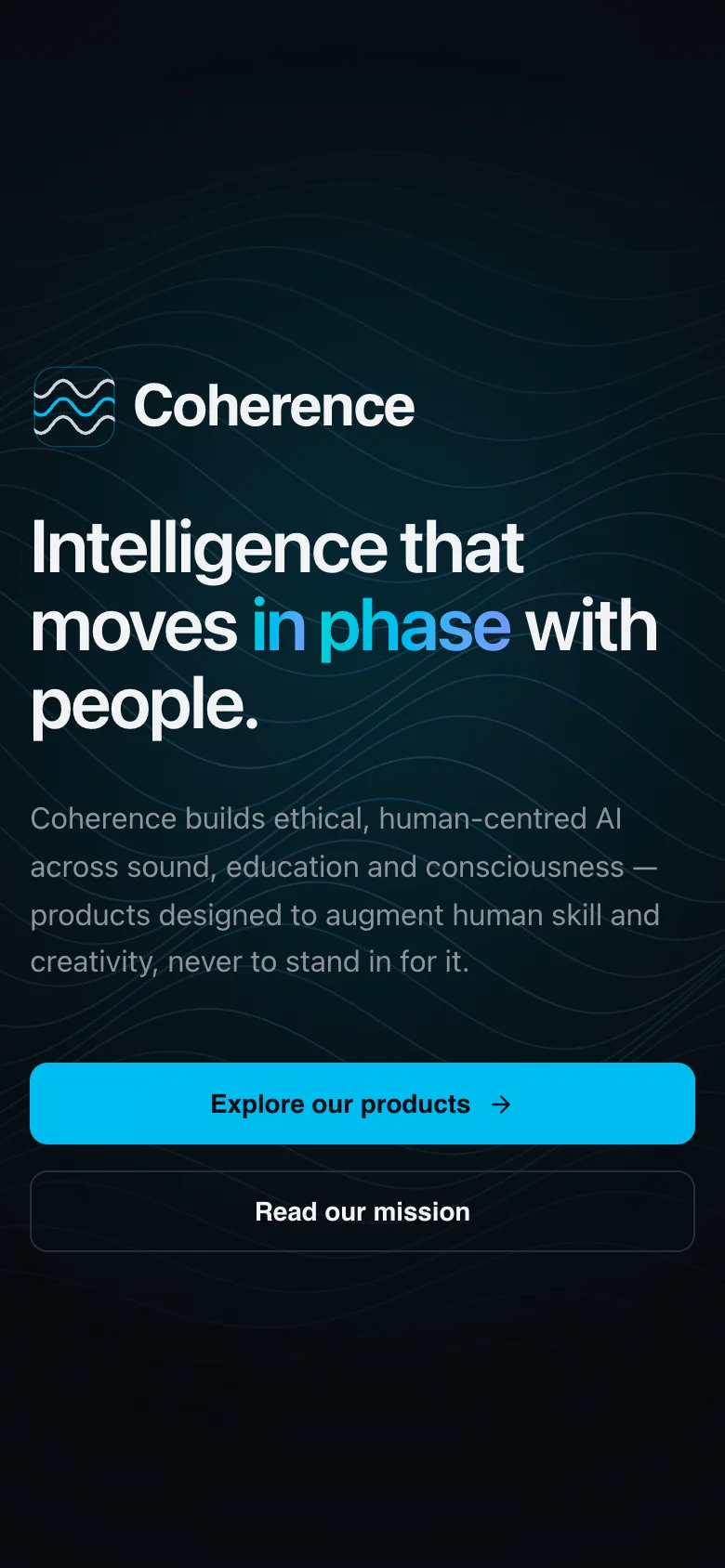
coherence.com on desktop, headed "Intelligence that moves in phase with people".
coherence.com on a mobile viewport, reflowed to a single column.
coherence.com — homepage, 1440×900
Live

Coherence

Live at coherence.com: brand identity generated with AI agents we directed, the motion system and website for the group behind Sonora, AboutAI, WakeUp and MudShadows. Agent work remains in build.

What we built
  • Brand identity
  • Motion system
  • Live website
  • Agent work — in build
Read the case study →
The new Domain Booth homepage on desktop: the headline “Premium Domains. Serious Buyers. Proven Results.” beside the animated DB monogram.
The new Domain Booth homepage on a phone, reflowed to a single column.
Our build of the Domain Booth homepage — 1440×900
Live

Domain Booth

Live at domainbooth.com for DomainBooth, a premium domain brokerage: a new animated mark, every page redesigned and rebuilt with designed mobile layouts, and a custom CMS for its sales record, featured names, press and enquiries.

What we built
  • Animated mark
  • Every page redesigned
  • Designed mobile layouts
  • Custom CMS
Read the case study →
Who we have built for

Twenty-one years. Names you know.

Apps, platforms and campaigns for these teams, long before the AI work. Every one is written up on the work page — what we did, and where our part ended.

See all of our work →
  • BBC Good Food logo
  • Charities Aid Foundation logo
  • GAME logo
  • NatWest logo
  • Next logo
  • NSPCC logo
  • Tesco logo
  • Worldpay logo
  • Samsung logo
  • Sony logo
  • Land Rover logo
  • UAP Limited logo
  • Netflix logo
  • Amazon Prime Video logo
  • Mercedes-Benz dealerships logo
  • San Miguel logo
  • Biovene Barcelona logo
  • Seventy7 logo
  • Littlewoods logo
  • Smile logo
  • The Co-operative Bank logo